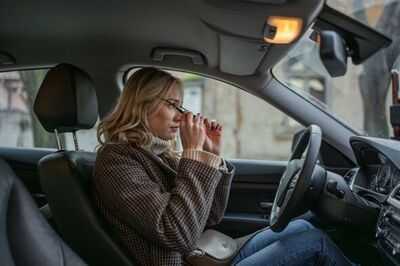
Millions of motorists who rely on glasses or contact lenses have been reminded they must wear them every time they drive if they need them to meet the legal eyesight standards.
The reminder comes from the Driver and Vehicle Licensing Agency (DVLA), which says drivers who fail to meet the minimum vision requirements risk prosecution and losing their licence. Under the rules, anyone who needs glasses or contact lenses to see clearly must wear them whenever they are behind the wheel.
Drivers must be able to read a number plate from 20 metres away - roughly the length of five parked cars - while wearing any corrective lenses they normally use.
They must also meet the legal eyesight threshold of visual acuity of at least 6/12 (decimal 0.5) on the Snellen scale, using both eyes together or the remaining eye if they only have sight in one.
Motorists must also have an adequate field of vision, which an optician can assess through specialist testing.
When drivers must inform the DVLA
Drivers are required to tell the DVLA if they develop any eyesight problem that affects both eyes, or the remaining eye if they only have one.
However, some common issues do not need to be reported, including being short-sighted, long-sighted or colour blind, provided the driver can still meet the required vision standards.
People who have had laser surgery to correct short-sightedness also do not need to inform the DVLA if their eyesight now meets the legal limits.
But if motorists report a medical condition that affects their vision, the DVLA may refer them for a special eyesight test with a contracted optician. This test is free.
Drivers can choose to have an eyesight test elsewhere, but they will have to pay for it themselves, and the DVLA does not guarantee it will accept the results unless it includes an Esterman visual field test.
Tougher standards for lorry and bus drivers
Professional drivers face stricter requirements. Those driving lorries or buses must have visual acuity of at least 6/7.5 in their best eye and 6/60 in the other, measured on the Snellen scale.
They must also have a horizontal field of vision of at least 160 degrees, with no defects within the central 30 degrees.
Corrective glasses can be used as long as their strength is no more than +8 dioptres, while there is no specific limit for contact lenses.
The eyesight check that can fail your driving test
Eyesight is also checked during the practical driving test run by the DVLA. At the start of the test, learners must read a number plate on a parked vehicle.
If they cannot, they automatically fail and the test will not continue. The DVLA will be notified and their licence will be revoked. To regain their licence they must first pass a DVSA eyesight test at a driving test centre before they can take another practical driving test.
-
Sunrisers Leeds X Account Suspended Amid Backlash Over Abrar Ahmed Signing
-
Planning To Use An Induction Cooktop During The LPG Shortage? Read These 5 Important Things First
-
IIT Gandhinagar To Review Michel Danino’s Role After Supreme Court Order In NCERT Textbook Controversy

-
Hansika Motwani’s First Instagram Post After Divorce From Sohael Khaturiya

-
Why Sunday Tourism Is Banned in Asia’s Cleanest Village?