
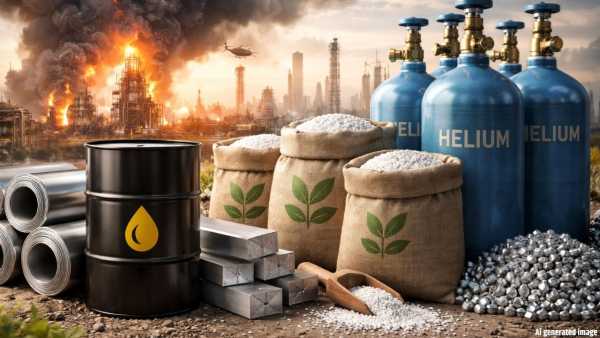
Seeing the continuously raging war in West Asia, the first fear that usually arises is about the prices of petrol and diesel. But the roots of the crisis go deeper than this. When the thunder of cannons echoes on the world's most important sea routes, its impact is not limited to fuel alone. According to market expert Akash Jindal, if this military tension continues for a long time, then the global supply chain of many important things related to everyday life may break. This simply means that expenses ranging from farming to mobile phones and building houses may increase.
Strait of Hormuz closed
The 'Strait of Hormuz' connecting the Persian Gulf to the Arabian Sea is considered the strategic lifeline of world trade. Not only the crude oil originating from the Gulf countries, but also industrial raw materials and gas on a large scale are transported to different corners of the world through this route. If there is a break in the movement of cargo ships in this area due to war, then it is almost certain to create chaos in the global market. International supply of goods will decrease and naturally there will be huge price pressure on them.
Cost will increase from construction to farming
The first and biggest victim of this tension could be the aluminum sector. The Gulf region is a very important center of aluminum production. Aluminum is widely used in the vehicles we drive, the houses we build or even the packaging of food items. If the shipments from there stop, the costs of the industries will increase and ultimately the economic burden will reach the customers.
Exactly the same is the situation in the fertilizer sector. The Middle East has a huge dominance in the global supply of urea and the raw material 'sulphur' used in its production. There may be a shortage of these agricultural products due to disruption of sea trade. If fertilizer becomes expensive, the cost of farming will directly increase.
The heat will reach the high-tech industry
This geopolitical crisis may also affect another essential commodity, helium. The Gulf region, especially Qatar, is a major producer of helium gas. Helium is used in MRI machines, scientific research and most importantly, semiconductor manufacturing. If regional energy infrastructure is damaged, the supply chains of high-tech industries around the world could collapse.
Along with this, there is a possibility of major fluctuations in the sugar and ethanol markets due to the war. It is a simple rule of economics that when crude oil prices skyrocket, many countries speed up the process of making ethanol from sugarcane for use as fuel. If this happens, the availability of sugar at the international level decreases and its prices may increase.
What is the condition of Indian markets?
It is a matter of relief that no immediate impact of this international tension is visible in the Indian markets. Our country produces itself on a large scale in sectors like sugar and aluminium, so there is no possibility of any huge shortage immediately. But, India is also dependent on the global supply chain for fertilizers and many industrial raw materials. If the passage of the Strait of Hormuz remains affected for a long time, then indirectly there will be inflationary pressure on Indian industries and markets. If we look at the current prices, the domestic market is quite stable right now.
- Aluminium: ₹330 to ₹345 per kg
- Urea (Government controlled): ₹266₹270 (per 45 kg bag)
- Sulfur (Industrial): ₹18 to ₹25 per kg
- Helium gas: ₹800 to ₹1200 per cubic meter
- Sugar (retail market): ₹40 to ₹45 per kg
- Ethanol (government procurement rate): Around ₹65 to ₹72 per liter
At present the situation is under control for India. This is currently being seen as a 'potential economic risk'. But if this conflict in West Asia continues for a long time, its economic shocks will definitely be felt through the global market to the Indian consumers.
-
Assam gets its own Science City, bigger than Kolkata’s, with Space and Eureka galleries

-
‘Boyfriend on Demand,’ starring Jisoo of Blackpink, reaches global Top 10 despite acting debate

-
Assam gets its own Science City, bigger than Kolkata’s, with Space and Eureka galleries

-
‘Boyfriend on Demand,’ starring Jisoo of Blackpink, reaches global Top 10 despite acting debate

-
Kathryn Hahn officially cast as mother Gothel in Disney’s live-action Tangled