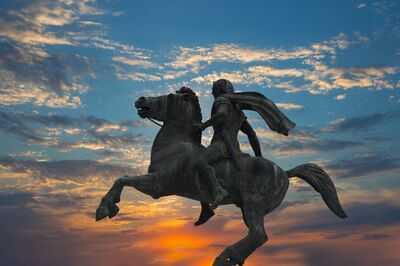
Archaeologists say they’ve finally pinpointed the site of a long-lost city founded by Alexander the Great - a bustling port that once plugged ancient Mesopotamia straight into the Persian Gulf’s trade routes.
The settlement, known as 'Alexandria on the Tigris', is reported to be in southern Iraq near the Gulf, with early accounts hailing the discovery as "absolutely stunning".
Founded in the fourth century BC, the city was one of several 'Alexandrias' established by the Macedonian conqueror as he carved an empire from Greece to the fringes of India.
- Claudia Winkleman shares real reason she left Strictly and truth about her relationship with Tess Daly
- Foreign Office issues 'stay indoors' alert for Brits heading to holiday hotspot
While Egypt’s Alexandria became world famous for its lighthouse and library, Alexandria on the Tigris has remained stubbornly out of reach, living more in legend than in maps - until now, reports Fox News.
Woolly mammoths will be back in 2028, how you could live to 200, alien signals lost in the weather, could we fight Godzilla, and a creature with 20 arms has been found near the Antarctic - all this and more in our latest weird science newsletter
Researchers say the location matches expectations for a strategically placed port linking river traffic on the Tigris with maritime routes across the Gulf and beyond.
In its heyday, the city would have been a key stop for goods, ideas and people moving between the heartlands of Mesopotamia and the wider ancient world.
Over centuries, the Tigris has shifted its course and dumped silt across the lowlands, steadily burying old shorelines and settlements.
Add in the rise and fall of empires, changing trade routes, and the scars of modern conflict, and the remains of the city vanished from view.
High-resolution geophysical scans and drone imagery have now mapped fortification walls, street grids, city blocks and industrial quarters.
Temple complexes, workshops with kilns and furnaces, and traces of a harbour-and-canal system have also emerged from beneath the soil - a rare, big-picture glimpse of an ancient metropolis frozen in time.
Stefan R. Hauser, archaeology professor at the University of Konstanz, told Fox News Digital the quality of evidence is "absolutely stunning", with building walls appearing just below the surface and preservation "surprisingly good".
The city’s footprint is vast - roughly 2.5 square miles (about 6.5km²) - which he says rivals or even surpasses some major capitals of the age.
Work at the site began in the 2010s under British archaeologists Jane Moon, Robert Killick and Stuart Campbell, but progress was slow and often dangerous due to periods of conflict and extremist control.
-
'Why Do Indians Love Pakistan So Much': Aniruddhacharya Over IPL Team Facing Backlash

-
'Sab Samay Ka Khel Hai': Hansika Motwani's Ex-Sister-In-Law Nancy James Takes Subtle Dig At Her After Divorce From Sohael Khaturiya

-
Did India Invent The Telescope? Foreigner’s Claim Goes Viral; Take A Look!
-
Galgotias University Basketball Team Shines at IIT Delhi Sports Fest

-
The Remarkable Journey of a Tea Seller Gaining Fame Among Bollywood Stars