
After quick commerce, if there is one industry that has been under the radar of investors for cash burn, it is the instant help and home services vertical. Urban Company, Snabbit and Pronto: the three leading players have made the 10-minute househelp market their own.
But this has reportedly come at the cost of spending close to $8 Mn per month as of December 2025.
The demand for quick home services has shot up tremendously since 2025’s festive season. So much so that perhaps the cashburn heavy model might be about to turn a corner. At least that’s what Snabbit founder and CEO Aayush Agarwal believes.
“Our discounts are at lifetime lows,” Agarwal told Inc42. “The fundamentals of our business have never been stronger,” he added.
Listed giant Urban Company is already feeling the impact of this cash burn on its cash balance with the company having slipped into losses for the past few quarters due to heavy discounting, expansion in insta help vertical.
Brokerages maintain the consensus that the market opportunity is real and large, but the business model for instant house help is still unproven at scale.
There are also concerns regarding the profitability timeline of Urban Company as well as Snabbitand Pronto which have raised significant VC funding.
Snabbit claims it touched 8.3 Lakh monthly orders in February 2026, slightly lower than Urban Company’s volume of 8.5 Lakh orders, while Pronto, according to multiple media reports, is doing 3.5 Lakh orders every month.
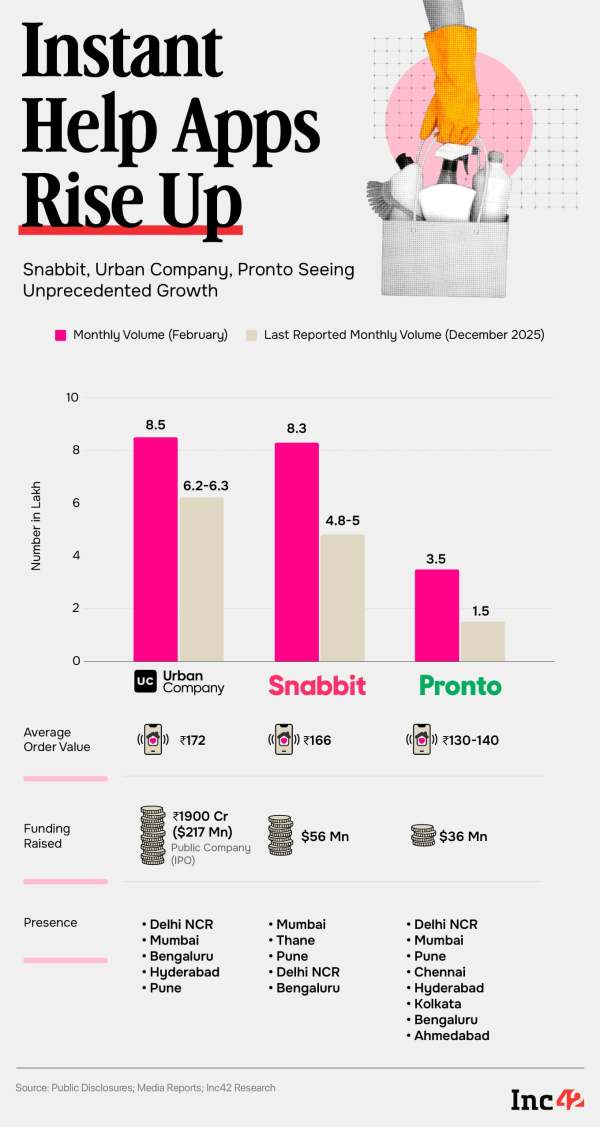
The order volumes have shot up nearly 40-50% over the last couple of months thanks to heavy discounting, expansion and new gig workforce.
Snabbit, having raised $56Mn so far, is now planning to go slow on discount strategy and deliberately chosen not to enter most of India’s major metros, at a time when rivals are racing to plant flags in as many cities as possible.
According to Agarwal, the CEO of Snabbit who learned the ropes of instant delivery at Zepto, this category will either make or break its investors in the next 18 months..
As cash burn pressure mounts, Agarwal believes the real game is density, and not discounts or deals.
Is The Age Of Discounts Over?Snabbit’s parity with a much older and highly capitalised rival like Urban Company in certain markets is certainly eye-catching, given the fact the latter is a market leader in the home services industry and has the operating leverage built over years of experience in the category.
The question is how was Snabbit able to close the gap? “There was a time when we were obviously playing the discount game with regards to competition,” he said. “But now that’s significantly reduced.”
Today, rather than chasing frequency of orders through promotional pricing, the focus has turned squarely to improving average order value (AOV), he added. Agarwal also feels that the end of the discounting model is nigh. “Such a strategy cannot be sustained in this category for a long term and the focus has to be on execution.”
On the other side of the rivalry, Urban Company is also keeping a close eye on unit economics. CEO Abhiraj Singh Bhal said after the Q3 FY26 results that InstaHelp is an early-stage business, and that the company is not yet fully clear on the quantum of investment for this vertical on a quarterly basis.
“Our view is that by Q3 FY28, the overall profits from the rest of the business should be sufficiently large enough to offset the losses in InstaHelp,” he had said.
Bhal conceded the fact that for InstaHelp is yet to break even, and the average order value (AOV) has to grow significantly (2X the current average) to help UC cover the expenses at the very least.
For Urban Company, the AOV stood at ₹172 in the December quarter, and according to media reports, the AOV for Snabbit and Pronto was near ₹130 and ₹120 respectively. However, Agarwal did not reveal any details on this front or about Snabbit’s unit economics and profitability right now.
Only Urban Company’s numbers are out in the open, and those don’t make for pretty reading yet. But Agarwal is certain of unit economics shining through soon. “We’re growing very fast and we’re growing without entering into new markets. We’re growing because our older markets are doing exceptionally well. Our discounts are at lifetime lows which proves that this strategy is working well.”
The Snabbit Way: Depth Before BreadthIf the instant help category is reminiscent of the early boom in quick commerce with heavy discounts and marketing hype, then it won’t be long before the fundamental realities will come into the equation.
A lot will depend on execution, stressed Agarwal again .“We are focused on expanding supply in dense micro-markets, improving partner utilisation, and pushing up average order values. It’s very easy to go to a lot of cities and get the first few users in — that kind of solves for absolute scale. But we’ve chosen a slightly different route, actually going deep within markets,” he claimed.
In Snabbit’s most mature markets, the company is seeing close to 1,500 jobs on weekends. Higher order density means more experts in a given area, which means faster dispatch times, better utilisation, and lower per-order costs — this is the core flywheel of the quick home services model.
“When you are able to drive depth, you’re not just able to solve for your own economic model. You’re also able to make the service more reliable and quicker,” the Snabbit CEO added.
One way that Snabbit wants to improve reliability is through safety and security policies. It launched a safety infrastructure layer built specifically for its female workforce in early March. “The system intercepts on its own if there is a risk and triggers an SOS, which is very critical because at times it is not at all possible for experts to be in possession of their phones, to unlock their phones, to actually press a button.” according to the CEO.
He believes that building a sustainable business is important but so is setting new benchmarks for trust and safety. In fact, Snabbit intends to open source the technology once internal rollout and stress testing is complete.
Currently, the company is in talks to raise a $100 Mn funding round and will look to expand into other categories as well. As Agarwal put it: “We’re seeing a very significant behavior shift in consumers where we’re seeing a lot of love for the service and the convenience it provides.”
The question for investors — and for analysts watching this sector — is whether depth-before-breadth, AOV discipline, and safety infrastructure will prove to be durable moats for Snabbit in the face of the sheer capital firepower and brand power of Urban Company.
[Edited By Nikhil Subramaniam]
The post Snabbit Says The Discount Game Is Almost Over; The Hard Part Comes Next appeared first on Inc42 Media.
-
US Judge Halts DOJ Subpoenas Related to Federal Reserve Renovation

-
Former ISIS Supporter Commits Fatal Shooting at Old Dominion University

-
How to Make a Killing review: Glen Powell stars in Kind Hearts and Coronets remake

-
Shocking Murder Plot Unveiled in Maharashtra: Teacher Killed After Multiple Poisoning Attempts

-
Donald Trump offers £7.6m reward for information on Iran's new Supreme Leader