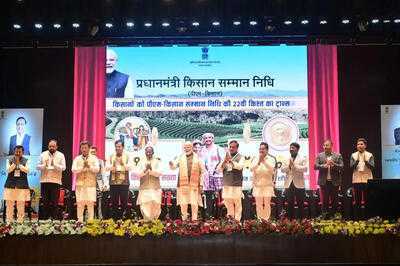
Guwahati, March 13: On Friday, Prime Minister Narendra Modi announced the release of the 22nd installment of the PM-KISAN Samman Nidhi scheme, providing Rs 2,000 to over 9.3 crore farmers nationwide. He emphasized the government's commitment to shielding Indian farmers from the impact of rising global fertilizer prices and supply chain disruptions.
Speaking at the Jyoti Bishnu Auditorium in Khanapara, Modi highlighted that the PM-KISAN initiative has become a crucial economic support mechanism for farmers, facilitating direct income assistance without intermediaries.
He mentioned that approximately 19 lakh farmers in Assam have benefited from this scheme, receiving nearly Rs 8,000 crore to date.
“Previously, some political factions suggested that farmers would need to repay the funds provided under PM-KISAN. Today, this scheme stands as an economic safety net for millions of farmers across the nation,” Modi stated.
The Prime Minister elaborated on the government's strategies to safeguard farmers from international price fluctuations in fertilizers and agricultural inputs.
He pointed out that global conflicts and geopolitical tensions often disrupt fertilizer supply chains, but assured that the government has taken measures to protect Indian farmers from price hikes and shortages.
“During the pandemic and global crises, fertilizer prices surged and supplies dwindled in international markets. Nevertheless, the government ensured that Indian farmers had access to fertilizers at reasonable prices,” he remarked.
Modi explained that while a bag of urea was priced around Rs 3,000 in global markets, Indian farmers continued to acquire it for approximately Rs 300 per bag due to government subsidies.
“To facilitate this, the government has allocated over Rs 12 lakh crore from public funds to support farmers,” he added.
The Prime Minister also underscored the government's initiatives to achieve self-sufficiency in agriculture and farm inputs, noting the revival of several previously closed fertilizer factories.
He highlighted programs like nano-urea, the promotion of natural farming, and micro-irrigation technologies aimed at enhancing crop yields while minimizing costs.
“Through the ‘Per Drop More Crop’ initiative, sprinkler and micro-irrigation systems are enabling farmers to utilize water more efficiently while boosting agricultural productivity,” Modi stated.
He also mentioned the promotion of solar pumps in agriculture, which not only assist in field irrigation but also allow farmers to generate electricity and earn supplementary income.
“Farmers are now becoming energy producers. Solar pumps are decreasing their reliance on diesel and reducing production expenses,” he noted.
Modi asserted that over the past decade, the government has established a robust support framework for farmers, integrating income assistance, crop insurance, irrigation support, and enhanced agricultural infrastructure.
“From MSP to PM-KISAN, crop insurance, and modern irrigation facilities, the government has developed a safety net for farmers,” he concluded.
The Prime Minister emphasized the necessity for India to ensure that international supply disruptions do not adversely affect its farmers, highlighting the significance of domestic production and technological advancements in agriculture.
-
Pedro Neto slapped with extra ban over Chelsea red card vs Arsenal as FA reveal punishment

-
Monalisa and Farmaan Khan Address Marriage Controversy Amid Love Jihad Allegations

-
Bomb Threat Reported at University of Virginia's Shannon Library

-
Netflix drops six part thriller based on 'gripping' novel you can binge in one night

-
Govt to rename Shahjahanabad Redevelopment Corporation: CM Rekha Gupta