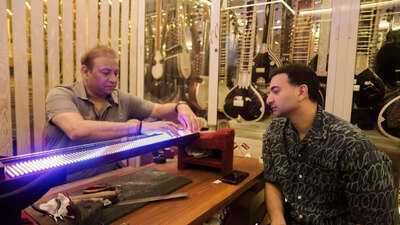
Neo-classical musician and sitarist Rishab Rikhiram Sharma will debut and perform on India’s first-ever LED-enhanced electric sitar during the India leg of his upcoming 10-city Sitar for Mental Health Tour 2026 . The pioneering instrument, titled ‘ SITAR A – The Next-Generation Electric Sitar’, has been conceptualised and built by his father, master luthier Sanjay Sharma, marking a significant advancement in the evolution of the sitar and contemporary classical music.
Designed as a reinterpretation of the traditional instrument, SITARA builds on a lineage of experimental sitars developed by Sanjay and Manjul Sharma's Rikhi Ram's Music , including the Rik-E-Sitar and the Studio Sitar. The new model integrates modern sound design, portability and lighting technology, while retaining the tonal character of the classical sitar. The instrument has been developed to expand the sitar’s role in contemporary performance contexts, particularly across film music, fusion and global live productions.
Explaining the vision behind the instrument, Sanjay Sharma says, “SITARA was created to give sitarists the ability to step into contemporary musical spaces where the electric guitar is often used. The idea was to enable sitar players to perform modern arrangements especially in Bollywood, fusion and world music, without needing to learn another instrument. While the acoustic sitar remains the soul of classical music, this instrument opens exciting possibilities for crossover and global performance.”
A defining aspect of SITARA is its compact, ergonomic design, developed with modern touring musicians in mind. Unlike the traditional sitar, the instrument is lightweight and allows performers to play while standing, making it well suited for contemporary stage productions.
“We wanted to design something practical for today’s performers,” Sharma explains. “The instrument is compact and travel-friendly, with a collapsible hand-rest frame and a custom-built active pickup system with volume and tone controls that can run through amplifiers and processors. At the same time, when played clean through an amplifier, it still retains the tonal character of a traditional sitar.”
The instrument also features an integrated LED interface with over, allowing the sitar to visually complement live performances through synchronized lighting effects.
“The high density 140+ LEDs interface adds a visual dimension to the music,” Sharma adds. “It was developed after Rishab’s last India tour in 2024, as he wanted to enhance the visual experience for audiences during live shows. The lighting can adapt to the mood and theme of each performance, seamlessly blending sound and visual storytelling.”
SITARA also introduces practical advantages for artists, including a silent-practice capability that allows musicians to rehearse through amplification systems without the acoustic projection of a traditional sitar. “One of the intentions behind the design was to make the sitar easier to live and travel with. Musicians can practice without disturbing others and carry the instrument far more easily than a traditional sitar,” adds Sharma.
SITARA continues the century-old legacy of Rikhi Ram’s Music, the historic instrument-making house founded in 1920, known for iconic creations such as the Studio Sitar (played by Pt. Ravi Shankar), Microphonic Sitar, E-rode (electric Sarod), microphonic Santoor and Tabla, Swarmandir (popularized by Daler Mehndi), Suroleen (Mandolin-Sarod hybrid) and the Rik-E-Sitar, among others.
“No other sitarist has performed publicly on this instrument yet,” Sharma notes. “In the hands of a skilled musician, it can move fluidly between Indian classical ragas and Western genres such as blues, rock ’n’ roll and heavier fusion styles. The idea is not to replace tradition, but to expand what the sitar can do and how new audiences can experience it.”
Following successful performances across North America, Europe, the Middle East and the United Kingdom, Rishab Rikhiram Sharma will bring the ‘Sitar for Mental Health Tour 2026’ to 10 cities across India. The tour arrives at a time when conversations around mental wellbeing, meditative soundscapes and transformative live experiences are resonating strongly with younger audiences positioning Sharma’s music at the intersection of classical tradition, contemporary culture and emotional healing through sound.
The tour, scheduled between March and April, is starting with Bengaluru and continuing to Mumbai, Pune, Hyderabad, Chennai, Jaipur, Ahmedabad, Chandigarh, Kolkata and New Delhi. It is expected to draw 10,000-15,000 attendees per city and is promoted and produced by Team Innovation and District.
-
FASTag annual pass fee hiked 2.5% to Rs 3,075 from 1 April: NHAI

-
HMRC issues new £473 alert to one million Brits - 'you could be missing out'

-
HMRC 'charge' warning to households earning over £60,000

-
Dhurandhar: The Revenge Set for Major Box Office Success

-
Punjab Discusses Agro-Industry Growth at Progressive Punjab Investors' Summit 2026
