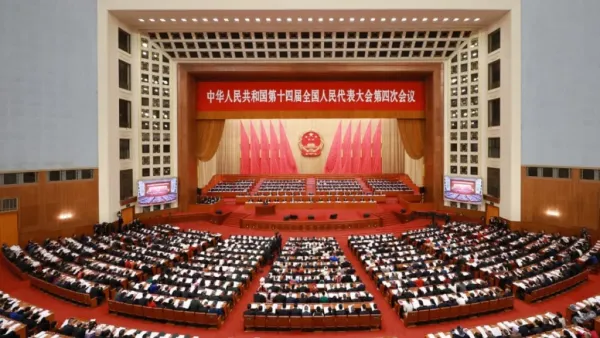
The emergence of the phrase “new forms of the smart economy” in China’s Government Work Report marks a significant shift in the legal and strategic framework governing the country’s next phase of economic transformation. Presented during the ongoing National People’s Congress session in Beijing, the report signals that artificial intelligence, digital infrastructure, and data-driven production models will form the backbone of China’s economic policy through the coming decade. When Liu Qingfeng, the chairman of iFlytek and one of the most prominent figures in China’s artificial intelligence sector, publicly emphasised that this policy direction would power the next leap in AI development, he was articulating not merely a technological ambition but a structural reorganisation of economic governance supported by a growing body of national legislation and regulatory policy.
Within China’s institutional framework, the Government Work Report functions as a key policy document that translates the strategic direction of the Communist Party of China into actionable administrative and regulatory priorities. The reference to new forms of the smart economy indicates that the Chinese leadership is embedding artificial intelligence, cloud computing, and data-driven services into the formal planning architecture that will shape economic policy in the years leading to the Fifteenth Five-Year Plan period from 2026 to 2030. In legal and regulatory terms, this shift intersects with an expanding set of statutes governing the digital economy, including the Data Security Law, the Cybersecurity Law, and the Personal Information Protection Law. These laws collectively establish a governance regime that seeks to promote technological innovation while maintaining strong oversight of data flows, algorithmic deployment, and digital infrastructure security.
The significance of the smart economy concept also lies in its connection with industrial policy and technological sovereignty. Over the past decade, China has increasingly emphasised domestic innovation capacity in sectors such as artificial intelligence, advanced semiconductors, and intelligent manufacturing systems. Artificial intelligence has been formally recognised as a strategic technology since the release of the New Generation Artificial Intelligence Development Plan in 2017, which set ambitious targets for China to become a global leader in AI by 2030. The Government Work Report’s inclusion of smart economy development, therefore, reflects continuity with this policy trajectory while elevating it to the level of macroeconomic planning.
From an international relations perspective, the elevation of artificial intelligence as a core growth engine carries substantial geopolitical implications. The global race for AI leadership is increasingly intertwined with national security considerations, export control regimes, and strategic competition between major powers. The United States has imposed restrictions on the export of advanced semiconductor technologies and high-performance computing components that are essential for large-scale AI training. These restrictions operate under the authority of the Export Control Reform Act and regulations administered by the United States Department of Commerce. China’s response has been to accelerate domestic research and development while integrating artificial intelligence more deeply into its industrial and economic planning.
The involvement of companies such as iFlytek illustrates how corporate innovation ecosystems are embedded within national strategy. iFlytek has become a leading developer of speech recognition and language processing technologies and has played a role in advancing Chinese language artificial intelligence applications across education, healthcare and public administration. Liu Qingfeng’s remarks during the Two Sessions highlight how industry leaders interpret the Government Work Report as a policy signal that investment and regulatory support for artificial intelligence will expand in the coming years.
Yet the legal and governance challenges associated with the smart economy are equally significant. Artificial intelligence systems raise complex questions regarding data privacy, algorithmic transparency and ethical oversight. China has begun addressing these issues through regulatory frameworks that require algorithm registration, content moderation obligations and oversight of generative artificial intelligence services. These measures illustrate a distinctive governance model that combines technological promotion with regulatory supervision designed to maintain social stability and national security.
The debates unfolding during the National People’s Congress session therefore reveal a broader transformation in how economic power is defined in the twenty first century. Artificial intelligence is no longer treated merely as a technological sector but as a foundational infrastructure capable of reshaping productivity, industrial organisation and geopolitical influence. The Government Work Report’s reference to the smart economy demonstrates that China is institutionalising this transformation within its highest policy planning mechanisms.
As policymakers and delegates deliberate in Beijing, the implications of this strategic direction extend far beyond domestic economic planning. The integration of artificial intelligence into China’s development blueprint will influence global technology markets, regulatory standards and international competition for digital leadership. In this sense the smart economy is not simply a policy slogan but a legal and strategic framework through which China seeks to shape the next phase of technological and economic development both within its borders and across the global system.
-
Brave Dog Saves Owner from Tiger Attack in Madhya Pradesh

-
Travelodge makes big change after staff gave sex attacker access to woman's room

-
School sued after parents say staff kept son's transgender identity secret before suicide

-
Indonesian Woman Claims Unusual Pregnancy After Mysterious Air Encounter

-
Trump Establishes Task Force to Combat Social Services Fraud