
Listen to this article in summarized format
Loading...
××
Subscribe to

Unlock AI Briefing and Premium Content
New Year Offer 24 Hours Left
Subscribe NowAlready a member? Sign In
What's Included
- Exclusive Stories
- Daily ePaper Access
- Smart Market Tools
- Curated Investment Ideas
- Ad-lite Experience
Subscription

Far beneath the Earth’s surface, scientists have uncovered evidence of a massive water reservoir hidden in a mineral called bridgmanite. This mineral is assumed to be present in the lower mantle, which begins at a depth of 660 km and extends to almost 2,900 km. For a long time, scientists believed that this part of the Earth was almost completely dry. However, new lab tests might suggest that the mineral bridgmanite has the capacity to carry a lot more water than previously known. According to ScienceDaily, the lower mantle could have served as a vast water reservoir.
Bridgmanite is formed under high pressures and temperatures found deep inside the planet. Scientists compressed tiny mineral samples using a diamond anvil cell, a device that is capable of generating immense pressures similar to those inside Earth’s mantle, to recreate these conditions. The samples were then heated to temperatures approaching 4,100°C, which allowed researchers to observe how the mineral behaves under realistic mantle conditions. The experiments showed that bridgmanite can incorporate hydrogen atoms within its crystal structure, which means that water can become chemically bound within the mineral itself. A surprising fact is that the mineral’s capacity to store water increases at higher temperatures, which would have been common during Earth’s early molten phase.
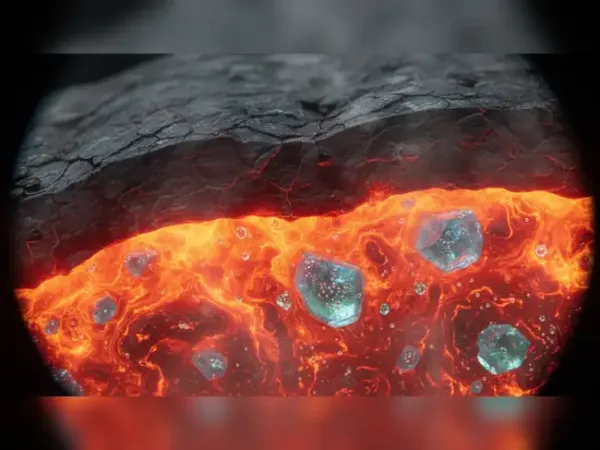
The young planet likely contained a magma ocean during that time, a period when a lot of the surface and upper mantle existed as molten rock. Bridgmanite could have stored water equivalent to 8%-100% of today’s ocean volume, according to estimates summarized by Phys.org. Instead of all water existing near the surface, a large portion may have been stored deep within the mantle, which changes how scientists think about the Earth’s early water cycle. Volcanic activity could have gradually released this water back to the surface through degassing over millions of years, which helped form Earth’s oceans and atmosphere.
An important role in Earth’s internal dynamics is played by water. When water is present inside minerals, it lowers their melting temperature and reduces their viscosity. This effect makes rocks act more smoothly under pressure, the slow circulation of rock inside Earth that powers plate tectonics, or mantle convection. The planet might have evolved very differently had water not acted as a geological lubricant. Plate tectonics, which shapes continents and drives earthquakes, would probably not have developed in the same way.
Recent research suggests that there is much more water locked inside our planet than previously believed. The water locked inside the deep interior of our Earth could hold the key to the geological activity that makes our planet alive. As we continue to research these minerals in the deep mantle of our Earth, we will unravel the mysteries of how water circulates from the inside to the surface.
Bridgmanite is formed under high pressures and temperatures found deep inside the planet. Scientists compressed tiny mineral samples using a diamond anvil cell, a device that is capable of generating immense pressures similar to those inside Earth’s mantle, to recreate these conditions. The samples were then heated to temperatures approaching 4,100°C, which allowed researchers to observe how the mineral behaves under realistic mantle conditions. The experiments showed that bridgmanite can incorporate hydrogen atoms within its crystal structure, which means that water can become chemically bound within the mineral itself. A surprising fact is that the mineral’s capacity to store water increases at higher temperatures, which would have been common during Earth’s early molten phase.
The young planet likely contained a magma ocean during that time, a period when a lot of the surface and upper mantle existed as molten rock. Bridgmanite could have stored water equivalent to 8%-100% of today’s ocean volume, according to estimates summarized by Phys.org. Instead of all water existing near the surface, a large portion may have been stored deep within the mantle, which changes how scientists think about the Earth’s early water cycle. Volcanic activity could have gradually released this water back to the surface through degassing over millions of years, which helped form Earth’s oceans and atmosphere.
Image Credit: Gemini
Recent research suggests that there is much more water locked inside our planet than previously believed. The water locked inside the deep interior of our Earth could hold the key to the geological activity that makes our planet alive. As we continue to research these minerals in the deep mantle of our Earth, we will unravel the mysteries of how water circulates from the inside to the surface.