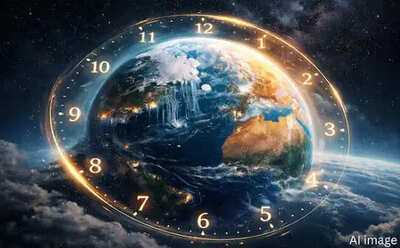
Climate change has traditionally been associated with extreme weather events like heatwaves and floods. However, recent studies indicate that its effects extend beyond these phenomena. Scientists have observed a slight alteration in the Earth's rotation speed due to climate change, which is directly influencing the length of our days. Researchers from the universities of Zurich and Vienna attribute this change primarily to rising sea levels and the accelerated melting of ice. Let’s delve into why the Earth’s rotation is being affected.
How is the Earth's Rotation Slowing Down?
As you may know, the Earth rotates on its axis, which is responsible for the cycle of day and night. However, this rotation is not constant. When glaciers melt on a large scale, the resulting water disperses into the oceans, altering the weight distribution on Earth. This shift in balance can cause a slight deceleration in its rotation.
How Much Longer Are Our Days Getting?
The changes in rotation speed are minimal, making them imperceptible to the average person. Research indicates that this alteration in the Earth's rotation is the most rapid observed in the last 3.6 million years. Over the past two decades, the length of a day has increased by approximately 1.33 milliseconds per century. From 2000 to 2020, this translates to a growth of 1.33 milliseconds in the duration of a day. While a millisecond may seem negligible, it can significantly disrupt timekeeping over extended periods.
Why is This Change Concerning?
A shift in the Earth's rotation speed is not considered a trivial matter. It signals that climate change is beginning to impact the planet's fundamental balance. Historically, such changes occurred naturally over long periods, but the current pace is alarming for scientists.
What Does This Mean for You?
Experts suggest that the average person will not experience any immediate or drastic changes in their daily life. This means you won’t suddenly need to work 25 hours instead of 24. However, this alteration could affect GPS and satellite systems. Even a millisecond discrepancy in the Earth's rotation and timekeeping could lead to significant errors in location and navigation. Additionally, scientific calculations related to space and nuclear energy could be disrupted by such a minor difference. To counteract this, timekeeping systems may need to incorporate leap seconds regularly to ensure global synchronization.
The Role of Ocean Water
As ice melts, the water contributes to the oceans, particularly accumulating around the equatorial regions. This accumulation alters the Earth's balance, causing it to rotate more slowly, which is why we are witnessing changes in day length.
A Warning for the Future
Scientists warn that if climate change continues at this rate, its effects may intensify. This means that not only will weather patterns be affected, but the Earth's balance will also continue to shift. This phenomenon impacts every part of the planet. If not addressed promptly, we may witness further changes that could directly affect our lives.
-
Iran Announces New Phase Of Missile & Drone Attacks Against US, Israel

-
UAE Reopens Airspace After Brief Full Closure Following Drone Strike Amid Ongoing West Asia Tensions

-
Drivers can't name eight animals you need to report if you have accident

-
M5 traffic RECAP: Closure both directions with 3 miles of queues as police rush to scene

-
M5 traffic RECAP: Closure both directions with 3 miles of queues as police rush to scene