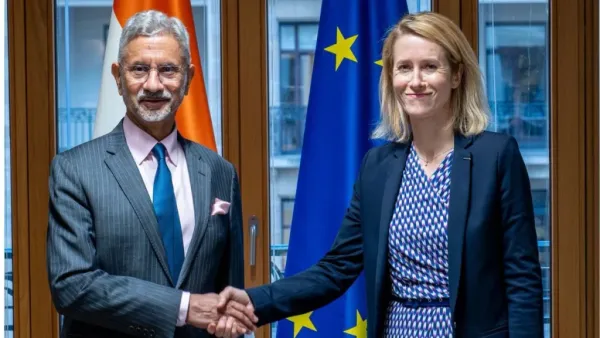
India and the European Union (EU) have accelerated discussions on a comprehensive trade and policy framework following External Affairs Minister S.Jaishankar’s official visit to Brussels on March 15–16, signalling renewed momentum in economic cooperation, regulatory alignment and strategic governance.
The visit, held at the invitation of EU High Representative and Vice President Kaja Kallacomes shortly after the 16th India-EU Summit and the participation of EU leaders in India’s Republic Day celebrations developments widely seen as reinforcing high-level political commitment to a long-pending trade and policy agenda.
At the centre of the discussions was the proposed India-EU Free Trade Agreement (FTA), a key policy instrument aimed at reducing tariff and non-tariff barriers, strengthening supply chains and facilitating regulatory convergence. Officials emphasised the urgency of early conclusion of the agreement, which is expected to significantly enhance bilateral trade flows and provide a structured legal framework for investment protection, digital trade norms and intellectual property rights.
During meetings with Antonio Costa and Ursula von der LeyenJaishankar highlighted India’s commitment to advancing the ‘Towards 2030: A Joint India-EU Comprehensive Strategic Agenda’. This framework outlines cooperation across trade, technology governance, climate policy, and security, and is increasingly being viewed as a roadmap for long-term institutional engagement.
Policy coordination also extended to the EU Foreign Affairs Council, where Jaishankar participated in deliberations alongside foreign ministers of member states. Maros Sefcovic joined discussions that focused on trade security, resilient supply chains, and emerging regulatory challenges in critical sectors such as semiconductors, green technologies and digital infrastructure.
A key highlight of the visit was India’s push to operationalise the Trade and Technology Council (TTC) as an “outcome-driven” platform. The TTC is expected to play a crucial role in harmonising standards, facilitating industrial collaboration, and addressing regulatory barriers affecting cross-border trade and innovation ecosystems. Officials indicated that greater industry integration into policy frameworks would be essential for achieving tangible outcomes.
In addition to trade negotiations, both sides explored defence industrial cooperation and maritime security frameworks under the broader Security and Defence Partnership. These discussions reflect a growing policy convergence on safeguarding trade routes, particularly in the Indo-Pacific, and ensuring energy security amid ongoing geopolitical tensions in West Asia and the Ukraine conflict.
Jaishankar’s bilateral meeting with Kallas reaffirmed a shared commitment to elevating India-EU relations to a higher strategic level, with both sides agreeing to expedite the next rounds of the Trade and Technology Council and Strategic Dialogue. This indicates a shift towards more structured and time-bound policy engagement mechanisms.
Further bilateral engagements with European countries including BelgiumGermany, the Netherlands and others focused on sector-specific policy cooperation, including green transition frameworks, critical technologies governance and people-to-people mobility agreements. Notably, India and Belgium agreed to establish a dedicated Strategic Dialogue at the ministerial level, institutionalising policy coordination.
According to official statements available in the public domain, the visit underscores a broader shift towards integrating trade policy with strategic and regulatory frameworks. With both sides prioritising sustainability, digital governance and economic security, the India-EU partnership is increasingly positioned as a key axis in global trade governance.
The developments indicate that the India-EU relationship is entering a phase of renewed strategic momentum, with policy-driven trade integration and institutional cooperation expected to define the next phase of engagement.
-
SC seeks response from Gujarat, Maharashtra on Bilkis Bano case convicts’ plea
-
Gig workers’ dignity, safety not priority for government, alleges Rahul
-
TMC Spotlights Muslim Nominees With 47 Minorities In Fray: Full List Of Muslim Candidates
-
Iranian Projectile Hits Near Australian Base In UAE, PM Albanese Urges Calm
-
The Benefits of Shatavari: An Ayurvedic Wonder Herb