Dubai: With the Iran-Israel-US conflict stretching into the third week and Iran's attacks on the UAE intensifying, authorities are rolling out measures to support banks and sustain consumer spending in a bid to cushion the impact on the economy.
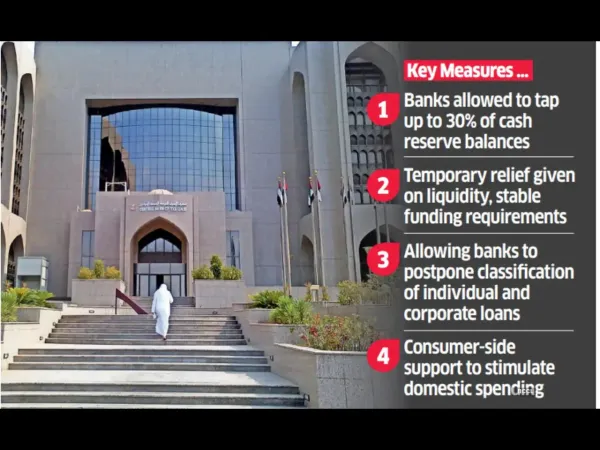
The Central Bank of the UAE late on Tuesday unveiled a five-pillar resilience package for banks, allowing them to continue lending to businesses and households despite heightened geopolitical uncertainty.
Economists said the move is aimed at ensuring continued credit flow and financing for companies and investment projects at a time when sectors such as tourism, logistics and real estate face disruptions from the conflict. The central bank has allowed banks to tap up to 30% of their cash reserve balances to inject liquidity into the system in both UAE dirhams and US dollars to ensure liquidity in the economy.
This would unlock up to AED 120 billion as the mandatory reserves of all banks operating in the UAE, which are parked with the central bank as a safety buffer, stand at over AED 400 billion.
"The package should be understood as a deliberate effort to ensure that liquidity continues to circulate under conditions of heightened uncertainty," said Raed Safadi, partner and chief economist at Whiteshield, a public policy and AI economics firm. "It is a technically strong and well-calibrated intervention, sufficient for the current phase of early-stage stress, and particularly powerful in its signalling effect."
By acting ahead of visible disruption, the authorities are anchoring expectations, discouraging defensive behaviour by banks, and reinforcing confidence among investors and market participants, he noted. "The likely impact is to reduce tail risks, stabilise sentiment, and preserve the flow of credit to the real economy," said Safadi, who is also former executive director and chief economist at Dubai's Department of Economy and Tourism.
The UAE central bank has also introduced relief on countercyclical capital buffer (CCyB) and capital conservation buffer (CCB), allowing banks to use part of their regulatory capital cushions to sustain lending.
The central bank, which holds AED 1 trillion in foreign exchange reserves, further said it remained committed to maintaining and further enhancing the contribution of the UAE's financial system. The UAE banking sector's liquidity, along with other assets, stand at AED 920 billion.
Safadi noted that while additional measures may be required if shocks persist or deepen, this intervention already achieves its primary objective of preventing the financial system from amplifying geopolitical stress.
The central bank also provided flexibility to banks to postpone classification of individual and corporate loans for customers affected by the extraordinary circumstances.
"This is a reflection of the beginning and not the end of strong government support to strengthen buffers in the economy. This will help support continued activity in the banking sector for now, but clearly there remains a high degree of geopolitical uncertainty that is unlikely to dissipate over the immediate term." said Robert Mogielnicki, founder of PoliSphere Advisory and a non-resident scholar at the Arab Gulf States Institute.
To stimulate consumer spending, the government has extended the Fazaa Discount Programme UAE membership to all UAE residents with families for free for one year. The programme was traditionally limited to Emiratis, government employees, and specific groups.
The membership allows residents to access discounts on groceries, fuel, restaurants, hotels, and entertainment. The move, linked to the 'Year of Family UAE 2026', is seen as an attempt to boost retail activity and support businesses amid slowing consumer demand due to regional tensions. To ensure prices of essential commodities do not go up, the UAE government has imposed fines of more than AED 200,000 on food retailers for 'unjustified price increases' to prevent vendors from exploiting the current crisis.
The ministry of economy and tourism last week said it had carried out more than 7,000 inspections of retailers and recorded 567 breaches.
Meanwhile, the Dubai chamber of commerce continued its series of meetings with business groups and business councils to monitor conditions in the local business environment, assess the outlook for the period ahead, and enhance the support available to all sectors as they respond to global challenges. It held 13 meetings this week across sectors.