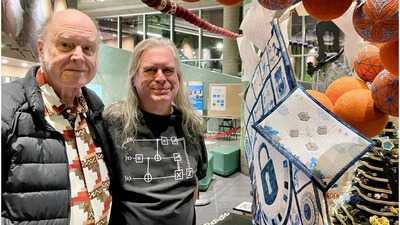
Turing Award honors inventors of quantum encryption
19 Mar 2026
The prestigious Turing Award, often dubbed the "Nobel Prize of computing," has been awarded to US physicist Charles H. Bennett and Canadian computer scientist Gilles Brassard.
They received this honor for their groundbreaking work in quantum cryptography, an advanced form of encryption that is virtually impossible to break.
Their pioneering research dates back to 1984 and has revolutionized secure communication and computing systems globally.
Bennett, Brassard's collaboration began in 1979
Innovation impact
Bennett, an IBM fellow in New York, and Brassard, a professor at the University of Montreal, first met at an academic conference in Puerto Rico in 1979.
Their initial conversation about creating a banknote that could never be forged led to decades of collaboration.
They developed BB84, a technique based on quantum physics principles like the behavior of particles such as electrons and photons.
A major step toward securing digital communications
Security breakthrough
Current encryption technologies rely on complex mathematical combinations, but the emergence of quantum computers poses a threat to their security.
However, Bennett and Brassard's BB84 method counters this threat by demonstrating that any attempt to hack or copy their quantum encryption key alters its elements' behavior, making replication impossible.
This innovative approach is seen as a major step toward securing digital communications in the future.
The award comes with a $1 million cash prize
Award significance
The Turing Award, named after mathematician and code-breaker Alan Turing, is given to individuals who have made substantial contributions to the computing community. The award comes with a $1 million cash prize.
The Association of Computer Machinery, which presents the award, hailed Bennett and Brassard's work as a "pathway toward securing digital communications in the decades ahead."
Their research is expected to play a major role in electronic communications in our data-dependent world.
-
'I Stay In Small Cottage, Please Understand...': Gaurav Gera Shares 28-Year-Old Handwritten Letter To Parents From His Struggling Days In Mumbai
-
'We Are Crushing Enemy': Benjamin Netanyahu Visits Arad Strike Site, Warns Iran Of Severe Blow

-
Iran Charging $2 Million Toll To Pass Strait Of Hormuz Amid Blockade: Report

-
Assam Minister Nandita Garlosa joins Congress ahead of polls

-
UK fuel rationing plans confirm who gets priority under emergency measures