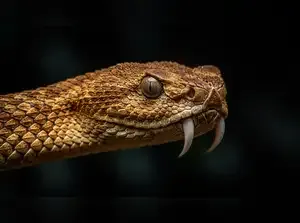
Scientists had long believed that venomous snakes had, over the years, been developing more and more complex venoms to ensure that they immobilized as many types of prey as possible. The more complex venom, therefore, was seen as the ultimate weapon.
However, new research has shown that there was a twist to the evolution of the venom of the rattlesnake. The snakes are not only making it more complex but are also making it less complex.
Recent research has also shown that rattlesnakes have evolved optimized venom compositions that have fewer types of toxins, especially in remote habitats where there is limited diversity of prey. Rather than having a rich chemical arsenal, the snakes have focused on developing toxins that are most effective against the few species of prey that they encounter regularly.
This is no longer considered an evolutionary deficit but rather a case of ecological efficiency.
The Guardian also reported that the venom profile of these island rattlesnakes is a very close match to the prey species that are most dominant in their ecosystems.
Despite the above simplification, the rattlesnake still has a vast genetic arsenal that enables it to vary the venom profile whenever the need arises. Studies conducted by the National Science Foundation have pointed out that the rattlesnake has a vast array of genes that code for the production of venom toxins.
As prey animals gain resistance to various toxins, the snake adapts by changing the chemical makeup of its venom.
But when the number of prey animals is limited, natural selection focuses on maximizing the potency of a smaller number of highly effective toxins, rather than the range of different ones.
A study published in BMC Biology in 2021 revealed that the proteins in snake venom have evolved convergently, implying that various species of snakes can have similar venom profiles despite being distantly related.
Did you have any idea that the interaction between venom and prey resistance is another factor that greatly influences the composition of venoms? Yes, in a study published in the journal Evolution in 2016, the interaction between rattlesnakes and California ground squirrels was investigated. Evidence of coadaptation between the predator and the prey was established.
Together, these studies show that the flexibility of rattlesnake venom is far greater than anyone ever imagined. In fact, it turns out that the venom has adapted to the local environment, not to the level of complexity. In some environments, the best venom is the one that is least complex.
Aren’t these facts intriguing?
However, new research has shown that there was a twist to the evolution of the venom of the rattlesnake. The snakes are not only making it more complex but are also making it less complex.
Recent research has also shown that rattlesnakes have evolved optimized venom compositions that have fewer types of toxins, especially in remote habitats where there is limited diversity of prey. Rather than having a rich chemical arsenal, the snakes have focused on developing toxins that are most effective against the few species of prey that they encounter regularly.
This is no longer considered an evolutionary deficit but rather a case of ecological efficiency.
Venom Simplification in Isolated Habitats
Evidence for this phenomenon is particularly evident in populations of rattlesnakes that live on remote islands. According to a 2025 study done by researchers at the University of South Florida, populations of rattlesnakes that live on uninhabited islands in the Gulf of California have venoms that contain significantly fewer families of toxins than those living on the mainland. This is due to a lack of prey diversity.Why do some snakes evolve simpler venom instead of stronger venom
Despite the above simplification, the rattlesnake still has a vast genetic arsenal that enables it to vary the venom profile whenever the need arises. Studies conducted by the National Science Foundation have pointed out that the rattlesnake has a vast array of genes that code for the production of venom toxins.
As prey animals gain resistance to various toxins, the snake adapts by changing the chemical makeup of its venom.
But when the number of prey animals is limited, natural selection focuses on maximizing the potency of a smaller number of highly effective toxins, rather than the range of different ones.
Evolution of Venom Proteins
Well, to our surprise, another fascinating find is that the reduced venom profiles are found in various lineages of snakes that have evolved independently.A study published in BMC Biology in 2021 revealed that the proteins in snake venom have evolved convergently, implying that various species of snakes can have similar venom profiles despite being distantly related.
Did you have any idea that the interaction between venom and prey resistance is another factor that greatly influences the composition of venoms? Yes, in a study published in the journal Evolution in 2016, the interaction between rattlesnakes and California ground squirrels was investigated. Evidence of coadaptation between the predator and the prey was established.
Together, these studies show that the flexibility of rattlesnake venom is far greater than anyone ever imagined. In fact, it turns out that the venom has adapted to the local environment, not to the level of complexity. In some environments, the best venom is the one that is least complex.
Aren’t these facts intriguing?