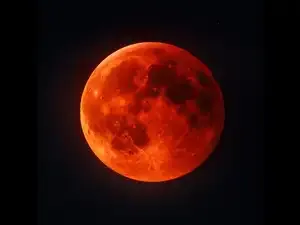
Lunar eclipses are commonly seen in colors ranging from red to orange to copper, and scientists have observed that the Moon's color during an eclipse is directly related to the state of the Earth’s atmosphere at that time. It has been proven that dust, smoke, or other particles in the atmosphere have a direct effect on the Moon's color during an eclipse (NASA Earth Observatory, Times of India). The Moon passes into the Earth's shadow, but it does not turn black or become invisible because some of the sun's rays bend around the edge of the Earth and fall on the Moon. The shorter wavelengths of light are deflected in every direction as the light passes through the atmosphere, but the longer wavelengths of light are able to pass through. This is the principle behind the orange or red color seen during sunset. The Moon would be almost invisible during the time of the eclipse without the influence of the atmosphere, as mentioned by astronomer TS Ganesh (TechNewsWorld).
The amount and type of particles in the atmosphere change how much light is allowed to pass through. Certain types of aerosols such as dust, wildfire smoke, sea salt, and volcanic ash, can block or scatter sunlight. NASA’s models include the Goddard Earth Observing System, and track how these particles move across the planet. Less red light reaches the Moon when aerosol levels are higher, and the eclipse appears darker or browner than bright red (NASA Earth Observatory). Large amounts of ash enter the upper atmosphere after major volcanic eruptions. Observations show that eclipses following such events often look dimmer and less vivid. Scientists use this effect to estimate aerosol levels, and often compare eclipse brightness with measurements like aerosol optical depth, which indicates how much light these particles block (NASA Earth Observatory).
NASA has a visual record of eclipse images that can be compared with atmospheric data. Researchers match the Moon's color and brightness to satellite aerosol maps to understand how different particles affect light. Large wildfire events or dust storms, for instance, often coincide with deeper or duller eclipse colors (NASA Earth Observatory).
One can easily observe the differences without the need for equipment. A more vibrant orange-red hue of the Moon, for instance, may indicate generally clear conditions, and a less vibrant, copper-colored Moon may indicate more particles in the atmosphere. Citizen science projects have recently been designed to encourage people to observe the colors of the eclipse and compare them to satellite data. There is still much to learn, as the satellite systems currently available do not always measure the precise atmosphere through which the eclipse passes. In addition to this, there is no way to measure the eclipse colors universally, which makes it more difficult to compare them. (National Science Foundation) Lunar eclipse colors are a simple indicator of what is currently in the atmosphere. What may seem like a remarkable visual display is, in fact, a simple indicator.
The amount and type of particles in the atmosphere change how much light is allowed to pass through. Certain types of aerosols such as dust, wildfire smoke, sea salt, and volcanic ash, can block or scatter sunlight. NASA’s models include the Goddard Earth Observing System, and track how these particles move across the planet. Less red light reaches the Moon when aerosol levels are higher, and the eclipse appears darker or browner than bright red (NASA Earth Observatory). Large amounts of ash enter the upper atmosphere after major volcanic eruptions. Observations show that eclipses following such events often look dimmer and less vivid. Scientists use this effect to estimate aerosol levels, and often compare eclipse brightness with measurements like aerosol optical depth, which indicates how much light these particles block (NASA Earth Observatory).
Image Credit: Gemini
NASA has a visual record of eclipse images that can be compared with atmospheric data. Researchers match the Moon's color and brightness to satellite aerosol maps to understand how different particles affect light. Large wildfire events or dust storms, for instance, often coincide with deeper or duller eclipse colors (NASA Earth Observatory).
One can easily observe the differences without the need for equipment. A more vibrant orange-red hue of the Moon, for instance, may indicate generally clear conditions, and a less vibrant, copper-colored Moon may indicate more particles in the atmosphere. Citizen science projects have recently been designed to encourage people to observe the colors of the eclipse and compare them to satellite data. There is still much to learn, as the satellite systems currently available do not always measure the precise atmosphere through which the eclipse passes. In addition to this, there is no way to measure the eclipse colors universally, which makes it more difficult to compare them. (National Science Foundation) Lunar eclipse colors are a simple indicator of what is currently in the atmosphere. What may seem like a remarkable visual display is, in fact, a simple indicator.