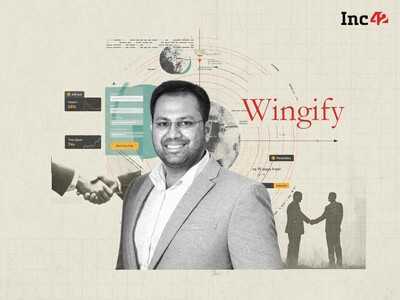
India’s $14 Bn software-as-a-service (SaaS) market received a dramatic thrust in the last decade with the emergence of unicorns like Zoho and Freshworks. In the post-Covid era, factors like rising digitisation and advancement in AI have propelled the industry to scale $70 Bn in valuation by 2030.
As the ecosystem grows in leaps and bounds, Wingify is fluttering its wings for the long haul with its flagship SaaS product Visual Website Optimizer (VWO), which enhances the digital journey by letting businesses assess the performance and improve conversion rates through websites.
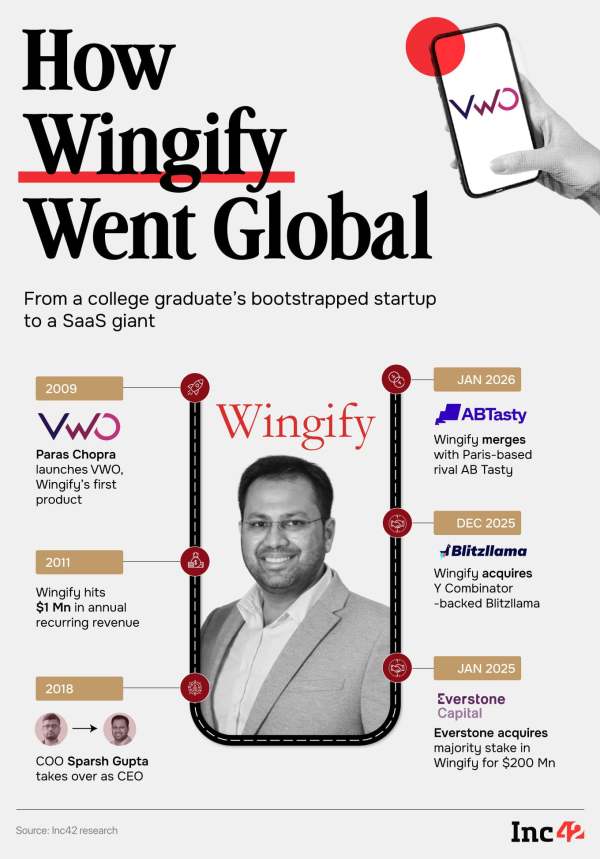
The first gush of winds beneath the wings came back in 2009, when Paras Chopra left his job to start building his own venture alongside Sparsh Gupta in Delhi. The company reached an annual recurring revenue of $1 Mn in 18 months.
Wingify expanded its global presence over the years and breached $50 Mn in ARR despite staying bootstrapped until it blipped on the radar of Singapore-based private equity firm Everstone Capital. In January 2025, Everstone acquired Wingify for $200 Mn, leading to a lucrative exit for Chopra, while Gupta stayed on as CEO.
Under Everstone, Wingify took a few turns. The company announced the first acquisition in its history in December 2025 when it struck an all-cash deal to take over AI user research platform Blitzllama for an undisclosed figure, and merged with French rival AB Tasty in late January.
Inc42 spoke to CEO Gupta to decode how the merger brought strategic value to both companies and how Wingify’s trajectory has played out after being acquired by Everstone.
“The top priority right now is to seamlessly integrate AB Tasty. The two businesses have been built differently in different parts of the world. So, it’s not trivial to make it happen successfully,” Gupta said.
Wingify plans to continue operating both AB Tasty’s platform as well as its own VWO platform to support existing customers. Over time, the company plans to integrate their capabilities closely and start pushing a unified solution. The teams under each function of the two companies will be merged as well.
“All functions – engineering, sales, marketing, customer service management, support – are coming together and merging into one team. It will take a few quarters to happen and will span into next year as well, but by the end of it, we will be one business,” he said.
From a leadership standpoint, Gupta will remain the CEO and Ankit Jain will continue as CTO leading the teams that run both the platforms. AB Tasty’s cofounders Alix de Sagazan and Rémi Aubert will stay on as the chief revenue officer and chief customer officer.
This will be the second test of Wingify’s ability to absorb new capabilities. It took over Blitzllama in 2025. Merging with AB Tasty is a much bigger endeavour compared to acquiring a relatively smaller startup.
Still, the precedent is promising considering that Wingify has added the Y Combinator-backed startup’s AI-powered user research tools into its own platform. “Blitzllama has been very well integrated already. We launched VWO Pulse in February, which is powered by Blitzllama,” said Gupta.
The $500 Mn FusionThe merger with AB Tasty has created a SaaS giant valued at $500 Mn, said the Wingify founder.
“Combined, we have almost $120 Mn revenue and around 4,000 customers globally,” Gupta claimed. It hasn’t only enabled the two companies to reach a larger scale, but also created a platform with a diversified customer portfolio, both in terms of geography and market segment.
Around 70% of AB Tasty’s business comes from Europe, particularly France and the UK. By contrast, 60% of VWO’s business comes from the US, while European regions like Germany, Southern Europe and Nordics make up roughly 20-30%.
AB Tasty’s customers are mainly large enterprises, particularly in ecommerce. On the other hand, VWO targets mid-sized companies in sectors like media, software, and travel.
As a result, despite being erstwhile competitors, the two companies bring in different feature sets to the table which can now be cross-sold to each other’s existing customers.
“Given the fact that they were serving ecommerce a lot more, AB Tasty has capabilities around merchandise recommendation and search. Those were completely non-existent in the VWO ecosystem,” Gupta said.
AB Tasty offers advanced personalisation through its Emotions AI tool, which analyses user behaviour on a website to detect their emotional state, and Adaptive CX, which tweaks a website to become more personalised as the user spends more time on it.
On the other hand, VWO’s products are more geared towards experimentation, analytics, and optimisation.
Charting Its Way Into An AI-Powered FutureWingify’s journey under Everstone highlights the fact that its acquisition hasn’t played out like a typical private-equity buyout. An acquisition by a PE firm is typically followed by measures to increase efficiency, involving aggressive cost reduction, organisational restructuring, and selling off assets.
Everstone, instead, came in to give an exit to Wingify’s shareholders with a mandate to keep the business running largely the same way it always had been, according to Gupta.
“We got access to a large network of advisors and a larger pool of capital. And we got a bigger appetite to aim for things like M&As that were a little more difficult for an organic, bootstrapped business,” he said, pointing to the example of the AB Tasty merger. “A deal of this sheer size would have been fairly difficult without someone with deep pockets on the cap table.”
The journey ahead for Wingify isn’t about a new way of working, rather, adjusting to a future that faces disruption. Wingify earlier competed mainly with other digital optimisation platforms like Optimizely and Adobe Target.
The rise of vibe coding and AI agents has, however, lowered the barrier for companies to build their own in-house tools, rather than relying on external companies. As a result, industry leaders like Zoho’s Sridhar Vembu argue that AI has exposed structural vulnerabilities in the SaaS business model.
Yet, Gupta believes that the AI wave presents more opportunity than threat for Wingify. “Whether it’s a large or small company, will they replace a product which is driving traffic, converting customers, doing personalisation for them when getting it wrong can have an impact on your revenue?” he questioned.
“For our business, we are not seeing it impacted by AI. Rather, we have leveraged AI as part of our platform and our operations and we have seen significant improvements.”
Gupta argued that AI has made platforms like VWO more valuable and easier to use. Earlier, customers had to sift through large volumes of data provided by the platform and configure their campaigns or website experiments in line with these insights. AI now analyses the patterns, line up observations, and even automatically make improvements for the customer. Even simple A/B testing – changing the way a particular product is presented on a website – no longer requires time-consuming work like creating image assets or drafting a marketing copy.
“These are tools that we are providing to our customers to optimise their entire digital experience faster and in a more nuanced way. We had all these tools in the product already, but with AI, businesses can do the same thing in a smarter way, driving more ROI,” said Gupta. “AI is the future of digital experience optimisation. It’s a pivotal point where the value we are creating for our customers could significantly change.”
[Edited by Kumar Chatterjee]
The post The Making Of A $500Mn SaaS Powerhouse: Inside Wingify’s Merger With AB Tasty appeared first on Inc42 Media.
-
Microsoft is fixing these six things Windows users have complained about for years

-
Expert reveals 'hidden hazard' lurking in your kitchen

-
Mikey Moore brings up Igor Tudor and talks with club as Tottenham star in the dark

-
Masterpiece crime drama is 'better than The Sopranos and Breaking Bad' - 96% score

-
Ian Wright argues with Carabao Cup final referees in unseen TV moment