273
CHANDIGARH: A series of political protests, sharp exchanges, and ideological signalling over the past week have pushed Punjab into a heightened phase of confrontation, with the Aam Aadmi Party government led by Bhagwant Mann locked in an intensifying battle with the BJP-led Centre and the state opposition.
The shift was visible on the ground in Ludhiana on March 16, when Congress workers staging a protest over civic and governance issues clashed with AAP supporters, leading to a tense standoff and police intervention. The confrontation underscored how political rivalry in Punjab is no longer confined to statements and Assembly debates but is increasingly spilling onto the streets.
Adding to the pressure, farmer groups under the banner of Kisan Mazdoor Morcha announced a fresh agitation beginning March 22, accusing the state government of cancelling scheduled meetings and failing to address long-pending demands to compensation and policy assurances. The announcement has revived memories of Punjab’s protest politics, signalling that agrarian unrest could once again become a central political issue.
You Might Be Interested In
These developments come at a time when Punjab’s political discourse is also being shaped by national-level messaging. During the Maghi rally, Union Home Minister Amit Shah’s renewed push for stricter anti-conversion laws in BJP-ruled states has injected an ideological dimension into the debate. While Punjab does not have such a law, the messaging has triggered a political response from the AAP leadership, which views it as an attempt to introduce religious polarization into the state.
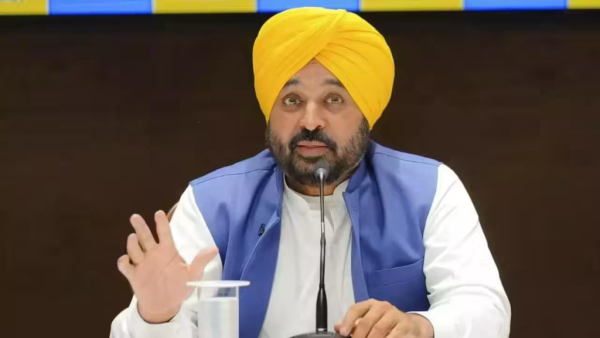
Chief Minister Bhagwant Mann responded by asserting that “religious politics will not work in Punjab,” positioning his government as a defender of the state’s social harmony. His remarks were accompanied by a broader attack on the Centre, with the state government alleging that Punjab’s financial dues, including funds under key heads such as the Rural Development Fund, remain pending. The Mann government has also raised concerns over what it describes as central interference in law-and-order matters.
The Bharatiya Janata Party, however, has sharpened its offensive. Amit Shah, during recent engagements, targeted the AAP government over issues of crime, drugs, and governance, while making it clear that the party is preparing to emerge as a principal contender in Punjab ahead of the 2027 Assembly elections. This reflects a strategic shift, with the BJP now working to build an independent political base in the state after parting ways with the Shiromani Akali Dal.
Within Punjab, the Indian National Congress is attempting to reassert itself by attacking both the Centre and the Mann government. Its leadership has raised concerns over agrarian distress and internal security challenges, including online border smuggling, while also accusing the state government of failing on governance. However, repeated on-ground confrontations with AAP workers indicate that the political context is becoming increasingly direct and combative.
Political analyst Harjit Singh said the developments point to a structural shift in Punjab’s politics. “What we are witnessing is not routine political rivalry but a layered confrontation where protests, governance issues and ideological messaging are all merging into one narrative,” he said. According to him, Punjab is no longer insulated from national political currents, with both AAP and BJP using the state to advance broader political objectives.
He further noted that AAP is attempting to project Punjab as a governance model to strengthen its national footprint, while the BJP is treating the state as a key expansion zone. “This is why even issues like law and order, farmer protests or financial dues are being amplified politically. The confrontation is strategic, not incidental,” he added.
Another Chandigarh-based observer pointed out that the timing of these developments is critical. With the AAP government having completed four years in office and the 2027 elections drawing closer, all parties have begun early positioning. Protests, ideological debates, and governance issues are being strategically used to shape voter perception.
The Mann government, for its part, continues to highlight its governance record, including claims of improved irrigation coverage and welfare delivery, while maintaining a confrontational stance against both the Centre and opposition. This dual approach reflects an attempt to balance administrative messaging with political assertion. What is emerging is a political landscape where confrontation is becoming the dominant mode of engagement. With protests on the ground, ideological signalling from the Centre, and aggressive positioning by all major players, Punjab is steadily evolving into a high-stakes battleground that extends beyond state politics and feeds directly into national political calculations.
-
Slovenia election sees ruling party tied with opposition

-
What Ian Wright was 'screaming' about Gabriel Martinelli during Arsenal Carabao Cup loss

-
Sharks with cocaine in their blood found off Caribbean island

-
The Shocking Incident That Altered a Bollywood Star's Career

-
Killer Ian Huntley to be cremated with no memorial as ashes to be scattered in secret