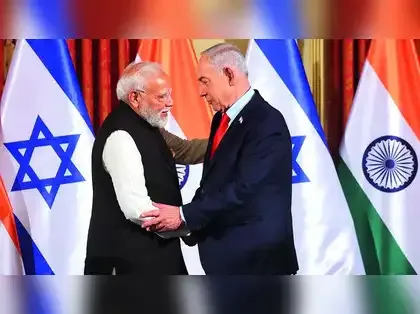
Toronto: In early 2000, still reeling from watching an Indian Airlines plane sit on a Kandahar tarmac while the Taliban dictated terms and New Delhi agonised, I had argued for a Washington-New Delhi-Tel Aviv security triangle.
The argument was geographic, and logical. India and Israel parenthesise 'the terror corridor' - a long, lethal arc running from Pakistan through Afghanistan, Iran, Lebanon to Gaza. Actors across that arc were never identical. But both India and Israel lived inside the blast radius of overlapping networks, state sponsors and ideologies of asymmetric violence.
Washington was the natural anchor: prime target of many of the same adversaries, indispensable military reach, and the only power capable of giving such an alignment both teeth and legitimacy. 25 yrs later, that triangle exists in recognisable form. But the anchor has come loose.
The US of 2026 launched a war against Iran without a broad coalition, with no visible exit strategy, and without appearing to calculate fully that Iran's most effective weapon of retaliation might not be a missile but a choke point. Roughly 20% of the world's petroleum liquids normally passes through a narrow channel that Tehran has now shown it can effectively choke. Brent crude is above $100.
The same regime whose strikes helped trigger the Hormuz crisis is now easing sanctions on Russian oil to manage the economic blowback, thereby boosting Vladimir Putin at the very moment it lectures allies about energy dependence. Washington remains a superpower. But it no longer appears a strategically consistent one. That leaves the other two vertices of the triangle standing in a far more complex alignment.
The architecture proposed in 2000 had, in fact, already been taking shape for decades, although largely covertly, occasionally acknowledged, and now difficult to ignore. The record is striking. Israeli military assistance reached India during the 1962 China war, discreetly and amid political sensitivity. Backchannel intelligence ties between R&AW and Mossad date back to 1968, on Indira Gandhi's instruction.
In the early 1980s, India and Israel were widely reported to have explored a joint strike on Pakistan's Kahuta nuclear facility. By 1992, when India finally formalised relations with Israel, the two countries had maintained discreet security ties for decades. Today, India remains one of Israel's most important arms customers, with Israeli technology woven into India's defence architecture at multiple levels.
Yet, the 'marriage made in heaven', to quote Benjamin Netanyahu, now faces its most gruelling earthly test.
Iran, whose Islamic Revolutionary Guard Corps has effectively closed the world's most critical oil choke point, has at least one Iranian ship, IRIS Lavan, sitting in safe harbour in India. Tehran has negotiated passage for Indian-flagged tankers through waters it has largely denied to Western-linked vessels, effectively treating India as a privileged neutral in a conflict against one of India's closest security partners.
This is not a contradiction. It is the payoff from a hedge maintained over decades. The 'terror corridor' in 2000 is today also an energy corridor. From the Strait of Hormuz to the International North-South Transport Corridor (INSTC), a multimodal route linking Mumbai to St Petersburg via Iran, India sits at the mouth of it all.
India kept Chabahar, its strategically critical port on Iran's Gulf of Oman coast, and New Delhi's primary overland route to Afghanistan and Central Asia that sidesteps Pakistan entirely - alive through successive rounds of US sanctions, maintaining relationships with patience while the West engaged and withdrew on its own erratic schedules.
India now holds something very few nations do: functional, productive relationships with Iran, Israel, Russia, the Gulf states and the US simultaneously. This may be the most sophisticated exercise of strategic autonomy in modern Indian history.
Indeed, where Nehru's non-alignment was, at least in theory, a form of principled abstention - a desire to stay out of the fray - today's India, under Narendra Modi and S Jaishankar, is practicing active, multi-vector engagement. India is no longer merely avoiding alignment. It is operating as an indispensable node in a network with few other common points.
The triangle of 2000 needs a new geometry. Washington remains relevant for its capital markets and technology. But it can no longer serve as the sole anchor. India and Israel now constitute a bilateral core in which India provides diplomatic depth that Israel structurally lacks - no Iran channel, no strategic Russia channel, no standing in fora like OIC. While Israel provides intelligence and technological depth that complements India's scale.
The strategic equation has shifted, perhaps decisively. The country that once needed Washington to anchor its security now occupies a singular diplomatic position that may yet help construct an off-ramp from a war that one of its closest security partners helped start.
India did not choose this moment. But it has been preparing for something like this for 50 yrs.
The argument was geographic, and logical. India and Israel parenthesise 'the terror corridor' - a long, lethal arc running from Pakistan through Afghanistan, Iran, Lebanon to Gaza. Actors across that arc were never identical. But both India and Israel lived inside the blast radius of overlapping networks, state sponsors and ideologies of asymmetric violence.
Washington was the natural anchor: prime target of many of the same adversaries, indispensable military reach, and the only power capable of giving such an alignment both teeth and legitimacy. 25 yrs later, that triangle exists in recognisable form. But the anchor has come loose.
The US of 2026 launched a war against Iran without a broad coalition, with no visible exit strategy, and without appearing to calculate fully that Iran's most effective weapon of retaliation might not be a missile but a choke point. Roughly 20% of the world's petroleum liquids normally passes through a narrow channel that Tehran has now shown it can effectively choke. Brent crude is above $100.
The same regime whose strikes helped trigger the Hormuz crisis is now easing sanctions on Russian oil to manage the economic blowback, thereby boosting Vladimir Putin at the very moment it lectures allies about energy dependence. Washington remains a superpower. But it no longer appears a strategically consistent one. That leaves the other two vertices of the triangle standing in a far more complex alignment.
The architecture proposed in 2000 had, in fact, already been taking shape for decades, although largely covertly, occasionally acknowledged, and now difficult to ignore. The record is striking. Israeli military assistance reached India during the 1962 China war, discreetly and amid political sensitivity. Backchannel intelligence ties between R&AW and Mossad date back to 1968, on Indira Gandhi's instruction.
In the early 1980s, India and Israel were widely reported to have explored a joint strike on Pakistan's Kahuta nuclear facility. By 1992, when India finally formalised relations with Israel, the two countries had maintained discreet security ties for decades. Today, India remains one of Israel's most important arms customers, with Israeli technology woven into India's defence architecture at multiple levels.
Yet, the 'marriage made in heaven', to quote Benjamin Netanyahu, now faces its most gruelling earthly test.
Iran, whose Islamic Revolutionary Guard Corps has effectively closed the world's most critical oil choke point, has at least one Iranian ship, IRIS Lavan, sitting in safe harbour in India. Tehran has negotiated passage for Indian-flagged tankers through waters it has largely denied to Western-linked vessels, effectively treating India as a privileged neutral in a conflict against one of India's closest security partners.
This is not a contradiction. It is the payoff from a hedge maintained over decades. The 'terror corridor' in 2000 is today also an energy corridor. From the Strait of Hormuz to the International North-South Transport Corridor (INSTC), a multimodal route linking Mumbai to St Petersburg via Iran, India sits at the mouth of it all.
India kept Chabahar, its strategically critical port on Iran's Gulf of Oman coast, and New Delhi's primary overland route to Afghanistan and Central Asia that sidesteps Pakistan entirely - alive through successive rounds of US sanctions, maintaining relationships with patience while the West engaged and withdrew on its own erratic schedules.
India now holds something very few nations do: functional, productive relationships with Iran, Israel, Russia, the Gulf states and the US simultaneously. This may be the most sophisticated exercise of strategic autonomy in modern Indian history.
Indeed, where Nehru's non-alignment was, at least in theory, a form of principled abstention - a desire to stay out of the fray - today's India, under Narendra Modi and S Jaishankar, is practicing active, multi-vector engagement. India is no longer merely avoiding alignment. It is operating as an indispensable node in a network with few other common points.
The triangle of 2000 needs a new geometry. Washington remains relevant for its capital markets and technology. But it can no longer serve as the sole anchor. India and Israel now constitute a bilateral core in which India provides diplomatic depth that Israel structurally lacks - no Iran channel, no strategic Russia channel, no standing in fora like OIC. While Israel provides intelligence and technological depth that complements India's scale.
The strategic equation has shifted, perhaps decisively. The country that once needed Washington to anchor its security now occupies a singular diplomatic position that may yet help construct an off-ramp from a war that one of its closest security partners helped start.
India did not choose this moment. But it has been preparing for something like this for 50 yrs.
(Disclaimer: The opinions expressed in this column are that of the writer. The facts and opinions expressed here do not reflect the views of www.economictimes.com.)


Arnie Guha
The writer is chair, advisory board of Green College, University of British Columbia. He is also member, Liberal Party of Canada