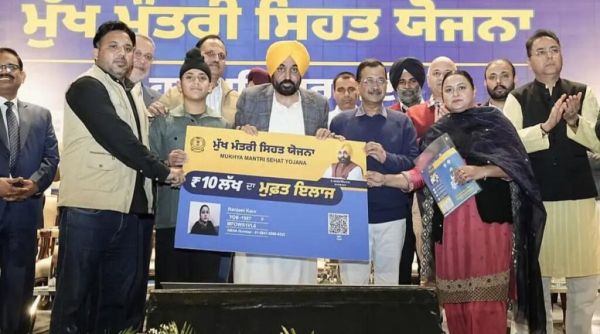
Mukhyamantri Sehat Yojana: At a time when rising medical costs are putting families across the country under financial stress, a glaring gap is emerging in the models of financing and delivery of health services. While the Centre’s Ayushman Bharat scheme makes a provision of ₹9,500 crore for a population of 140 crore, Punjab’s Mukhyamantri Sehat Yojana allocates ₹2,000 crore for only 3 crore residents, that is, almost ten times more per capita investment.
Cashless treatment up to Rs 10 lakh
This difference is not just of budget, but of thinking. While the national scheme limits both eligibility and coverage to ₹5 lakh, Punjab’s model ensures cashless treatment up to ₹10 lakh to every resident without any conditions. The Punjab government, under the leadership of Chief Minister Bhagwant Singh Mann, has established healthcare as not a targeted benefit but an assured right, where the basis of treatment is not a name in the list but a real need.
People benefit from Chief Minister Health Scheme
For most Indian families two questions immediately arise with any medical emergency, how soon will the treatment begin and how will the expenses be borne. Addressing both these concerns, the Punjab government has made a provision of ₹2,000 crore for the Mukhyamantri Sehat Yojana in the Budget 2026-27, under which cashless health cover of up to ₹10 lakh per family is being provided to about 3 crore residents of 65 lakh families.
Unlike targeted schemes like Ayushman Bharat, Punjab’s model is based on universal coverage, with no eligibility barriers of any kind.
marked as economically weak
The difference between the two approaches is fundamental. Mukhyamantri Sehat Yojana does not ask who is eligible. Every resident of Punjab is included in this, regardless of income. In contrast, the Ayushman Bharat scheme launched in 2026 is limited to only those households identified as economically vulnerable in the SECC database. A large section of the population, especially those from low and middle income groups who are not included in this database, still remains outside its coverage.
Chief Minister Health Scheme is different from Ayushman Bharat
The scope of coverage also makes this difference more clear. Ayushman Bharat is limited to ₹5 lakh per family since its inception and there has been no change in this despite rising medical costs. In comparison, the Mukhyamantri Sehat Yojana doubles this limit to ₹10 lakh and also protects families who were previously outside the scope of government health schemes.
Priority to accessible health care
Financial commitment also reflects this priority. While the Center is spending ₹9,500 crore for 140 crore people, Punjab is investing ₹2,000 crore for 3 crore residents, which is far higher per capita and a clear signal of prioritizing comprehensive, accessible healthcare.
Cashless treatment of serious diseases
Mukhyamantri Sehat Yojana also expands the scope of treatment. Beneficiaries can avail cashless treatment for a range of diseases including heart disease, cancer, kidney disease, orthopedic treatment and accident critical conditions under 2,300 treatment packages. In comparison, Ayushman Bharat is limited to about 1,900 packages. It is clear that the decision on treatment here is based on medical necessity and not on financial capacity.
Online application through Voter ID
The process of accessing the scheme also shows a major change. In Ayushman Bharat, one has to first check whether the family’s name is in the SECC list or not, and families outside the list have to go through additional documentation to prove eligibility. In contrast, Mukhyamantri Sehat Yojana simplifies this process. Residents can apply by visiting Seva Kendras or Common Service Centres, or online through Aadhaar or Voter ID, without proof of income or profession. To ensure wider reach, trained youth club members are going door-to-door to assist people in registering and delivering health cards to their homes.
Special treatments including chemotherapy are completely cashless.
Its impact is clearly visible now. In Moga, 98-year-old woman Mukhtiyar Kaur got special treatment including chemotherapy completely cashless under this scheme. In this age where continuous medical care is extremely important, Sehat Card ensured that the treatment could start without any delay and financial pressure.
Health care should reach every citizen
Health and Family Welfare Minister Dr Balbir Singh said, “Under the leadership of Chief Minister Bhagwant Singh Mann, Mukhyamantri SEHAT Yojana is based on the principle that healthcare should reach every citizen and not just a select few. Through higher per capita investment, Punjab is ensuring that access to treatment is determined by need, not eligibility or income.”
Continuously increasing access to health services
More than 9 lakh Sehat cards have been issued so far and beneficiaries are receiving treatment in a network of over 900 empaneled hospitals, thereby continuously increasing access to health services across the state. In a country where a single hospital bill can send families into debt, the gap is no longer merely administrative, but ideological. One model limits the service based on eligibility, while the other makes it a right of every citizen.
-
Want to stay away from cough and cold? Do these important things to protect yourself in the changing weather, you will get relief in a jiffy.
-
Make dark circles under the eyes disappear within minutes with these home remedies!

-
Summer Special: The easiest way to identify sweet and red watermelon without cutting it, even shopkeepers hide this secret!

-
Benefits of Fruits for Skin: Orange, Papaya and More

-
‘Dhurandhar 2’ performed brilliantly at the box office, entry into the Rs 700 crore club is certain! Know its earnings so far.