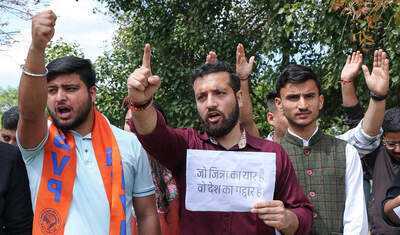
Jammu University is currently at the center of a heated debate regarding its master's program in political science. The university's departmental affairs committee has made a significant recommendation to remove topics related to historical figures such as Muhammad Ali Jinnah, Sir Syed Ahmad Khan, and the renowned poet-philosopher Muhammad Iqbal from the curriculum. This decision comes in the wake of growing protests from student organizations against the inclusion of these figures.
The controversy began when the revised curriculum under the New Education Policy 2020 included Jinnah in a chapter titled 'Minorities and Nation.' The All India Student Council expressed strong opposition to this decision, arguing that teaching about individuals associated with the two-nation theory and the partition of India undermines national sentiments and sends a misleading message to students.
Read More: Mehbooba Mufti Prays for Palestine, Lebanon, and Iran on Eid, Ignores Attacks on Tehran
In response to the protests, demonstrations were led by the secretary of the Jammu and Kashmir unit of the council, Sanak Shrivats. He issued a clear warning that if immediate changes to the curriculum were not made, the protests would escalate. Additionally, he called for the inclusion of figures who have positively contributed to minority welfare and nation-building.
On the other hand, the political science department defended the curriculum. Professor Baljeet Singh Mann, the head of the department, stated that the program aims to provide students with a comprehensive understanding of modern Indian political thought. It includes prominent thinkers such as Vinayak Damodar Savarkar, Madhav Sadashiv Golwalkar, Mahatma Gandhi, B.R. Ambedkar, Jawaharlal Nehru, and Sardar Vallabhbhai Patel, alongside Jinnah, Sir Syed, and Iqbal, to help students grasp various perspectives.
However, under increasing pressure from the protests, the departmental affairs committee unanimously recommended the removal of these topics. This recommendation will apply to both one-year and two-year master's programs. The committee took the concerns raised by the council seriously and acknowledged the necessity for broad consensus on this issue.
The proposal has now been forwarded to the academic council, which is scheduled to meet online on March 24 to make a final decision on whether to remove these topics from the curriculum. If the academic council approves this recommendation, a new curriculum could be implemented in the upcoming session. This entire situation has sparked a significant debate within the education sector. One side argues that including all ideologies and figures in the study of history and politics is essential for students to develop a well-rounded perspective. Conversely, the other side contends that emphasizing controversial figures could create confusion among students.
Experts suggest that curriculum development should be a balanced process, avoiding the complete disregard of any ideology while not overly favoring one side. It is also crucial for students to have opportunities to develop critical thinking skills so they can analyze facts independently. Currently, Jammu University's decision may serve as a precedent for other educational institutions in the future. It will be interesting to see what final decision the academic council makes on this issue and how it impacts students and the education system.
-
'Let the sleeping lions roar / decolonise your mind': Poems inspired by African writers
-
Tim Sherwood BEGS to take Igor Tudor's job and save Tottenham on live TV

-
Tamil Nadu: Nine police officers convicted in 2020 custodial killing of father, son
-
Meryl Streep reveals she recorded 'a million versions' of secret 'Project Hail Mary' cameo

-
UPI-Based Loan Facility for Women: Bank of Baroda Launches Instant Credit via Mobile