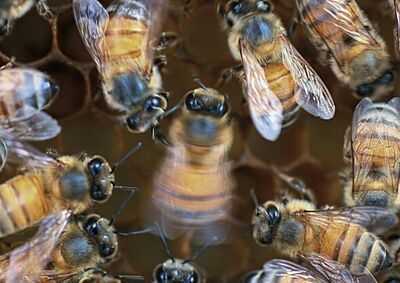
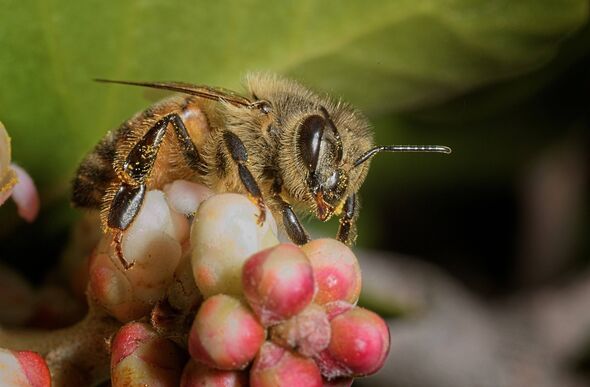
Honey bees perform a dance with greater accuracy when observed by larger crowds, new research has revealed. The exactness of their "waggle dance" varies based on the number of spectators and their composition, the study found. Scientists in America have recently painstakingly decoded intricate aspects of the dance - a sophisticated method of social interaction within the animal world.
Researchers at the University of California San Diego alongside their collaborators have uncovered how the waggle dance transmits vital intelligence about food locations for fellow colony members.
Fresh analysis of the dance's mechanics has now demonstrated that the performer isn't the only factor that counts - the audience composition is equally significant. The trials revealed that the foraging bee isn't merely relaying a fixed message.
Rather, the accuracy of the performer's guidance to the food location is influenced by its observers.
When a foraging bee arrives back at the colony after locating a worthwhile food supply, the research group noted that it shares the positional details with colony companions through a "blazing-fast, complex" routine.
Whilst fellow bees observe attentively, the dancing forager moves forwards whilst "waggling" its abdomen, before circling back and repeating the display within seconds.
The orientation of the waggle dance indicates the bearing of the food in relation to the sun, whilst the length of the display communicates the range to the location. Professor James Nieh, of the UC San Diego School of Biological Sciences, compared the new discoveries to a street performance.
With a substantial audience, he explains street musicians concentrate on the performance itself. But when the crowd dwindles, the performer scans faces, shifts position and invests more effort into finding and retaining an audience.
Prof Nieh explains the search for a receptive audience fundamentally alters the bee's performance because it is challenging to maintain the precision of a rapid, repeated movement pattern whilst simultaneously moving around to locate and engage an audience.
He said: "Everyone has seen a street musician or a performer adjust to a changing crowd. In the hive, we see a comparable trade-off. When fewer bees follow, dancers move more as they search for their audience, and the dance becomes less precise."
Working alongside scientists from Queen Mary University of London and the Chinese Academy of Sciences, Prof Nieh examined experimental hives and observed the honey bee "dance floor," which replicated the crowded, dynamic social environment found in real hives.
In the initial part of the experiment, the team assessed fluctuating numbers of bees in the primary dancing area to test the changes caused by different audience sizes.
In a second set of experiments, the researchers maintained the number of bees constant, but altered the age of the audience members by introducing young worker bees, which are not interested in following dances. In both experimental scenarios, dancers were less accurate when performing for a smaller audience.
Professor Ken Tan, the study's senior author from the Chinese Academy of Sciences, stated: "The waggle dance is often presented as a one-way information transfer.
"Our data show that feedback from the audience shapes the signal itself.
"In that sense, the dancer is not only sending information, but also responding to social conditions on the dance floor."
The new study, published in the journal Proceedings of the National Academy of Sciences (PNAS), also offered insights into how dancers perceive audience size and composition.
The research team discovered that audience members frequently make antennal and body contact with dancers.
Such tactile cues likely provide information about audience composition, according to the researchers.
Professor Lars Chittka, from Queen Mary University of London, said the study demonstrates that "humans aren't the only ones who perform differently depending on their audience."
He added: "Our study shows that honey bees quite literally dance better when they know someone is watching.
"When followers are scarce, dancers wander around searching for listeners - and in doing so, their signals become fuzzier.
"It's a lovely reminder that even in the miniature world of insects, communication is a deeply social affair."
The researcher noted that the findings also provide insight into how animal groups manage information.
Prof Nieh stated: "The new findings show that the accuracy of a signal can depend on the availability of receivers, not only on the motivation of the sender."
He further added: "That kind of feedback may be important in animal societies, engineered swarms and other distributed systems where the quality of information can rise or fall with audience dynamics."
-
Ricky Ponting Asks Players To Focus On Getting 'Physically, Technically And Mentally' Fit For IPL 2026

-
Digital Arrest Scam: How An 81-Year-Old Businessman Lost ₹15.45 Crore In 40-Day Psychological Hostage

-
Tim Cook May Retire Soon: Who Is Apple's Next CEO?

-
Madhya Pradesh Govt To Issue 'Vidyarambh' Certificates To Anganwadi Children Completing Pre-School

-
Rajinikanth Calls Dhurandhar 2 'Box Office Ka Baap', Congratulates Ranveer Singh & Aditya Dhar In Heartfelt Post