
Finance and corporate affairs minister Nirmala Sitharaman on Monday introduced in the Lok Sabha a bill to amend laws governing both companies and limited liability partnerships (LLPs), proposing steps for ease of doing business with further decriminalisation and a flexible corporate social responsibility (CSR) and share buyback framework, among others.
The Corporate Laws (Amendment) Bill, 2026, which proposes to further empower the National Financial Reporting Authority (NFRA), has now been referred to a joint parliamentary committee for a detailed scrutiny, as suggested by Sitharaman and endorsed by the house.
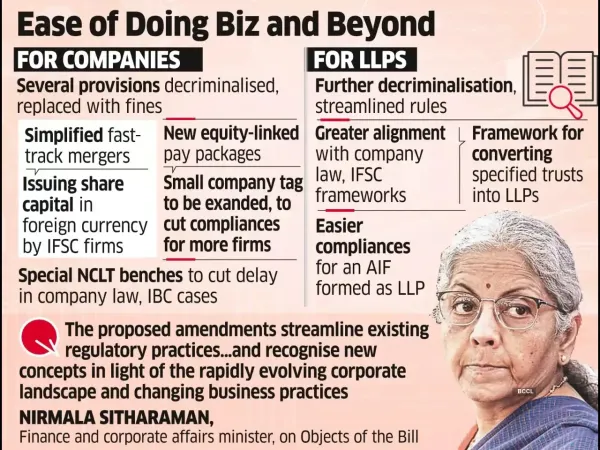
Share buybacks, fast-track mergers
The bill seeks to enable specified companies to conduct two share buybacks in a year, with a gap of at least six months, up from just one now. The eligible category of companies will be notified later.
The proposed changes will allow eligible companies to buy back more than 25% of their paid-up capital and free reserves, said Anjali Malhotra, partner (regulatory) at Nangia Global. "This is expected to attract investors to debt-free companies, especially private ones," she added.
The bill also proposes relaxing procedures for fast-track mergers and amalgamations through rationalisation of approval thresholds and allowing the filing of such applications before a single bench of the National Company Law Tribunal.
The bill reflects a "broader recalibration of the regulatory framework, combining decriminalisation with process simplification, targeted relaxations, and recognition of evolving business practices", said Prasenjit Sarkar, partner, Grant Thornton Bharat.
Empowering NFRA
The bill expands the NFRA's power to issue directions to auditors in public interest or interest of investors and creditors for professional misconduct. It provides for the intimation of registration details of auditors, and for filing of returns with the NFRA. A fund will be set up to enable the NFRA to discharge its functions effectively. The Bill expands the NFRA's adjudicatory and enforcement powers, said Manmeet Kaur, partner at Karanjawala & Co. "At the same time, it also bars the jurisdiction of Civil Courts over NFRA matters," she said.
CSR, mandatory audits
The bill proposes to double the profit threshold for companies to undertake CSR spending to ₹10 crore to reduce the cost for small companies. Besides, companies having CSR amount up to ₹1 crore or more need not constitute a corporate social responsibility committee. Similarly, it seeks to exempt audit requirements for small companies, with the turnover threshold to be decided later, purportedly to avoid potential misuse.
The bill also allows multi-disciplinary partnerships for cost and secretarial auditors and eases compliances for alternative investment funds formed as LLPs. It introduces new forms of instruments such as restricted stock units and stock appreciation rights, which are linked to a company's share capital, for executive compensation, on top of the employee stock ownership plan.
Provisions for LLP
The bill proposes several minor offences to be decriminalised and replaced with fines, and focuses on modernising the LLP framework.
The incorporation process is proposed to be streamlined and specific structural conditions are introduced for LLPs in International Financial Services Centres Authority (IFSC). It allows such LLPs to maintain partner contributions, books of account and financial statements in permitted foreign currency. It introduces a framework for conversion of specified trusts (registered with the stock markets regulator Sebi or the IFSC) into LLPs, subject to conditions. "The (Bill's) proposed compliance simplifications, including through expansion of the small-company definition and rationalisation of CSR and audit requirements clearly recognise India's growth-stage businesses," said Bharat Varadachari, partner at EY India.
The Corporate Laws (Amendment) Bill, 2026, which proposes to further empower the National Financial Reporting Authority (NFRA), has now been referred to a joint parliamentary committee for a detailed scrutiny, as suggested by Sitharaman and endorsed by the house.
Bill also proposes decriminalisation, flexible CSR norms, expanded buybacks, stronger NFRA role
Share buybacks, fast-track mergers
The bill seeks to enable specified companies to conduct two share buybacks in a year, with a gap of at least six months, up from just one now. The eligible category of companies will be notified later.
The proposed changes will allow eligible companies to buy back more than 25% of their paid-up capital and free reserves, said Anjali Malhotra, partner (regulatory) at Nangia Global. "This is expected to attract investors to debt-free companies, especially private ones," she added.
The bill also proposes relaxing procedures for fast-track mergers and amalgamations through rationalisation of approval thresholds and allowing the filing of such applications before a single bench of the National Company Law Tribunal.
The bill reflects a "broader recalibration of the regulatory framework, combining decriminalisation with process simplification, targeted relaxations, and recognition of evolving business practices", said Prasenjit Sarkar, partner, Grant Thornton Bharat.
Empowering NFRA
The bill expands the NFRA's power to issue directions to auditors in public interest or interest of investors and creditors for professional misconduct. It provides for the intimation of registration details of auditors, and for filing of returns with the NFRA. A fund will be set up to enable the NFRA to discharge its functions effectively. The Bill expands the NFRA's adjudicatory and enforcement powers, said Manmeet Kaur, partner at Karanjawala & Co. "At the same time, it also bars the jurisdiction of Civil Courts over NFRA matters," she said.
CSR, mandatory audits
The bill proposes to double the profit threshold for companies to undertake CSR spending to ₹10 crore to reduce the cost for small companies. Besides, companies having CSR amount up to ₹1 crore or more need not constitute a corporate social responsibility committee. Similarly, it seeks to exempt audit requirements for small companies, with the turnover threshold to be decided later, purportedly to avoid potential misuse.
The bill also allows multi-disciplinary partnerships for cost and secretarial auditors and eases compliances for alternative investment funds formed as LLPs. It introduces new forms of instruments such as restricted stock units and stock appreciation rights, which are linked to a company's share capital, for executive compensation, on top of the employee stock ownership plan.
Provisions for LLP
The bill proposes several minor offences to be decriminalised and replaced with fines, and focuses on modernising the LLP framework.
The incorporation process is proposed to be streamlined and specific structural conditions are introduced for LLPs in International Financial Services Centres Authority (IFSC). It allows such LLPs to maintain partner contributions, books of account and financial statements in permitted foreign currency. It introduces a framework for conversion of specified trusts (registered with the stock markets regulator Sebi or the IFSC) into LLPs, subject to conditions. "The (Bill's) proposed compliance simplifications, including through expansion of the small-company definition and rationalisation of CSR and audit requirements clearly recognise India's growth-stage businesses," said Bharat Varadachari, partner at EY India.