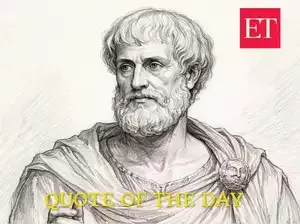
Quote of the Day: A powerful Quote of the Day often rises above time, offering clarity in moments when truth feels clouded by opinion, pressure, or popular belief. Few thinkers have explored the nature of truth and reason as deeply as Aristotle, whose ideas continue to influence philosophy, science, and everyday thinking even today. His reflections remind us that integrity is not always about being accepted—it is about being honest. In an age shaped by constant noise and competing narratives, such a quote becomes more than just words; it becomes guidance.
Quote of the Day Today March 23
The Quote of the Day by Aristotle is: “The high-minded man must care more for the truth than for what people think.”
This statement captures the essence of intellectual courage. Aristotle believed that truth stands above popularity, and that a person of character must be willing to uphold it—even when it is inconvenient or unpopular. His philosophy consistently emphasized reason, observation, and clarity over blind acceptance.
Early Life and Intellectual Foundations of Aristotle
Aristotle was born in 384 BCE in Stagira, a city in northern Greece. The son of Nicomachus, a physician to the Macedonian king, Aristotle grew up in an environment that valued knowledge and inquiry. After his father’s death, he moved to Athens, where he joined Plato’s Academy, one of the most important intellectual centers of the ancient world. He remained there for nearly 20 years, first as a student and later as a colleague, as per information sourced from Britannica.
Although deeply influenced by his teacher Plato, Aristotle gradually developed his own philosophical direction. He began to question the theory of abstract Forms and instead focused more on observation and practical understanding. His early works show a strong Platonic influence, but over time, he carved out a unique path that would define his legacy.
Career, Achievements, and Lasting Legacy
Aristotle’s intellectual range was extraordinary. He wrote on subjects as diverse as biology, ethics, politics, metaphysics, logic, and rhetoric. In fact, he is often regarded as the founder of formal logic, having developed a system that remained authoritative for centuries. His scientific work, particularly in zoology, was groundbreaking, combining careful observation with theoretical insight.
After leaving Athens, Aristotle conducted research in places like Assus and Lesbos, where he studied marine life and animal classification in remarkable detail. Later, he was invited by King Philip II of Macedonia to tutor his son, who would become Alexander the Great. This connection placed Aristotle at the center of one of history’s most influential periods, as per information sourced from Britannica.
Upon returning to Athens, Aristotle founded his own school, the Lyceum. Unlike Plato’s Academy, the Lyceum emphasized research and empirical study. Aristotle and his students, known as Peripatetics, engaged in systematic inquiry across disciplines. He also established one of the earliest research libraries, creating a foundation for organized learning.
Even after centuries of intellectual change—from the Renaissance to the Enlightenment—Aristotle’s ideas have remained deeply embedded in Western thought. His work shaped medieval Christian and Islamic philosophy and continues to influence modern debates in ethics, science, and politics, as per information sourced from Britannica.
Meaning of the Quote
The meaning behind Aristotle’s quote lies in its insistence on intellectual honesty. To be “high-minded” is not simply to be intelligent, but to possess moral strength—the courage to prioritize truth over approval.
In practical terms, this means resisting the urge to conform when the majority is wrong. It means questioning assumptions, seeking evidence, and standing firm in one’s convictions. Aristotle understood that public opinion can be fleeting and often unreliable, but truth, grounded in reason and observation, has enduring value.
The quote also reflects a deeper philosophical principle: that knowledge requires independence of thought. Without the willingness to challenge accepted ideas, progress becomes impossible. Whether in science, politics, or personal life, real growth happens when individuals are brave enough to think differently.
Today, this message feels especially relevant. In a world driven by social validation and constant feedback, it is easy to prioritize approval over accuracy. Aristotle’s words remind us that true integrity lies in choosing truth—even when it comes at a cost.
Beyond the Quote of the Day, Aristotle left behind a wealth of timeless insights:
“Knowing yourself is the beginning of all wisdom.”
“What is a friend? A single soul dwelling in two bodies.”
“Educating the mind without educating the heart is no education at all.”
“Hope is a waking dream.”
“No great mind has ever existed without a touch of madness.”
“Happiness depends upon ourselves.”
“Excellence is never an accident. It is always the result of high intention, sincere effort, and intelligent execution; it represents the wise choice of many alternatives - choice, not chance, determines your destiny.”
“Anybody can become angry — that is easy, but to be angry with the right person and to the right degree and at the right time and for the right purpose, and in the right way — that is not within everybody's power and is not easy.”
“A friend to all is a friend to none.”
As a Quote of the Day, Aristotle’s words serve as a powerful reminder that truth is not always comfortable—but it is always necessary. His legacy challenges us to think deeply, question boldly, and value truth above all else.
Quote of the Day Today March 23
The Quote of the Day by Aristotle is: “The high-minded man must care more for the truth than for what people think.”
This statement captures the essence of intellectual courage. Aristotle believed that truth stands above popularity, and that a person of character must be willing to uphold it—even when it is inconvenient or unpopular. His philosophy consistently emphasized reason, observation, and clarity over blind acceptance.
Early Life and Intellectual Foundations of Aristotle
Aristotle was born in 384 BCE in Stagira, a city in northern Greece. The son of Nicomachus, a physician to the Macedonian king, Aristotle grew up in an environment that valued knowledge and inquiry. After his father’s death, he moved to Athens, where he joined Plato’s Academy, one of the most important intellectual centers of the ancient world. He remained there for nearly 20 years, first as a student and later as a colleague, as per information sourced from Britannica.
Although deeply influenced by his teacher Plato, Aristotle gradually developed his own philosophical direction. He began to question the theory of abstract Forms and instead focused more on observation and practical understanding. His early works show a strong Platonic influence, but over time, he carved out a unique path that would define his legacy.
Career, Achievements, and Lasting Legacy
Aristotle’s intellectual range was extraordinary. He wrote on subjects as diverse as biology, ethics, politics, metaphysics, logic, and rhetoric. In fact, he is often regarded as the founder of formal logic, having developed a system that remained authoritative for centuries. His scientific work, particularly in zoology, was groundbreaking, combining careful observation with theoretical insight.
After leaving Athens, Aristotle conducted research in places like Assus and Lesbos, where he studied marine life and animal classification in remarkable detail. Later, he was invited by King Philip II of Macedonia to tutor his son, who would become Alexander the Great. This connection placed Aristotle at the center of one of history’s most influential periods, as per information sourced from Britannica.
Upon returning to Athens, Aristotle founded his own school, the Lyceum. Unlike Plato’s Academy, the Lyceum emphasized research and empirical study. Aristotle and his students, known as Peripatetics, engaged in systematic inquiry across disciplines. He also established one of the earliest research libraries, creating a foundation for organized learning.
Even after centuries of intellectual change—from the Renaissance to the Enlightenment—Aristotle’s ideas have remained deeply embedded in Western thought. His work shaped medieval Christian and Islamic philosophy and continues to influence modern debates in ethics, science, and politics, as per information sourced from Britannica.
Meaning of the Quote
The meaning behind Aristotle’s quote lies in its insistence on intellectual honesty. To be “high-minded” is not simply to be intelligent, but to possess moral strength—the courage to prioritize truth over approval.
In practical terms, this means resisting the urge to conform when the majority is wrong. It means questioning assumptions, seeking evidence, and standing firm in one’s convictions. Aristotle understood that public opinion can be fleeting and often unreliable, but truth, grounded in reason and observation, has enduring value.
The quote also reflects a deeper philosophical principle: that knowledge requires independence of thought. Without the willingness to challenge accepted ideas, progress becomes impossible. Whether in science, politics, or personal life, real growth happens when individuals are brave enough to think differently.
Today, this message feels especially relevant. In a world driven by social validation and constant feedback, it is easy to prioritize approval over accuracy. Aristotle’s words remind us that true integrity lies in choosing truth—even when it comes at a cost.
Other Iconic Quotes by Aristotle
Beyond the Quote of the Day, Aristotle left behind a wealth of timeless insights:
“Knowing yourself is the beginning of all wisdom.”
“What is a friend? A single soul dwelling in two bodies.”
“Educating the mind without educating the heart is no education at all.”
“Hope is a waking dream.”
“No great mind has ever existed without a touch of madness.”
“Happiness depends upon ourselves.”
“Excellence is never an accident. It is always the result of high intention, sincere effort, and intelligent execution; it represents the wise choice of many alternatives - choice, not chance, determines your destiny.”
“Anybody can become angry — that is easy, but to be angry with the right person and to the right degree and at the right time and for the right purpose, and in the right way — that is not within everybody's power and is not easy.”
“A friend to all is a friend to none.”
As a Quote of the Day, Aristotle’s words serve as a powerful reminder that truth is not always comfortable—but it is always necessary. His legacy challenges us to think deeply, question boldly, and value truth above all else.