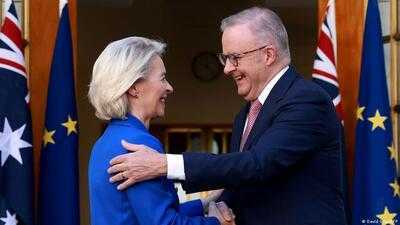
The European Union and Australia have agreed on a sweeping new trade deal, compromising to boost exports in the face of global uncertainty over trade.Australia and the European Union agreed on a new trade deal after eight years of negotiations. EU chief Ursula von der Leyen and Australian Prime Minister Anthony Albanese announced the agreement at a ceremony in the Australian capital, Canberra. It is the latest trade accord signed by the EU in a push to diversify trade as Europe faces challenges from the United States and China. Albanese and von der Leyen also agreed on a security and defense partnership. "The EU and Australia may be geographically far apart but we couldn't closer in terms of how we see the world," European Commission President Ursula von der Leyen said after meeting Prime Minister Anthony Albanese in Canberra. "With these dynamic new partnerships on security and defense, as well as trade, we are moving even closer together." Albanese called the deal a "significant moment" for Australia. The European Union is Australia's third-largest two-way trading partner and second-largest source of foreign investment. What is in the new EU-Australia trade deal? The agreement will remove over 99% of tariffs on EU goods exports to Australia, according to AFP news agency, cutting €1 billion ($1.16 billion) a year in duties for companies. Australian tariffs will drop to zero for wine, sparkling wine, fruit and vegetables and chocolates from day one and for cheeses over three years. European car makers will benefit from Australia raising the threshold for its luxury car tax on electric vehicles, with three-quarters of EVs will now becoming exempt. Australia will also lower tariffs on imports of critical minerals. The deal could see EU exports to Australia increase by 33% over the next decade, according to a European Commission press release, with daily, motor vehicles and chemicals seeing the strongest growth. Key sticking points on access to the EU market for Australian beef were overcome to reach the deal. For beef, the EU will open two tariff rate quotas of a total of 30,600 tons. This includes 55% percent of grass-fed beef entering duty free, while 45% will enter with a reduced duty of 7.5%. However, this will be phased in over five years to protect EU farmers. The local livestock industry was originally pushing for 50,000 tons a year tariff free, Australian media had previously reported. The EU will allow a quota of 25,000 tons of Australian grass-fed sheep and goat meat phased over seven years. EU to allow Australia to use protected names The negotiations had stalled in the past over the right of Australian wine and cheese producers to use names such as prosecco, parmesan and feta on locally made products. These are protected product names (known as Protected Designation of Origin) in the EU and can normally only be used on products coming from specific areas and made in a certain way. But Australia will be allowed to keep using some of geographical names, such as feta and gruyere, where producers have used it for at least five years. Australian winemakers will be allowed to make and export Italian-style sparkling wine under the label 'prosecco' but will have to stop using it for exports after 10 years. Australian Trade Minister Don Farrell said earlier in March that the trade deal would add 10 billion Australian dollars ($7.1 billion, €6 billion) in trade for Australia in the first year. The deal is expected to be formally signed after it is approved by the European Council and Australia's parliament. Edited by: Louis Oelofse
-
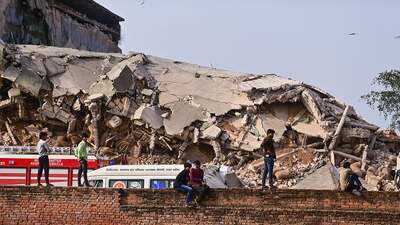
Cold storage collapse in Prayagraj kills 4, injures 14; ammonia leak triggered
-
Britain's most affordable town for families with £325pm mortgage payments has been named

-
Newlyweds Nupur Sanon, Stebin Ben steal a kiss under the Northern Lights on honeymoon

-
Two teenagers killed in fatal bus crash as community leaves tributes

-
Noel De Souza: The Unsung Indian Journalist in Hollywood