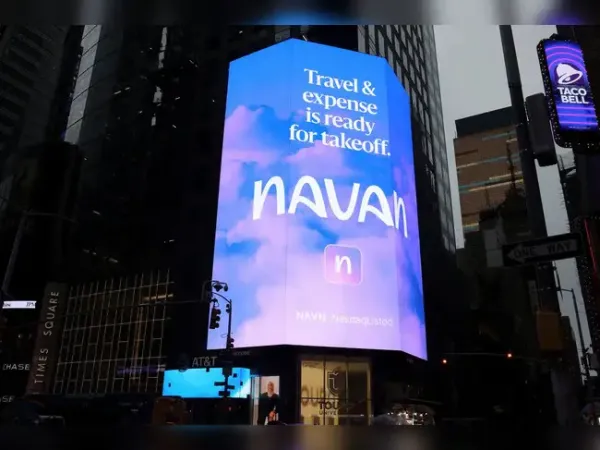
Corporate travel booking agency Navan on Wednesday forecast 2027 revenue above Wall Street estimates, banking on strong demand from on-boarding new company clients to its platform.
Shares of Navan rose over 21% in aftermarket trading.
The Palo Alto, California-based firm makes a bulk of its revenue from big enterprise customers, which includes companies in the AI & technology, manufacturing and health sectors.
In February, Navan signed on Yahoo, which selected the platform to integrate AI into the travel booking process and reduce its travel spend by 7% to 10%.
Navan expects 2027 revenue in the range of $866 million to $874 million, compared with analysts' average estimate of about $839 million, as per LSEG-compiled data.
"We are seeing a great return and very attractive payback on our sales and marketing investment," CFO Aurelien Nolf told Reuters, adding that it was going to remain a priority as Navan looks to onboard more clients over the next year.
Sales and marketing expenses during the fourth quarter ended January 31 more than doubled to $117.3 million from $57 million last year.
During the same period, gross bookings came in at $2.3 billion, up 42% from last year and above analysts' estimates of $2.14 billion.
Fourth-quarter revenue grew 34.7% to $178 million, above expectations of $162 million. It posted an adjusted per share profit of 2 cents for the reported quarter, compared to estimates of a loss of 12 cents.
Navan could also benefit from an increase in the cost of travel as oil prices spike due to the ongoing conflict in the Middle East.
"Navan earns more money when the cost of travel goes up, that's a fact," Nolf said. "Something like gas being more expensive would benefit us in the short term," he added.
The travel technology company debuted on Nasdaq at $22 per share in October at a valuation of roughly $5.9 billion. Since then, its value has fallen 61.3% to $8.51 per share as of Tuesday's close.
Shares of Navan rose over 21% in aftermarket trading.
The Palo Alto, California-based firm makes a bulk of its revenue from big enterprise customers, which includes companies in the AI & technology, manufacturing and health sectors.
In February, Navan signed on Yahoo, which selected the platform to integrate AI into the travel booking process and reduce its travel spend by 7% to 10%.
Navan expects 2027 revenue in the range of $866 million to $874 million, compared with analysts' average estimate of about $839 million, as per LSEG-compiled data.
"We are seeing a great return and very attractive payback on our sales and marketing investment," CFO Aurelien Nolf told Reuters, adding that it was going to remain a priority as Navan looks to onboard more clients over the next year.
Sales and marketing expenses during the fourth quarter ended January 31 more than doubled to $117.3 million from $57 million last year.
During the same period, gross bookings came in at $2.3 billion, up 42% from last year and above analysts' estimates of $2.14 billion.
Fourth-quarter revenue grew 34.7% to $178 million, above expectations of $162 million. It posted an adjusted per share profit of 2 cents for the reported quarter, compared to estimates of a loss of 12 cents.
Navan could also benefit from an increase in the cost of travel as oil prices spike due to the ongoing conflict in the Middle East.
"Navan earns more money when the cost of travel goes up, that's a fact," Nolf said. "Something like gas being more expensive would benefit us in the short term," he added.
The travel technology company debuted on Nasdaq at $22 per share in October at a valuation of roughly $5.9 billion. Since then, its value has fallen 61.3% to $8.51 per share as of Tuesday's close.