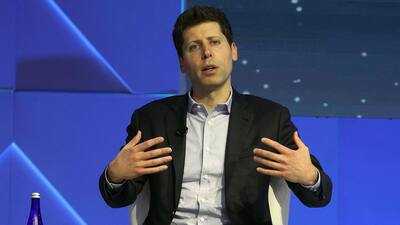
AI could soon be cheaper than human labor: Sam Altman
26 Mar 2026
OpenAI CEO Sam Altman has warned that artificial intelligence (AI) is on track to become cheaper than human labor.
In an interview with Forbes, he explained that the cost of operating AI models at the 'inference' stage, when they produce outputs, is already much lower than the energy needed for humans to do similar intellectual work.
AI's efficiency and future improvements
Cost comparison
Altman challenged the usual comparisons that stack AI's training costs against human effort.
He noted that human intelligence takes decades of biological 'training' and energy consumption over a lifetime.
On a per-unit basis of intellectual output, he said, AI systems are becoming highly efficient and this efficiency is only going to improve further.
The impact of AI on jobs
Energy concerns
Altman also warned that despite AI being cheaper per task, its widespread use could increase total global energy consumption.
He said the technology will have a 'big impact' on jobs, but not uniformly. Some roles will be partially automated while others may be completely transformed with new categories of work emerging, similar to past technological shifts.
Skills for the future
Skill evolution
Altman stressed the importance of adaptability, resilience, and fluency in using AI tools over narrowly focusing on coding as a universal skill.
He also highlighted resource allocation as an important aspect of AI's growth. A growing share of resources is now going toward 'inference,' or the continued use of AI, rather than initial model training.
India's dynamic AI market
Market dynamics
Altman described India as one of the most dynamic markets for AI adoption, saying the country is investing across the full stack from infrastructure to applications.
He said India is already OpenAI's fastest-growing market for its coding product and could soon become its largest.
However, he warned that delivering AI services costs more than traditional internet services, so companies will have to make such markets financially viable at scale.
Adapting education systems to tech shifts
Educational shift
On fears of AI making humans think less, Altman drew parallels with past tech shifts like search engines.
He said the real risk isn't the tech itself but whether education systems adapt.
If teaching methods don't change, students could become overly reliant on AI tools.
Altman also pointed to safety and privacy concerns as major roadblocks in adopting AI-powered personal agents widely.
-
Arsenal's full 12-player injury list as Mikel Arteta faces potential title race crisis

-
Of translation, transgression, and transcreation: A conversation on knowledge across languages
-
Spanish Para Badminton International 2026: Pramod Bhagat leads India's charge with one gold and two silvers

-
Thomas Skinners hits back at BBC with bombshell Question Time pay statement

-
Ram Gopal Varma questions film industry's loud silence on 'Dhurandhar 2' success