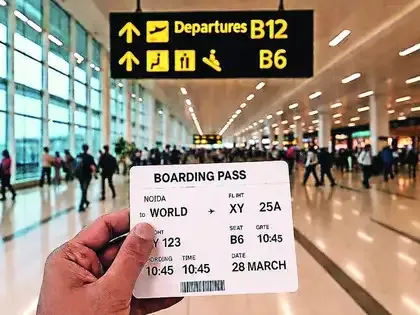
Today's inauguration of the first phase of Noida International Airport is being seen as a vital piece in India's effort to build its own transit hub. Indians are driving global aviation growth. But a large part of business is conducted overseas. Dubai and Singapore have served as India's gateways for a considerable amount of time, and bringing a transit hub onshore faces challenges deeper than the infrastructure build-up the Noida airport represents.
A transit hub runs on interlocking ecosystems of airports, airlines, aircraft maintenance and leasing, cargo handling, and retail. All of these have to come together at scale to create an aviation hub. India is essentially a traffic-originating market that is in the process of setting up capacities across each of these silos. And it's relying heavily on the private sector to step up.
Singapore, Doha and Dubai have achieved their market dominance through heavy state intervention in aviation. Governments there built strong airlines and large airports with public funds, which helped them to anchor international traffic to these destinations. It allowed for the consequential growth in logistics and aircraft maintenance capabilities. The countries strategically kept taxes on jet fuel low, and built domestic aircraft leasing capability. They negotiated hard for open skies, and developed tourism around transit.
Also Read: Land given, jobs pending- Jewar youths disillusioned as Noida airport nears launch
India, by contrast, is relying on the market to reach the same ends. Its airports are being built by private firms, some of them foreign - like Zurich International Airport, which will operate Noida International Airport as a subsidiary, Yamuna International Airport Private Limited (YIAPL). The country's principal airlines are privately owned, with strong overseas shareholding extending to strategic interest of Singapore Airlines in Tata-owned Air India. This creates a patchwork of ownership that will have to traverse a different path to airline-airport convergence.
IndiGo and Air India have placed large aircraft orders with Boeing and Airbus, and should be able to relocate maintenance facilities away from Dubai and Singapore. Onshore aircraft leasing, which is picking up in Gujarat's GIFT City, has a symbiotic relationship with MRO (maintenance, repair, operations/overhaul). But the bigger hurdle is the historical experience with repossessing aircraft from India's legion of failed airlines. The legal framework has been tweaked, but market perceptions will take time to alter.
Aviation turbine fuel (ATF) for international flights is exempt from central VAT, in line with global tax practice. But the elephant in the room is the diversity in state VAT on jet fuel for domestic flights. This has two market-distorting effects: one, it keeps domestic aviation uncompetitive. Two, states can leverage tax on jet fuel to get ahead in the airports game.Also Read: Here’s everything you need to know about Noida International Airport
Noida airport benefits from UP government's decision to tax ATF at 1%. Aircraft refuelling at Delhi's Indira Gandhi International Airport pay an eye-watering 25%. IGI Airport handles the biggest chunk of cargo traffic from the country, which will, by design, shift to the Noida airport less than 100 km away because existing capacity is under strain. Tax differential hastens the transition, and can be avoided if the Centre prevails on Delhi government to match UP's tax on jet fuel.
India's journey towards becoming a transit hub involves an unusually large number of stakeholders. Even the location of the first hub is up in the air - bets are split between Delhi and Bengaluru. These cities now have airports at distances that permit development of logistics and aeronautical services.
The US has four primary cargo hubs and three for passengers, each anchored by an airline. The numbers are similar for China, the world's second-biggest aviation market. India at third place will be replicating this model more than the city-state transit hubs that draw India's international traffic. This accounts for divergence in outcomes and, hence, methods. Some elements of the Dubai or Singapore models - such as retail - can be de-emphasised as India builds its own hubs.
How the various parts of Indian aviation come together will also be determined by geopolitical events. The airline industry is particularly prone to shocks and business downturns. There is additional drag of low-margin domestic aviation in the hub-and-spoke configuration.
The most pressing need is to claw back market share from foreign carriers. This limits India's options to open its skies while its airlines bulk up their fleets. Slow aircraft addition, with spillover effects on factors like training pilots in the country, reinforces the pricing power of West Asian carriers that are pushing for liberalised bilateral flying rights.
Finally, it's India's originating traffic pitted against the locational advantage of East Asia's and West Asia's transit hubs. Strong interest by foreign investors in every link in India's aviation value chain indicates the location factor can be neutralised. For that to happen, a lot of moving parts would have to fuse into a sophisticated piece of machinery.
A transit hub runs on interlocking ecosystems of airports, airlines, aircraft maintenance and leasing, cargo handling, and retail. All of these have to come together at scale to create an aviation hub. India is essentially a traffic-originating market that is in the process of setting up capacities across each of these silos. And it's relying heavily on the private sector to step up.
Singapore, Doha and Dubai have achieved their market dominance through heavy state intervention in aviation. Governments there built strong airlines and large airports with public funds, which helped them to anchor international traffic to these destinations. It allowed for the consequential growth in logistics and aircraft maintenance capabilities. The countries strategically kept taxes on jet fuel low, and built domestic aircraft leasing capability. They negotiated hard for open skies, and developed tourism around transit.
Also Read: Land given, jobs pending- Jewar youths disillusioned as Noida airport nears launch
India, by contrast, is relying on the market to reach the same ends. Its airports are being built by private firms, some of them foreign - like Zurich International Airport, which will operate Noida International Airport as a subsidiary, Yamuna International Airport Private Limited (YIAPL). The country's principal airlines are privately owned, with strong overseas shareholding extending to strategic interest of Singapore Airlines in Tata-owned Air India. This creates a patchwork of ownership that will have to traverse a different path to airline-airport convergence.
IndiGo and Air India have placed large aircraft orders with Boeing and Airbus, and should be able to relocate maintenance facilities away from Dubai and Singapore. Onshore aircraft leasing, which is picking up in Gujarat's GIFT City, has a symbiotic relationship with MRO (maintenance, repair, operations/overhaul). But the bigger hurdle is the historical experience with repossessing aircraft from India's legion of failed airlines. The legal framework has been tweaked, but market perceptions will take time to alter.
Aviation turbine fuel (ATF) for international flights is exempt from central VAT, in line with global tax practice. But the elephant in the room is the diversity in state VAT on jet fuel for domestic flights. This has two market-distorting effects: one, it keeps domestic aviation uncompetitive. Two, states can leverage tax on jet fuel to get ahead in the airports game.Also Read: Here’s everything you need to know about Noida International Airport
Noida airport benefits from UP government's decision to tax ATF at 1%. Aircraft refuelling at Delhi's Indira Gandhi International Airport pay an eye-watering 25%. IGI Airport handles the biggest chunk of cargo traffic from the country, which will, by design, shift to the Noida airport less than 100 km away because existing capacity is under strain. Tax differential hastens the transition, and can be avoided if the Centre prevails on Delhi government to match UP's tax on jet fuel.
India's journey towards becoming a transit hub involves an unusually large number of stakeholders. Even the location of the first hub is up in the air - bets are split between Delhi and Bengaluru. These cities now have airports at distances that permit development of logistics and aeronautical services.
The US has four primary cargo hubs and three for passengers, each anchored by an airline. The numbers are similar for China, the world's second-biggest aviation market. India at third place will be replicating this model more than the city-state transit hubs that draw India's international traffic. This accounts for divergence in outcomes and, hence, methods. Some elements of the Dubai or Singapore models - such as retail - can be de-emphasised as India builds its own hubs.
How the various parts of Indian aviation come together will also be determined by geopolitical events. The airline industry is particularly prone to shocks and business downturns. There is additional drag of low-margin domestic aviation in the hub-and-spoke configuration.
The most pressing need is to claw back market share from foreign carriers. This limits India's options to open its skies while its airlines bulk up their fleets. Slow aircraft addition, with spillover effects on factors like training pilots in the country, reinforces the pricing power of West Asian carriers that are pushing for liberalised bilateral flying rights.
Finally, it's India's originating traffic pitted against the locational advantage of East Asia's and West Asia's transit hubs. Strong interest by foreign investors in every link in India's aviation value chain indicates the location factor can be neutralised. For that to happen, a lot of moving parts would have to fuse into a sophisticated piece of machinery.
(Disclaimer: The opinions expressed in this column are that of the writer. The facts and opinions expressed here do not reflect the views of www.economictimes.com.)



Dipankar Bhattacharyya