Snow had settled heavily over Bishkek by the time we arrived, the Kyrgyz capital wrapped in a thick white blanket that seemed determined to mute whatever bustle the city might normally produce. Staring out of the hotel window that morning, we found ourselves confronted with a practical question that invariably arises sooner or later on any trip: what exactly does one eat in Kyrgyzstan?
The country's culinary traditions are shaped by its nomadic pastoral heritage and rely heavily on meat - especially mutton, beef, and horse - often accompanied by noodles, dumplings or broth. Having already travelled through several Central Asian countries over the past weeks, I could see that this might present a small complication.
My partner grew up vegetarian and can manage chicken when circumstances demand it. But red meat is unvaryingly a firm no. Pizza reliably appears wherever you go these days, and there is usually Chinese food somewhere in the vicinity. But we were hoping for something that felt at least a little more local. As long as it wasn't, strictly speaking, too local.
Unexpectedly, salvation appeared in the form of an excellent Japanese restaurant around the corner from the hotel. Stepping inside felt like entering a neighbourhood eatery in Wakayama or Hokkaido: cheerful welcomes of 'Irasshaimase!' greeted us at the door, while warm oshibori - small rolled hand-towels - were handed over with urgency given the freezing temperatures outside.
A quick scan of Google Maps revealed that Bishkek had also quietly accumulated a small constellation of Korean eateries, ranging from noodle houses to those specialising in a baffling variety of kimchi. Travelling almost non-stop, we have developed something of a talent for sniffing out precisely the opposite of what it means to sample local cuisine.
In Argentina and Paraguay, for instance, we somehow managed to locate remarkably authentic Korean restaurants in the most unlikely corners. In Peru, we found that long-standing migration from Japan had even resulted in an entire fusion cuisine of its own called 'Nikkei'. It blends Japanese techniques with Peruvian ingredients such as lime, chilli peppers and Pacific seafood. We happily alternated between sashimi and ceviche, never going hungry, while determinedly skipping skewers of anticucho, or beef heart.
Presence of Koreans in Kyrgyzstan traces back largely to a forced migration ordered by Stalin in 1937. Tens of thousands of ethnic Koreans living in the Russian far east were abruptly deported to Central Asia on suspicion that they might collaborate with Japan. Their descendants - 'Koryo-saram' (Korean people) - went on to become farmers, traders and urban professionals across Kazakhstan and Kyrgyzstan.
Japanese presence has a different origin. After the end of WW2, thousands of Japanese prisoners captured by the Soviet Union were transported to labour camps scattered across Central Asia, including Kyrgyzstan, where they were put to work on construction and infrastructure projects.
Stepping back out of the restaurant into the brittle cold of the evening, Bishkek presented itself in its most stripped-down form. Wide Soviet-era boulevards cut through low apartment blocks and marble government buildings, all framed by the distant, snow-capped wall of the Tien Shan mountains.
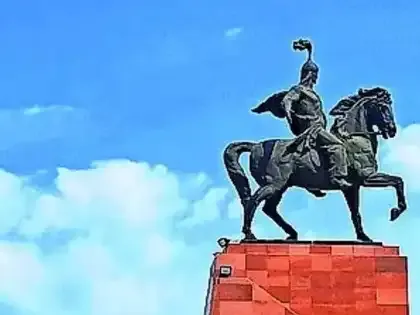
Trudging through the snow eventually brings one to the heart of the city: Ala-Too Square. Here, the open expanse is dominated by the towering statue of the national hero Manas, sword raised and cloak billowing. The vast Epic of Manas - allegedly even eclipsing the Mahabharat in length - tells the story of a warrior-leader who united the Kyrgyz tribes and defended them against foreign enemies.
Traditionally performed by specialist storytellers known as manaschi, we found one happily blasting lines at the night sky, stars blinking as if keeping pace with the rhythm of his recitation. Standing there listening to his lines, the meaning of which escaped us, did remind us of how the past is always present, and nothing is ever truly far away.
The country's culinary traditions are shaped by its nomadic pastoral heritage and rely heavily on meat - especially mutton, beef, and horse - often accompanied by noodles, dumplings or broth. Having already travelled through several Central Asian countries over the past weeks, I could see that this might present a small complication.
My partner grew up vegetarian and can manage chicken when circumstances demand it. But red meat is unvaryingly a firm no. Pizza reliably appears wherever you go these days, and there is usually Chinese food somewhere in the vicinity. But we were hoping for something that felt at least a little more local. As long as it wasn't, strictly speaking, too local.
Unexpectedly, salvation appeared in the form of an excellent Japanese restaurant around the corner from the hotel. Stepping inside felt like entering a neighbourhood eatery in Wakayama or Hokkaido: cheerful welcomes of 'Irasshaimase!' greeted us at the door, while warm oshibori - small rolled hand-towels - were handed over with urgency given the freezing temperatures outside.
A quick scan of Google Maps revealed that Bishkek had also quietly accumulated a small constellation of Korean eateries, ranging from noodle houses to those specialising in a baffling variety of kimchi. Travelling almost non-stop, we have developed something of a talent for sniffing out precisely the opposite of what it means to sample local cuisine.
In Argentina and Paraguay, for instance, we somehow managed to locate remarkably authentic Korean restaurants in the most unlikely corners. In Peru, we found that long-standing migration from Japan had even resulted in an entire fusion cuisine of its own called 'Nikkei'. It blends Japanese techniques with Peruvian ingredients such as lime, chilli peppers and Pacific seafood. We happily alternated between sashimi and ceviche, never going hungry, while determinedly skipping skewers of anticucho, or beef heart.
Presence of Koreans in Kyrgyzstan traces back largely to a forced migration ordered by Stalin in 1937. Tens of thousands of ethnic Koreans living in the Russian far east were abruptly deported to Central Asia on suspicion that they might collaborate with Japan. Their descendants - 'Koryo-saram' (Korean people) - went on to become farmers, traders and urban professionals across Kazakhstan and Kyrgyzstan.
Japanese presence has a different origin. After the end of WW2, thousands of Japanese prisoners captured by the Soviet Union were transported to labour camps scattered across Central Asia, including Kyrgyzstan, where they were put to work on construction and infrastructure projects.
Stepping back out of the restaurant into the brittle cold of the evening, Bishkek presented itself in its most stripped-down form. Wide Soviet-era boulevards cut through low apartment blocks and marble government buildings, all framed by the distant, snow-capped wall of the Tien Shan mountains.
Trudging through the snow eventually brings one to the heart of the city: Ala-Too Square. Here, the open expanse is dominated by the towering statue of the national hero Manas, sword raised and cloak billowing. The vast Epic of Manas - allegedly even eclipsing the Mahabharat in length - tells the story of a warrior-leader who united the Kyrgyz tribes and defended them against foreign enemies.
Traditionally performed by specialist storytellers known as manaschi, we found one happily blasting lines at the night sky, stars blinking as if keeping pace with the rhythm of his recitation. Standing there listening to his lines, the meaning of which escaped us, did remind us of how the past is always present, and nothing is ever truly far away.
(Disclaimer: The opinions expressed in this column are that of the writer. The facts and opinions expressed here do not reflect the views of www.economictimes.com.)





Michiel Baas
The writer is author of Muscular India: Masculinity, Mobility & the New Middle Class