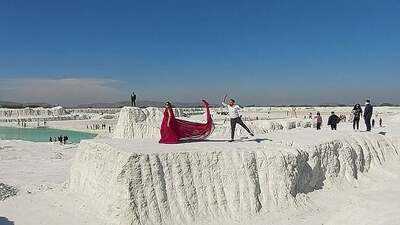
A marble waste dumping yard in Rajasthan’s Ajmer district, known for its striking white landscape and growing popularity among tourists, has come under scrutiny from environmental experts and researchers who have flagged it as a potential health hazard.
Located in Kishangarh, the site — spread over about 350 acres — receives marble slurry waste from more than 1,200 cutting units in the region. According to estimates, over 700 tankers discharge around 22 lakh litres of slurry at the site every day, drawing between 5,000 and 20,000 visitors daily depending on weekends and holidays.
The dumping yard has gained attention on social media and is often compared by visitors to destinations such as Bolivia’s salt flats or snow-covered landscapes, leading to its emergence as a hub for pre-wedding and commercial shoots.
Environmental concerns flaggedResearchers at the Central University of Rajasthan have described the site as a “toxic tourist destination”, citing findings from scientific studies on its environmental and health impact.
According to Laxmi Kant Sharma, an environmental science professor at the university, the dumping yard operates without key safeguards such as engineered liners, dust suppression systems or groundwater monitoring mechanisms.
He said studies have recorded total dissolved solids in nearby water sources at levels up to 10 times above safe limits within a 6-km radius. Elevated concentrations of lead silicate in soil and nitrate and fluoride in water have also been reported, indicating significant contamination.
Air quality concerns have also been flagged, with particulate matter (PM2.5) levels exceeding prescribed standards. Experts said the fine particles, often smaller than 75 micrometres, can spread over large distances and affect soil fertility and human health.
Sharma said prolonged exposure could increase the risk of respiratory conditions, including silicosis, and called for immediate intervention to prevent further environmental degradation.
The Aravallis — Defining an eco-system with a tape measureThe site has evolved into a tourism destination over the past decade, with organised access and commercial activities managed by the Kishangarh Marble Association.
Visitors are required to obtain entry passes, with charges applicable for photography and commercial shoots. Facilities such as changing rooms, restaurants, recreational zones and a helipad have been developed at the site.
Kishangarh Marble Association president Sudhir Jain said the revenue generated is used for maintenance and infrastructure. He added that no health-related complaints from tourists have been formally reported and that the association is complying with guidelines issued by authorities.
The issue has also been taken up by the National Green Tribunal, which constituted a joint committee involving state and central pollution control bodies to examine the environmental impact of the dumping yard.
Ground reality and local impactDuring a visit to the site, visitors, including children, were seen without protective gear despite visible dust in the air. Individuals managing on-site activities were observed covering their faces with cloth, while marble dust was seen settling across the area.
Farmers in nearby villages such as Tokra, Bhojiyawas and Rahimpura said marble dust frequently settles on agricultural land and mixes with irrigation water, affecting crop yields.
One farmer said slurry overflow had rendered parts of his field unfit for cultivation, forcing him to seek alternative sources of income.
Policy response and political viewKishangarh MLA Vikas Chaudhary said the dumping yard is being maintained by the industry and has contributed to the region’s visibility as a tourist destination.
He added that while newer machinery has reduced waste generation, authorities remain open to addressing environmental or health concerns if substantiated.
The dumping yard traces its origins to the 1980s, when the Rajasthan State Industrial Development and Investment Corporation allotted land for marble waste disposal. Over decades, accumulated slurry formed large white plateaus and mounds, giving the site its current appearance.
The location gained wider public attention after being featured in film and music shoots, contributing to its rise as a social media-driven tourist attraction.
Legal and environmental scrutiny continues, with experts emphasising the need for regulatory oversight as visitor numbers increase and ecological concerns persist.
Illegal mining can cause irreversible damage: SC to set up expert panel on Aravallis-
Eamonn Holmes and Ruth Langsford debt woes as joint account racks up six-figure debts

-
Photos: Horses, hats and royals at the 30th edition of Dubai World Cup

-
Illegal Protein Supplement Factory Uncovered in Delhi: One Arrested
-
After 8 golds and a silver at KITG 2026, Karnataka swimmer Manikanta L aims for Asiad qualification

-
Two Odisha achievers find mention in PM Modi's 'Mann Ki Baat'; CM Majhi expresses gratitude