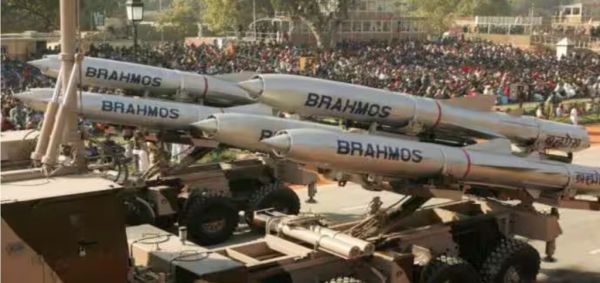
The Indian Army is planning to significantly enhance its long-range strike capabilities. For this, it is going to acquire an extended-range variant of **BrahMos** supersonic cruise missile, which will have a range of more than **800 km**. Defense sources told ANI that this upgrade will almost double the current operational range (over 450 km) of the BrahMos system already with the Army. A decision on this proposal is expected soon; This requirement will be discussed and possibly approved in a high-level meeting of the Defense Acquisition Council (DAC) or the Defense Ministry.
This step has been taken keeping in mind the lessons learned from recent conflicts, including **the confrontation between India and Pakistan under ‘Operation Sindoor’ in May 2025**. During this operation, BrahMos missiles—which were primarily launched from Su-30MKI fighter aircraft—were used effectively against Pakistani targets (including airbases and their associated infrastructure). This proved the combat capability of this system in a real war situation. Later, Defense Minister Rajnath Singh described the operation as “just a trailer”. He said that for India, “victory has now become a habit” and “every inch of Pakistan’s territory is now within the reach of BrahMos.” He stressed the need to further strengthen the capabilities of the army.
The emphasis on long-range precision strike weapons is also influenced by the ongoing conflicts in West Asia—particularly the US-Israel-Iran equation—which have underlined the importance of ‘stand-off strike’ options. Along with the upgrade of BrahMos, the Indian Army is also restructuring its military structure on a large scale. This includes the inclusion of special drone regiments and platoons in artillery and infantry troops; Increasing production of indigenous drones in army workshops; and exploring the possibility of creating a dedicated missile force.
Indigenization (manufacturing in the country) has continued to increase in the manufacturing of BrahMos, a joint venture between India and Russia; Now most of the work in the final phase of its construction is done in India only. This not only gives India strategic autonomy (freedom to take its own decisions), but also maintains its advanced supersonic speed and accuracy.
This variant with increased lethality will provide the Army with the capability and flexibility to penetrate deeper into enemy territory against changing threats. This will further strengthen India’s deterrent capability (ability to prevent the enemy from attacking) on sensitive borders. Officials consider this an important step towards modernizing the army’s firepower amid changing battlefield conditions. No final contract has been signed yet, but the chances of this proposal being approved seem quite strong.
-
Mann Ki Baat: Amritsar man lauded by PM Modi for preserving manuscripts

-
Divya Dutta ecstatic about IFFD 2026 in Delhi, calls it a ‘deja vu’

-
IPL 2026: Rahane’s fifty powers KKR to a massive 220/4 against MI

-
‘Big thanks’: Centre’s PNG push gets boost as 6000 consumers give up LPG for piped natural gas

-
‘Why this happens only when Mumbai is playing?’: Fans outrage as toss controversy hits MI vs KKR clash