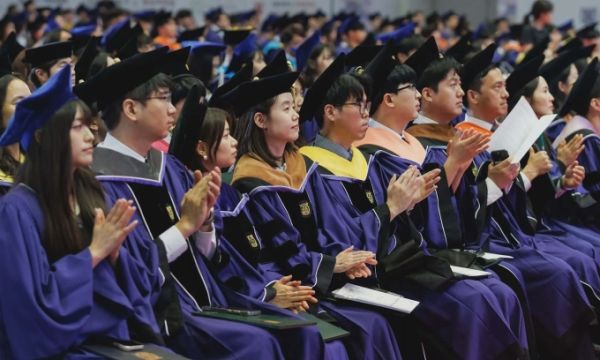
Data from the Korea Education Statistics Service under the Korean Educational Development Institute (KEDI), released in mid-March, showed the number of new doctorates awarded in 2025 was up 51.6% from a decade earlier and the highest since tracking began in 1999.
Yet among the 7,005 newly minted PhDs who found employment, 10.4% reported earning less than 20 million won ($13,400) a year, up from 6.3% in 2011, with the real decline steeper after inflation.
The wage problem is concentrated outside science and technology. Arts and humanities had the highest share of low-paid PhD holders at 26.8%, followed by education at 19% and social sciences, journalism and information studies at 14.9%, the KEDI data showed. Agriculture, forestry and fisheries recorded 11.1%, while services stood at 10.6%.
That pattern is particularly relevant for the tens of thousands of Vietnamese pursuing degrees in South Korea, where they now form the single largest group of international students. Vietnam overtook China in 2025 as the top source country, with 107,807 students enrolled as of August, according to Korea Immigration Service data reported by The Korea Times.
By January 2026, that figure had climbed to nearly 116,000, or 37.9% of all foreign students in the country, according to the Ministry of Justice.
The surge has been driven by government recruitment under Seoul’s “Study Korea 300K” initiative, which eased visa requirements, expanded scholarships and lowered financial thresholds for foreign students.
South Korea hit its target of 300,000 international students in mid-2025, nearly two years ahead of schedule.
But the fields international students are entering mirror the ones where Korean PhD holders are struggling most. STEM majors account for just 19% of all international students in South Korea, The Korea Times reported, meaning the vast majority are concentrated in humanities, social sciences and other non-STEM disciplines where doctoral employment prospects are weakest.
The outlook for foreign graduates who do earn advanced degrees is even bleaker than for their Korean peers. A report from the Korea Research Institute for Vocational Education and Training (KRIVET) found that only 48.9% of foreign STEM PhDs in Korea secured employment, compared with 58.3% of domestic graduates.
Among those who found work, 73.1% ended up in postdoctoral research positions, which are typically temporary and low-paying, The Korea Herald reported. The income gap was stark: just 7.8% of foreign PhDs earned more than 50 million won ($33,500) a year, compared with 42.7% of Korean PhDs.
Financial pressures are also building earlier in the pipeline. The share of foreign PhD students receiving scholarships fell from 83.1% in 2017 to 71.2% in 2023, while self-funded tuition nearly doubled over the same period, the KRIVET report showed.
Visa complications add another layer. A Korea Herald investigation published in December found that rigid sponsorship rules and employer unfamiliarity with the paperwork effectively shut many foreign graduates out of the job market.
Do Ngoc Minh Luong, a Vietnamese computer science graduate from Seoul National University, told the paper that companies she interned at struggled with the documentation required to hire foreign employees.
“I feel like Korean companies don’t really know much about the visa process,” she said.
Song Chang-yong, a senior research fellow at KRIVET, noted that the domestic labor market can absorb only about 2,000 to 3,000 PhD-level positions each year, mostly in science and engineering.
“There are also a considerable number of people whose goal is the doctorate degree itself, so the low-wage problem of PhD holders should be interpreted by considering multiple complex factors,” he told The Korea Times.
Professor Kwon Sang-uk of Kyungpook National University said a university degree in South Korea no longer guarantees employment, and that the rush to pursue higher credentials has created a “credential surplus,” according to the Hankook Ilbo.
The mismatch poses a dilemma for Vietnamese families investing heavily in Korean education.
South Korea now enrolls more Vietnamese students than Canada and the U.S. combined, according to ICEF Monitoran international education industry tracker. Yet the system recruiting them is simultaneously producing more graduates than its own labor market can absorb, particularly in the non-STEM fields where most international students are concentrated.
Women drove much of the recent PhD growth, accounting for a record 43.5% of new doctoral recipients in 2025 with 8,629 graduates, up from 20.5% when KEDI began tracking in 1999, a more than sevenfold increase over the past 26 years.
South Korea produced just 5,586 doctorates in 1999. That number surpassed 10,000 in 2010 before nearly doubling again over the following 15 years.
-
Rupee Seen Bouncing Up as RBI Extends Safety Net Below
-
Bajaj Finserv plans AI-only fund, direct bets in concert: Sanjiv Bajaj, Chairman & MD

-
UPI cleanup drive: Govt asks banks, NPCI to curb failures, boost success rates

-
Microfinance sector back on track with higher-value loans

-
Factories firing on all cylinders as LPG supply eases