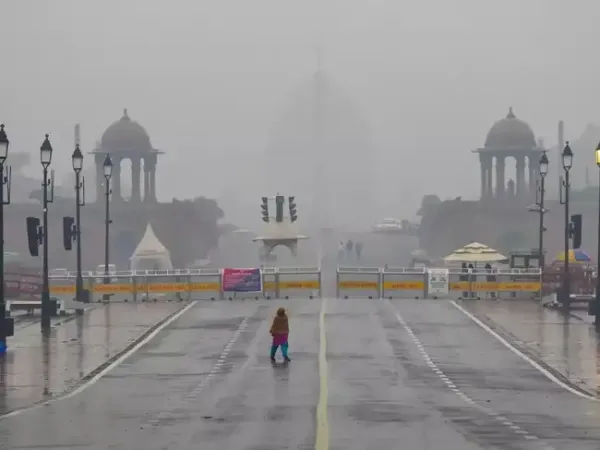
Very light rain or drizzle is expected across Delhi-NCR on Tuesday, according to the India Meteorological Department (IMD). The region is likely to witness a generally cloudy sky with intermittent weather activity through the day.
Rainfall is expected during the afternoon or evening hours, possibly accompanied by thunderstorms and gusty winds.
Thunderstorms and gusty winds forecast by IMD
The IMD has predicted wind speeds of 20–30 kmph, with gusts reaching up to 40 kmph. A yellow alert has been issued, warning residents of sudden weather changes, thunderstorms and lightning activity across Delhi-NCR.
Recent rainfall prompts weather alerts
The advisory follows rainfall and strong winds witnessed across Delhi-NCR on Monday. Initially, light showers were forecast, but conditions intensified, prompting the IMD to upgrade its alert from yellow to orange.
The orange alert indicated moderate rain, lightning and stronger winds, and remained in effect until 6 p.m. on Monday.
Cloudy skies with intermittent sunshine likely
For Tuesday, the IMD expects scattered light rainfall with mostly cloudy skies and brief sunny intervals. Residents are advised to remain cautious during periods of strong winds and thunderstorms.
Western disturbance driving Delhi-NCR weather
The current weather conditions are being influenced by a western disturbance over north Iran and the Caspian Sea region, along with cyclonic circulation over northwest Rajasthan.
Another western disturbance is expected around April 2, which may bring very light rainfall to Delhi-NCR on April 3 and 4.
The IMD has also warned of dust storms followed by thunderstorms, light rain and strong winds of 60–80 kmph in parts of Haryana and Rajasthan, including areas such as Farukhnagar, Rewari, Narnaul and Bhiwadi.
Air quality in Delhi-NCR likely to improve temporarily
Rainfall and stronger winds are expected to bring temporary relief to air pollution levels in Delhi-NCR by dispersing pollutants.
Past trends show that even light showers can improve the Air Quality Index (AQI) in the short term, although levels often remain in the “poor” to “very poor” category, indicating only partial and temporary relief.
Inputs from agencies
Rainfall is expected during the afternoon or evening hours, possibly accompanied by thunderstorms and gusty winds.
Thunderstorms and gusty winds forecast by IMD
The IMD has predicted wind speeds of 20–30 kmph, with gusts reaching up to 40 kmph. A yellow alert has been issued, warning residents of sudden weather changes, thunderstorms and lightning activity across Delhi-NCR.Recent rainfall prompts weather alerts
The advisory follows rainfall and strong winds witnessed across Delhi-NCR on Monday. Initially, light showers were forecast, but conditions intensified, prompting the IMD to upgrade its alert from yellow to orange.The orange alert indicated moderate rain, lightning and stronger winds, and remained in effect until 6 p.m. on Monday.
Cloudy skies with intermittent sunshine likely
For Tuesday, the IMD expects scattered light rainfall with mostly cloudy skies and brief sunny intervals. Residents are advised to remain cautious during periods of strong winds and thunderstorms.Western disturbance driving Delhi-NCR weather
The current weather conditions are being influenced by a western disturbance over north Iran and the Caspian Sea region, along with cyclonic circulation over northwest Rajasthan.Another western disturbance is expected around April 2, which may bring very light rainfall to Delhi-NCR on April 3 and 4.
Neighbouring regions to see dust storms and heavy winds
The IMD has also warned of dust storms followed by thunderstorms, light rain and strong winds of 60–80 kmph in parts of Haryana and Rajasthan, including areas such as Farukhnagar, Rewari, Narnaul and Bhiwadi.Air quality in Delhi-NCR likely to improve temporarily
Rainfall and stronger winds are expected to bring temporary relief to air pollution levels in Delhi-NCR by dispersing pollutants.Past trends show that even light showers can improve the Air Quality Index (AQI) in the short term, although levels often remain in the “poor” to “very poor” category, indicating only partial and temporary relief.
Inputs from agencies