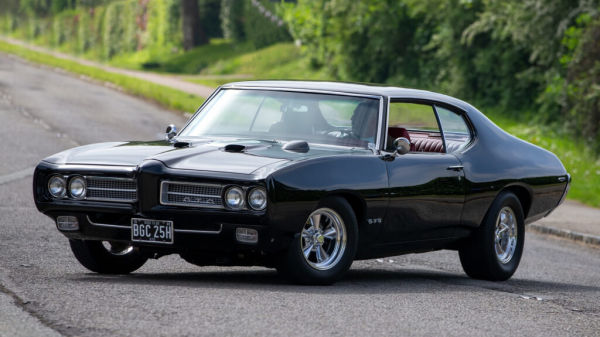
If you were to say the term American muscle car, a Pontiac GTO will certainly spring to a lot of people’s minds, and for good reason. Originally a trim level of the 1964 Pontiac Tempest, the GTO nameplate, which stands for Gran Turismo Omologato (Grand Touring Homologation in Italian) became synonymous with big power in a modest package. Arguably, it started the whole muscle car trend, debuting before giants like the Mustang, Charger, and more. It had the muscle to back it up as well, with later examples boasting either a 400 or 455 cubic inch engine in top trim, with various options such as the famous Ram Air intake, characterized by its hood scoop.
Power figures are impressive for the time, boasting 360 hp and 500 lb-ft torque with the 455 big block, or 370 hp and 445 lb-ft torque with the Ram Air 400 in 1970. But how fast was it, really, in comparison to its peers? It’s hard to say in pure mathematical terms because of the variables; different magazines and journals list varying times, ranging from 14.6 at 99.6 mph to 13.6 at 104.5 mph with the 400 Ram Air and manual, the fastest configuration. The 455 was slower still, dropping down to 15 seconds.
Quite a few cars could certainly hang with the GTO, and more still could exceed it. For this article, we’ll take a look at the original GTO’s fastest year of 1970 and measure it against all muscle cars built up to that point, so nothing post-1970, and no special models like the Super Stock Hursts or Yenkos — these are common production cars only. Let’s kick it off.
1970 Dodge Challenger R/T 440 Six Pack: 13.6 @ 105 mph
Our opening car already matches the GTO’s best recorded time, and beats the 455 by over a second at the line, a massive length in drag racing terms: 1970 was the debut year of the Dodge Challenger. Made famous by its starring role in the hit movie “Vanishing Point,” the 1970 Dodge Challenger, in this case a 400 Six Pack-equipped R/T trim, is one of the most iconic muscle cars ever made, though its status is somewhat deceptive; Challengers are actually pony cars.
Pony cars are smaller vehicles, in this case built on the Chrysler E-body, a crucial point when talking about power/weight ratio. This 1970 Dodge Challenger R/T houses the same engine as the midsize and full-size muscle cars, but the ’69 Charger R/T 440 weighing 3,900 pounds, whereas the ’70 Challenger comes in at 3,395 pounds. With less weight and a smaller profile to move through the air, the Challenger will naturally be the faster of the two body styles, and certainly as fast or faster than the GTO.
The 440 Six Pack does all the heavy lifting here, of course, boasting 375 hp and 480 lb-ft torque. Much like the 455, these were large, powerful engines designed for cruising; Winnebago motorhomes used these engines, for example, albeit with different accessories and tunes. When you take that engine, give it three carbs and some performance upgrades, and shove it into a car the size of a Challenger, it’s no wonder they exceed the GTO’s figures.
1970 Ford Mustang BOSS 429: 13.6 @ 114 mph
Here’s another car with a bit of a spotty drag racing record; Motor Trend actually tested their own ’69 Boss 429 and got a blistering 12.3-second quarter mile time at 112 mph. For these purposes, let’s use the worst-case scenario — a 1970 model year, same engine, running a 13.6 at 114. And that shouldn’t be all too surprising, because here we have an example of another smaller car with a massive engine shoved under the hood.
Originally, the Mustang didn’t even have a big block at all; the Mustang is one of the progenitors of the term pony car — smaller, more nimble cars with small block V8s like the 289 Ford or 350 Chevy in the Camaro. That changed in 1967, when Ford introduced the 390 option for the Mustang. The company continuously experimented with the design over the next couple of years, and while the 1970 car shares the same basic architecture as the original, their bodies are very different — as are their engines.
The 429 cubic-inch big block is, ostensibly, a racing engine. In fact, the Boss 429 itself was designed to compete in NASCAR. A little-known fact is that the 429 actually uses a hemispherical combustion chamber, like the legendary 426 HEMI engine from Mopar; this configuration allows for extremely efficient combustion processes, especially at rev ranges expected in racing, making this engine particularly well-suited to high-speed runs. It’s believed that Ford underrated the engine at 375 hp and 450 lb-ft torque, which — coupled with the Mustang’s slim profile — made for an extremely potent muscle car.
1970 Buick GS / GSX Stage 1: 13.38 @ 105.5 mph
With 360 hp and a whopping 510 lb-ft torque, the 1970 Buick GS Stage 1 rips up a quarter-mile track at 13.38 seconds, according to Motor Trend’s January 1970 issue. This one’s a bit conflated, however; the same car was also tested over at Hot Rod Magazine in November 1969, reaching the finish line after 14.40 seconds at 96 mph, albeit with the automatic. Being that the manual is faster for both the GTO and GS Stage 1, we’ll use those times instead for consistency.
Most people probably don’t say Buick and high-performance in the same breath anymore, but that wasn’t true in 1970. In fact, the GS Stage 1 was one of the fastest muscle cars on the market — and much like the previous entry, the GS and GSX special-edition were midsize, built on the same A-body platform as the GTO, Chevelle, Olds 4-4-2, and so on. The fastest Olds 4-4-2, a 1966 model with the W-30 and manual accomplished a 13.8-second time, making it about on-par with the GTO. This makes the Buick GS the second-fastest GM-platform in the quarter-mile run.
The engine used by the GS Stage 1 was the 455 cubic inch (7.4-liter) big block, among the most powerful Buick engines ever produced, and it was also Buick’s biggest ever V8 fitted to a production car. While it doesn’t have the same power rating as some others on this list, that engine more than makes up for it in raw torque, especially with the close-ratio Muncie 4-speed it was often paired with.
1970 Chevrolet Chevelle SS 454: 13.12 @ 107.01 mph
Arguably the first true mid-size car on this list, the 1970 Chevrolet Chevelle SS 454 is yet another iconic muscle car, wearing its classic Le Mans racing stripes and SS badging. Moreover, the LS6 engine option code bumped up power to 450 horsepower and 500 lb-ft torque, more power than anything else on this list, at least in terms of factory ratings. This produced rapid times frequently teasing the low-13 second mark, with Hot Rod attaining a respectable 13.44 @ 108.17 mph in their best run, for instance.
The 1970 Chevelle SS came in several different variants, each with their own power and top speed figures, ranging from the entry-level L34-code 396 ci unit with 350 hp, up to the infamous LS6. LS6-powered Chevelles are sometimes referred to today as the king of muscle cars, directly competing with the likes of the infamous 426 HEMI, the 428 Cobra Jet, and more. Much like the 429, the LS6 was a bespoke high-performance engine, sporting an 11.25:1 compression ratio, aggressive solid-lifter camshaft, aluminum pistons, and more, topped off with a thirsty 800 cfm (cubic feet per minute) Holley carburetor. All that runs through a Muncie M-22 Rock Crusher transmission.
In short, the LS6-powered Chevelle is the 1970 equivalent of a supercar today, though it’s decidedly less refined than one. According to Motor Trendthe transmission is noisy and unrefined, the engine unhappy on unleaded gasoline due to its high compression ratio, and it’s almost impossible to drive hard without spinning tires if you’re running regular street rubber. It’s decidedly specialized for one purpose — going fast, and it does that very well, indeed.
1970 Plymouth Barracuda 426 Hemi: 13.10 @ 107.1 mph
It should come as no surprise that the top spot is secured by a Hemi, an engine that needs no introduction to drag racing enthusiasts. In truth, the infamous Elephant Block could likely accommodate several spots on this list, but the fastest among them, at least according to Car Craft magazine, is the 1970 Plymouth Hemi ‘Cuda. Much like Ford’s 429, the 426 Street Hemi is widely rumored to have a significantly underreported horsepower rating throughout its production run — an impressive 425 hp and 490 lb/ft torque, so says Chrysler.
This was a massive, racing-oriented engine that just barely fit in a lot of these cars; getting hemi heads on the block required a lot of real-estate, one reason why you don’t see them too often. The option itself cost an eye-watering $900, or over $7,500 today — basically you have to buy a third of the car over again at the dealership. But what you get is, for all intents and purposes, the closest thing to a factory-built racecar without crossing the line into specialist vehicles. The A-body Barracuda was built with this in mind, being an early example of a hero sports car alongside its sister Dodge Challenger.
To put it into perspective, the already (supposedly) underrated 426 Hemi can launch the infamous Hurst Hemi ’68 Barracuda deep into 10-second times at over 120 mph. That same engine, albeit tuned for street use, propels the 1970 Hemi ‘Cuda over a second and a half faster than the GTO down the strip. With its light weight and massive performance, it’s simply no contest for the Pontiac at this stage.