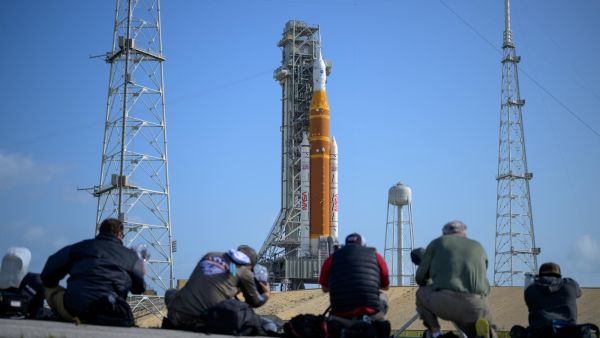
The countdown has begun for Mission Artemis II, the US attempt to resume its manned journey, after 54 years, to the Moon on April 1, from the Kennedy Space Center, Cape Canaveral Space Force, on Florida’s Atlantic coast.
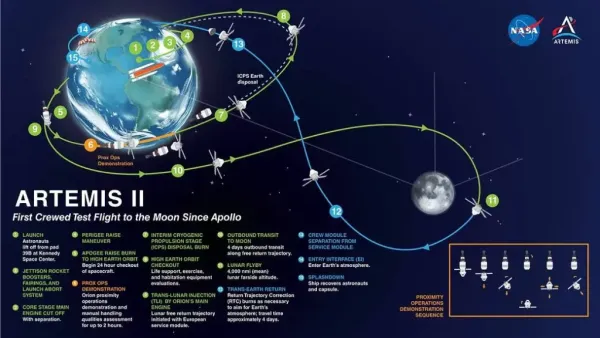
The effort by the National Aeronautical and Space Administration (NASA) will be to send four astronauts on a 10-day journey to circle the Moon without landing or entering orbit. The team is unique in the sense that it consists of the first woman astronaut, Christina Koch, Victor Glover, the first person of colour, and Jeremy Hansen, the first non-American.
Though India is not part of the Artemis programme, it has signed the Artemis Accords as the 27th nation with the US to continue civil exploration and use of outer space for advancing the overall programme. The Indian Space Research Organisation (ISRO), which is spearheading India’s Chandramana (moon mission), will be keenly following the Artemis II mission.

After the lift off from the Kennedy Space Center, the Artemis II crew will travel about 5,000 miles beyond the far side (South Pole), reaching farther from Earth than any human in history. After achieving this, the spacecraft will return to Earth for a high-speed splashdown into the Pacific Ocean.
It will be a historic moment as it will mark the return of the US to the Moon after half a century since the last crewed lunar mission, Apollo 17. The astronauts will be witnessing the Moon’s far side from a distance no Apollo crew ever reach. This will signal the beginning of a new era of lunar exploration.
Artemis: The Greek connection
Artemis is the Greek goddess of the Moon, wilderness and hunting. She is also the twin sister of Apollo, who is associated with the Sun, light and reason. Apollo and Artemis are children of the Greek god Zeus and Leto.
By carefully naming the programme Artemis, NASA is conveying a continuity in its Moon and outer space ambitions. It would be pertinent to recall that the US lunar mission during 1960-72 was christened Apollo.
The first human landing – by astronauts Neil Armstrong and Buzz Aldrin – was achieved by Apollo 11 on July 20 1969. Thereafter, a total of 12 US astronauts walked on the Moon’s surface up to 1972. The final crewed mission of Apollo 17 was in December 1972, with Gene Cernan being the astronaut to land.
The Artemis programme was launched by NASA in 2017 with the ultimate goal of sustained exploration of the red planet, Mars. In 2022, Artemis I demonstrated the successful unmanned test flight of the space launch system (SLS) and the Orion spacecraft.
The overall Artemis programme has five missions. The Artemis V is scheduled for late 2028 with the SLS rocket, while the Artemis IV intends to land astronauts in early 2028 on the south side of the Moon. Plans are afoot to build infrastructure that includes a space station in lunar orbit.
Under the Artemis program, a major objective of the Moon mission is aimed at scientific discovery, economic benefits and inspiration for a new generation of explorers. The intention is also to build global alliances and explore deep space for the benefit of all, according to NASA.
India a key player
India is the first country to land on the south side of the Moon through its Chandrayaan-3 mission in August 2023. Significantly, Chandrayaan-1, the Moon impact probe (MIP), launched in 2008, discovered the presence of “trapped water in ice” on the lunar south pole side.
After its presence was confirmed by NASA a few years later, the region started attracting a lot of attention. The successful landing of Chandrayaan-3 has accelerated the quest, with China, Israel, Japan and the US joining the race. Chandrayaan-4, which is under development, will have a 9,200 kg satellite. The mission involves sample collection and further experiments at the south pole.
The mission’s complexity and scale will highlight ISRO’s growing lunar exploration capabilities, with four modules travelling to the Moon’s orbit and two landing on the surface.
One of the big draws to the south pole is the presence of water ice trapped in lunar craters. It can potentially be converted to potable water, oxygen and, perhaps, rocket fuel. This can help in habitation and infrastructure creation for undertaking and sustaining long-term and deep space explorations in the future, feel space scientists. Billionaire Jeff Bezos’ space company, Blue Origin, unveiled plans to build a space station on the Moon, too.
Even while pursuing its own Moon mission and outer space exploration, India signed the Artemis Accords in June 2023. They are a practical set of principles, guidelines and best practices to enhance the governance of the civil exploration and use of outer space with the intention of advancing the Artemis programme.
India has outlined its own ambitious vision for space exploration under its Space Vision 2047. This includes missions such as Chandramana series for lunar exploration and Gaganyaan continuation programme (sending humans to space) that would lead to its own space station, Bhartiya Antariksha Station, reflecting India’s vision for advancements in space exploration, according to Dr Jitendra Singh, Union Minister of State for Space, Earth Sciences.
However, ISRO will explore the possibilities of participation in the Artemis programme in the future. India’s partnership with the US has been increasing in recent years.
In June 2025, Indian astronaut, Group Captain Shubhanshu Shukla, flew aboard Crew Dragon of SpaceX during the ISRO-NASA joint mission to the International Space Station (ISS) under the Spaceflight Agreement with Axiom Space INC. He was the mission pilot for the 14-day scientific mission, which conducted experiments, including those of ISRO. He became the second Indian to travel to space after Squadron Leader Rakesh Sharma’s 1984 mission on Soyuz T-11.
In July 2025, the NASA-ISRO Synthetic Aperture Radar (NISAR), a joint Earth observation project, was successfully launched from the SHAR Centre in Andhra Pradesh’s Sriharikota by the GSLV F16 of the ISRO. It will map the entire Earth’s surface in 12-day cycles over five years and provide high-resolution data useful for studying natural disasters, climate change, ice mass, etc.
-
'A Spin Masterclass': R Ashwin Breaks Down Yuzvendra Chahal's Magic Ball To Jos Buttler In IPL 2026; Spinner REACTS

-
RCF T20 Tournament 2026: Automotive Manufacturers Cruise To 7-Wicket Win; Jain Irrigation Register 4-Wicket Victory

-
National 9-Ball Pool: Shruthi Beats Natasha For Junior Girls Title; Aarav Sancheti Wins Boys’ Crown
-
Sikkim State Lottery Result: April 1, 2026, 6 PM Live - Watch Streaming Of Winners List Of Dear Regal Wednesday Weekly Draw
-
All India Chess Masters Season 3: Palaash Mapara Wins 5th Straight Game, Takes Sole Lead