India’s electric two-wheeler (e2W) market posted close to 22% jump year-on-year in FY26, with most legacy players and startups gaining market share at the cost of Ola Electric that led the segment until the previous year.
Retail sales of e2W crossed 1.35 million units last fiscal against 1.11 million units in FY25, despite production challenges arising from a shortage of rare earth metals, according to registrations data from the government-run Vahan portal.
Bengaluru-based Ola Electric sold only 10,118 vehicles in March, accounting for 5.4% market share, a sharp decline from the 22.1% share it held in April 2025. For FY26, the Bhavish Aggarwal-led EV maker sold 164,000 vehicles, less than half of 344,000 units it sold in FY25.
The market is now dominated by legacy players Bajaj Auto and TVS Motor that reported robust growth in volumes through the year.
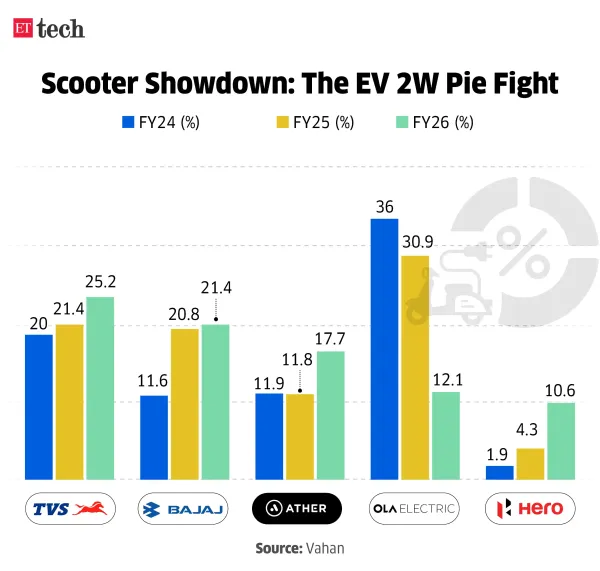
TVS Motor, which sold slightly less than 20,000 scooters in April 2025 with a 22.3% market share, more than doubled its volumes to 49,484 units last month, raising its share to nearly 27%.
Bajaj Auto did even better, emerging as the segment leader with 28.5% share in March 2026, up from 21.4% in April 2025.
Ola Electric’s new-age rival Ather Energy, which made its stock market debut this fiscal year, recorded 35,736 registrations last month, translating to a 19.4% market share, up from 13,332 units and a 15% share in April 2025.
While monthly e2W sales averaged around 112,000 units in FY26, the peak was in October when around 140,000 units were registered, driven largely by festive demand during Dussehra and Diwali.
Automakers typically offer discounts, cashbacks, and financing schemes during this period, while also ramping up production to meet higher demand.
As Ola Electric ceded ground, other players such as Hero MotoCorp and Greaves Electric Mobility also expanded their presence in the market.
Ola Electric’s decline in market share is attributed to multiple factors, including service-related concerns, quality issues, and rising customer dissatisfaction.
Earlier this week, the company indicated an improvement in demand, stating that daily orders had crossed 1,000 units in the final week of March. It said it has implemented deep operational changes, including improved parts availability and diagnostics, and claimed that over 80% of vehicles are now serviced the same day.
During FY26, Chinese export restrictions on rare earth metals disrupted India’s EV industry, affecting the supply of permanent magnets critical for electric motors. The curbs led to import delays, raised the risk of production disruptions, and forced manufacturers to explore alternative sourcing strategies.
Rare earth metals are a group of 17 chemically similar elements essential for high-tech applications, including electric vehicle motors, wind turbines, and electronics.
Retail sales of e2W crossed 1.35 million units last fiscal against 1.11 million units in FY25, despite production challenges arising from a shortage of rare earth metals, according to registrations data from the government-run Vahan portal.
Bengaluru-based Ola Electric sold only 10,118 vehicles in March, accounting for 5.4% market share, a sharp decline from the 22.1% share it held in April 2025. For FY26, the Bhavish Aggarwal-led EV maker sold 164,000 vehicles, less than half of 344,000 units it sold in FY25.
The market is now dominated by legacy players Bajaj Auto and TVS Motor that reported robust growth in volumes through the year.
TVS Motor, which sold slightly less than 20,000 scooters in April 2025 with a 22.3% market share, more than doubled its volumes to 49,484 units last month, raising its share to nearly 27%.
Bajaj Auto did even better, emerging as the segment leader with 28.5% share in March 2026, up from 21.4% in April 2025.
Ola Electric’s new-age rival Ather Energy, which made its stock market debut this fiscal year, recorded 35,736 registrations last month, translating to a 19.4% market share, up from 13,332 units and a 15% share in April 2025.
While monthly e2W sales averaged around 112,000 units in FY26, the peak was in October when around 140,000 units were registered, driven largely by festive demand during Dussehra and Diwali.
Automakers typically offer discounts, cashbacks, and financing schemes during this period, while also ramping up production to meet higher demand.
As Ola Electric ceded ground, other players such as Hero MotoCorp and Greaves Electric Mobility also expanded their presence in the market.
Ola Electric’s decline in market share is attributed to multiple factors, including service-related concerns, quality issues, and rising customer dissatisfaction.
Earlier this week, the company indicated an improvement in demand, stating that daily orders had crossed 1,000 units in the final week of March. It said it has implemented deep operational changes, including improved parts availability and diagnostics, and claimed that over 80% of vehicles are now serviced the same day.
During FY26, Chinese export restrictions on rare earth metals disrupted India’s EV industry, affecting the supply of permanent magnets critical for electric motors. The curbs led to import delays, raised the risk of production disruptions, and forced manufacturers to explore alternative sourcing strategies.
Rare earth metals are a group of 17 chemically similar elements essential for high-tech applications, including electric vehicle motors, wind turbines, and electronics.
( Originally published on Apr 02, 2026 )