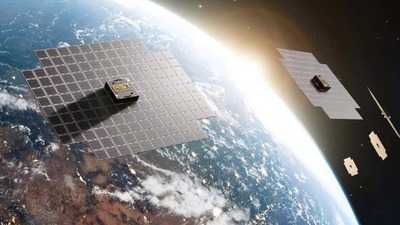
How reflective satellites will harm ecosystems across the Earth
06 Apr 2026
Plans to deploy reflective satellites and mirrors in low Earth orbit have raised alarms among researchers.
The proposed technology could disrupt human health and ecosystems globally, experts have warned.
The presidents of four international scientific societies, representing some 2,500 researchers from over 30 countries, have raised concerns about these plans in letters to the US Federal Communications Commission (FCC).
Disruption to biological clocks and ecosystems
Potential
The proposed scale of orbital deployment would drastically alter the natural night-time light environment on a global scale.
This change could disrupt biological clocks regulating sleep and hormone secretion in humans and animals, migration patterns of nocturnal species, seasonal cycles in plants, and even marine phytoplankton rhythms that underpin ocean food webs.
Potential implications for food security
Call for caution
The researchers have urged regulators to conduct a thorough environmental review and impose limits on satellite reflectivity and cumulative night sky brightness.
Professor Charalambos Kyriacou, a geneticist at the University of Leicester, warned that these plans could have global implications for food security as plants require the night.
Reflect Orbital plans to use satellites with large reflective mirrors to redirect sunlight onto areas about 5km-6km wide on demand.
SpaceX's mega constellation plan adds to concerns
Expansion proposal
Meanwhile, SpaceX has proposed launching up to one million satellites to create a massive solar-powered computing network in orbit.
The company claims this system could cut down energy and cooling requirements of terrestrial data centers.
However, these proposals have also drawn criticism from experts who warn about their potential impact on the night sky and ecosystems.
Current satellites already brightening night sky
Current impact
Ruskin Hartley, the CEO of DarkSky International, a non-profit dedicated to protecting natural night skies, emphasized that the current number of satellites in orbit has already increased diffuse night sky brightness/sky glow by about 10%.
Dr. Miroslav Kocifaj from the Slovak Academy of Sciences in Bratislava noted that individual satellites might leave streaks in telescope images, while sunlight reflected by satellites and debris brightens the sky.
Predicted rise in brightness by 2035
Future projections
Kocifaj's modeling suggests such objects already add between 3-8 microcandela per square meter to night sky brightness.
By 2035, he predicts this might rise to between 5-19 microcandela, nearing the threshold that astronomers have set for preserving naturally dark skies.
Professor Tami Martino from the University of Guelph said that the real question is not brightness compared to moonlight, but whether biological systems can detect the change.
-
Assembly Elections 2026: Voting Begins Across Assam, Kerala, Puducherry Amid Tight Contests

-
Iran Launches Drone Strikes On UAE, Kuwait After Lavan Refinery Hit Despite Ceasefire

-
Continued Israeli strikes in Lebanon threaten fragile US–Iran ceasefire

-
Trump's 'Right Hand' JD Vance To Lead US-Iran Talks In Pakistan, Tehran Confirms Participation

-
Allu Arjun birthday: From Kajal Aggarwal to Jr NTR, wishes the 'Raaka' actor; Rashmika Mandanna hopes he parties hard