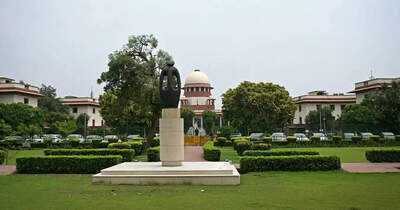
On Monday, three scholars were prohibited by the Supreme Court from participating in any government projects due to their involvement in drafting a chapter on "corruption in the judiciary" for a textbook that has since been withdrawn. They have now requested a hearing regarding this decision, as reported by a legal news outlet.
In personal affidavits submitted to the court, the academics—Michel Danino, Suparna Diwakar, and Alok Prasanna Kumar—asserted their credibility and experience in the field, emphasizing that they are not inexperienced scholars.
The bench, led by Chief Justice Surya Kant and Justice Joymalya Bagchi, was addressing a suo motu case concerning the controversial chapter.
This chapter was included in a Class 8 social science textbook published by the National Council of Educational Research and Training (NCERT). On March 10, the NCERT issued an apology for the chapter and announced the withdrawal of the entire textbook.
The apology followed the court's suo motu cognizance of the issue, which led to a ban on the publication and reprinting of the textbook.
According to an affidavit from NCERT Director Dinesh Prasad Saklani, Danino, a visiting professor, oversaw the chapter's drafting, while Diwakar and Kumar contributed as an educator and legal researcher, respectively.
On March 11, the court instructed the Centre and state governments to ensure that the three academics are not involved in any other curriculum-related projects.
Furthermore, it directed that they should not be assigned any roles involving public funds. The court expressed concerns that the academics either lacked sufficient knowledge about the Indian judiciary or intentionally misrepresented facts, stating that such individuals should not be involved in preparing educational materials for future generations.
During the hearing, advocate Gopal Sankaranarayanan, representing Kumar, argued that the court's remarks had unfairly biased public perception against them. He noted that their applications aimed to clarify their position.
In response, the Chief Justice questioned whether they were defending their actions.
Sankaranarayanan explained that the applications were intended to provide context and demonstrate the new educational approaches adopted following the 2020 National Education Policy.
He pointed out that textbooks for Classes 6 and 7 address issues faced by various governmental bodies, suggesting that the judiciary was unfairly singled out.
Advocate J Sai Deepak, representing Diwakar, emphasized that the chapter's creation was a collaborative effort, with no single individual holding exclusive authority.
Chief Justice Kant indicated that the court intends to hear from all three academics.
The chapter in question highlighted various forms of corruption within the judiciary, identifying it as one of the challenges facing the judicial system, as noted by another media outlet. It was part of a textbook titled "Exploring Society: India and Beyond."
During a hearing on February 26, Solicitor General Tushar Mehta, representing the government, apologized to the court. However, the bench remarked that the NCERT's press release at that time did not contain any explicit apology.
-
EasyJet flight forced to abort landing moments before touchdown at major airport

-
Nora Fatehi's Controversial Song Sparks National Commission Inquiry: What's Next?

-
Elderly Man Ties the Knot with Young Bride, Sparks Reactions Online

-
BBC confirms new spin-off series of beloved show as fans say 'what we need right now'

-
Vaping likely causes oral and lung cancers, say researchers