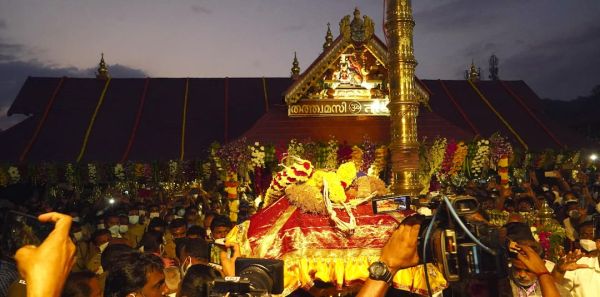
The Centre has told the Supreme Court that Hinduism not only treats women as equals but places them on a pedestal higher than men, while defending its position in the ongoing Sabarimala hearing.
Solicitor General Tushar Mehta presented the government’s case before a nine-judge Constitution bench hearing petitions related to discrimination against women at religious places, including the Sabarimala temple in Kerala.
He argued that the 2018 Sabarimala judgment, which lifted the ban on entry of women aged 10-50, was based on an assumption that men are superior, an idea he said does not reflect broader Hindu traditions.
“It is submitted that considering its unique and distinct features in Hinduism, its rituals, beliefs, mode of worship, and other religious rights under Article 25 and 26 can never be tested directly, without any balancing and optimisation, on the touchstone of Article 14,” Mehta said.
“It is Hinduism which has always had the concept of worshipping ‘womanhood’, even during prehistoric times. Hinduism has not just treated women as equals, but women are placed on a much higher pedestal than men. Arguably, Hinduism is the only religion in the world where Goddesses are not only worshipped, but men touch their feet and become devotees of sacred ‘mother goddesses’,” he added.
Examples Of Temples With Gender-Specific Customs
The Solicitor General cited several temples where entry is restricted based on gender, arguing that such practices are rooted in faith and are not instances of discrimination.
These include:
- Attukal Bhagavathy Temple in Kerala, where men are not allowed on the main day of the Pongal festival
- Chakkulathukavu Temple in Kerala, where only women enter during ‘Naari Puja’
- Brahma Temple in Pushkar, where married men do not enter the inner sanctum
- Bhagavati Amman Temple in Kanyakumari, where married men are barred
- A Mata Temple in Muzaffarpur, Bihar, where men are prohibited during a specific period
- Kottankulangara Sree Devi Temple in Kerala, where men dress as women to offer prayers
- Kamrup Kamakhya Temple in Assam, where men are barred during Ambubachi
Customs Beyond Judicial Review, Says Centre
Mehta argued that permissibility of entry based on gender is not a facet of “gender discrimination” but part of religious practice, faith and belief, which lies beyond the scope of judicial review.
He further said notions such as patriarchy and gender stereotypes are not intrinsic to India’s civilisational ethos, questioning their application in debates over women’s entry into the Sabarimala temple.