70
With polling just 11 days away, a dramatically redrawn electoral roll and a BJP manifesto aimed squarely at Mamata Banerjee’s core voters are turning what was once a foregone conclusion into West Bengal’s most unpredictable election ever.
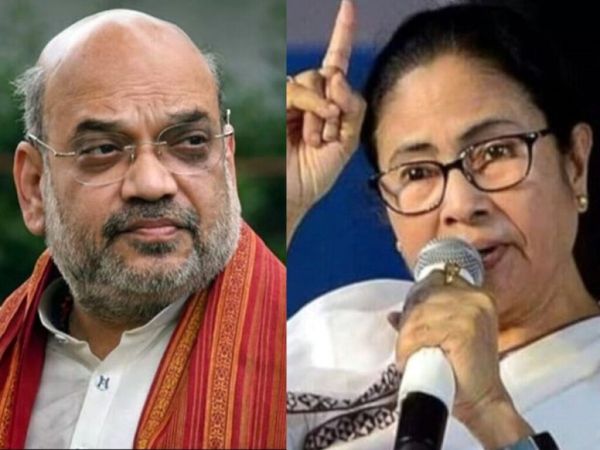
On Friday, Union Home Minister Amit Shah arrived in Kolkata to release the BJP’s manifesto—its “Sankalp Patra”—and served notice that the party intends to fight the election on every front Mamata Banerjee considers her own.
The BJP’s Bengal manifesto targets Muslims, women and youth—the very segments that have traditionally sustained Mamata Banerjee’s Trinamool Congress (TMC)—through a mix of UCC (Uniform Civil Code), women’s cash support and youth allowances.
You Might Be Interested In
“Bengal, weary of the TMC, now wants change,” Shah declared, describing the last 15 years of Trinamool rule as “a period of darkness” and promising a “zero tolerance” policy against infiltrators under a slogan that was impossible to miss in its directness: “Detect, Delete, Deport.”
But the manifesto’s sharpest bid to unsettle Mamata Banerjee was not on borders—it was on welfare. The BJP pledged to transfer Rs 3,000 into the bank account of every woman in Bengal between the 1st and 5th of every month. The TMC’s Lakshmir Bhandar scheme currently pays Rs 1,500 to women in the general category and Rs 1,700 to SC and ST beneficiaries. The BJP promise is precisely double. It also announced that it would double TMC’s Yuva Sathi payout of Rs 1,500 for unemployed voters up to 40 years of age, apart from other monetary support packages.
For the TMC, the immediate task is to defend its record and question the credibility of the BJP’s offers.
On Friday, barely three hours after Shah released the BJP’s manifesto, Trinamool second-in-command Abhishek Banerjee was already spitting fire in a hurriedly convened media conference.
He repeatedly framed the UCC promise as part of a “divisive national agenda” that would disturb Bengal’s social fabric, and accused the BJP of “copying and inflating” ongoing welfare schemes without explaining how they will be financed at the state level.
He also accused the BJP of having a habit of reneging on its promises—referring to promises made in Delhi and Maharashtra.
But the numbers that matter most in Bengal’s 2026 Assembly election are not the ones on any manifesto. They are the 9,102,577 names quietly erased from the state’s electoral rolls since October last year—a deletion so sweeping it has shaved 11.88% off the electorate, reducing it from 7.66 crore to 6.75 crore, and redrawn the political map of every one of the state’s 294 constituencies.
“Ninety-one lakh people have been deleted from the electoral rolls,” Chief Minister Mamata Banerjee reiterates at every rally, her voice sharpening on the number.
The Election Commission insists the Special Intensive Revision—the SIR, as it has come to be known—was a long-overdue cleansing of absent, shifted, duplicate and deceased voter names. But where the cuts fell has ignited a furious political war.
Several districts recording the heaviest deletions—Murshidabad, Malda, North 24-Parganas, South 24-Parganas, Nadia—are also the districts that have underpinned Trinamool Congress dominance since 2011, carrying within them the minority belt, the Matua refugee pocket, and the welfare-recipient base on which Mamata Banerjee has constructed three consecutive election victories.
“The revision affected minorities, migrants and economically weaker sections,” the TMC has alleged in repeated complaints to the Election Commission and before the Supreme Court. “Legitimate voters have been disenfranchised,” has been the party’s refrain.
The BJP’s response was unsparing. “We believe the revision has removed ineligible names in areas where the BJP was historically weak,” a senior party leader said, making explicit what the saffron camp had long argued: that a significant portion of the minority-belt voter rolls contained undocumented Bangladeshi migrants—the “infiltrators” at the centre of its 2026 campaign.
No district illustrates the stakes more starkly than Murshidabad, where 66% of the population is Muslim and the Trinamool Congress won 20 of its 22 Assembly seats in 2021. Nearly 7.48 lakh names have been removed from the district’s rolls, and of the roughly 11 lakh cases placed under judicial adjudication, 4.5 lakh were eventually struck off. The consequence, analysts say, is arithmetically alarming for the ruling party: in 12 of Murshidabad’s 22 seats, the volume of deletions now exceeds the TMC’s winning margin from 2021.
“The TMC’s statewide arithmetic rests on three pillars—the minority belt, women voters and the two 24-Parganas,” said political analyst Biswanath Chakraborty. “If its leads in these segments shrink even marginally, the BJP becomes competitive in dozens of additional seats.”
“The road to power in Bengal runs through its women,” observed one political analyst, and the numbers bear it out. Of the state’s 6.75 crore eligible voters, 3.44 crore—nearly 49%—are women.
CSDS-Lokniti data shows that 53% of women voted TMC in the 2024 Lok Sabha elections, an 11-percentage point rise over 2019. It is a coalition Mamata Banerjee has spent a decade building and the TMC manifesto had already announced a Rs 500 increase in Lakshmir Bhandar, raising the payout to Rs 1,500 for general category beneficiaries.
The BJP has now placed a Rs 3,000 bid directly against it.
Whether that is enough to hold women who are—according to several ground reports—increasingly dividing between rural voters who prioritise welfare and urban women who want jobs and safety is the question neither party can yet answer.
The latest Matrize-ABP survey, released last week, placed the TMC at 43% of the vote and the BJP at 41%—a two-point gap that, under Bengal’s constituency geometry, could produce anything from a comfortable Trinamool majority to a hung Assembly. The survey projected the TMC winning between 140 and 160 seats and the BJP between 130 and 150, against a majority line of 148.
“This two-point difference may appear small, but under West Bengal’s seat distribution, even a limited lead can still produce a majority if vote concentration remains efficient,” the agency noted.
The BJP is counting on North Bengal, where it has dominated since 2019 and where analysts project a sweep of 46 to 52 of 54 seats. It is also banking on the Jangalmahal plateau districts of Purulia, Bankura and Jhargram, where its tribal voter base is relatively undisturbed and SIR deletions were comparatively modest—Jhargram, for example, lost only 55,364 names. The TMC, meanwhile, holds a structural advantage in South Bengal’s coastal and delta belt and in Kolkata’s urban wards, where its welfare architecture and organisational muscle remain intact.
“That is where chemistry could override arithmetic,” said political analyst Suman Bhattacharya, referring to the way a heightened sense of threat in Muslim-majority constituencies could produce near-total consolidation behind the TMC, mathematically recovering much of what the SIR deleted. “If the sense of threat produces near-total consolidation, the TMC may recover much of what it loses numerically.”
As Bengal moves towards its two-phase vote on April 23 and 29, the contest has resolved into something rare in Indian state-level politics: a genuinely open race between a deeply entrenched incumbent whose coalition is numerically emasculated and a challenger with momentum, a welfare bid, and a border narrative—but no track record of governing Bengal.
The results on May 4 will tell which, in the end, Bengal chose to trust.
-
RCB Vs MI, IPL 2026 At Wankhede Stadium In Mumbai: Here's How To Cut Through Massive Rush, Tickets & Everything You Should Know

-
IPL 2026: Delhi Capitals' Nitish Rana Fined 25% Match Fee For Code Of Conduct Breach
-
TS Inter Results 2026: Supplementary Exams From May 13; Marks Memo Download Today At 5 PM

-
Punjab Govt Releases ₹13 Crore Pre-Matric Scholarship For 92,000 SC Students

-
Telangana TS Inter 1st, 2nd Year Results 2026 Out: Check Topper List Here