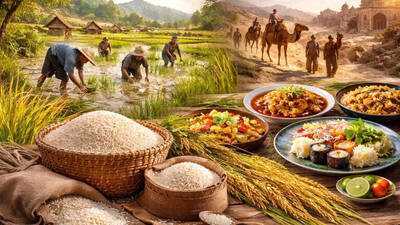
Rice is among the most commonly eaten foods around the world, being an integral part of the daily diet for billions of people. From a humble dal-chawal meal in India to the sushi in Japan or the paella in Spain, this food grain has found its way into global eating habits.
Its rise from being just another plant to being an integral part of the daily diet has taken centuries, starting from ancient China, when humans first domesticated rice and began growing it.
Origins of rice cultivation in ancient China
Rice is one of the oldest grains, which can be traced as far back as 9,000 years ago. Rice was originally grown along the Yangtze River Valley in China, where it was one of the earliest food sources.
A study, " ”, published in the journal Proceedings of the National Academy of Sciences (PNAS) states that there are archaeological and genetic pieces of evidence proving that rice domestication started around 9,000 years ago in China.
The soil and water available in this region were rich; unlike other plants used as food sources, rice would grow even in muddy soil. These early civilisations were aware of the significance of this plant since it provided enough food for them, and it could easily be stored and cooked.
How rice spread to India and Asia
The consumption of rice in China was responsible for its eventual spread to other regions in Asia, like India and Southeast Asia. It was not an immediate process but occurred gradually over a span of years because of migrations and trade.
A genetic study, “ ”, published in Nature, shows that cultivated rice originated in southern China and later spread to South and Southeast Asia, including India.
Once rice made its way to India, it began to establish itself as a staple crop. In fact, the climate conditions in India were quite favourable for growing rice, especially since India had a monsoon cycle.
Rice becomes a global staple
Rice became a part of Western cultures via trading routes by about the 7th century, spreading first to Persia and then to Europe.
Then, during the time of great explorations and trade throughout the world, it made its way to Africa and the Americas.
Each culture embraced it and created its own cooking style centred around the use of rice.
Currently, rice is a basic food for over 50% of the world’s population, accounting for a considerable share of their total caloric consumption.
Why rice became so important
The world supremacy of rice is no coincidence because there are many reasons why rice was critical in human civilisations. It can grow in various climates, particularly in flooded paddies where other grains will struggle to flourish. Rice is also nutritious, cheap, and convenient to prepare.
Furthermore, rice is versatile and can be cooked in thousands of ways, ranging from plain steamed rice to elaborate dishes.
Cultural significance of rice
Apart from being nutritious, rice is a food item that also holds great significance for various cultures. For example, Indians use this food item in their everyday diets, but it is also used in religious ceremonies and festivals.
For Japanese people, rice is more than just a source of food; it represents their culture and traditions. In some other regions of the world, rice is considered a symbol of prosperity and community.
For thousands of years, the importance of rice has transcended beyond being a simple food item to become an integral part of human culture.
The journey of rice from its origins in ancient China to becoming an essential component of the global diet represents the interdependence between human beings through time.
From a crop in a small valley in China, rice became one of the primary sources of food in the world.
-
The Retention Economy: Why Service Businesses Win on Relationships

-
Rajnath Singh pushes for defence ties with Germany amid new threats

-
Priyanka Chopra, Richard Madden’s ‘Citadel 2’ to be out on May 6

-
Suresh Triveni’s ‘Razaa’ earns nomination at New York Indian Film Festival

-
Crude Oil Price Update: Crude oil prices fell, Brent slipped below $95, know the Pakistan connection?