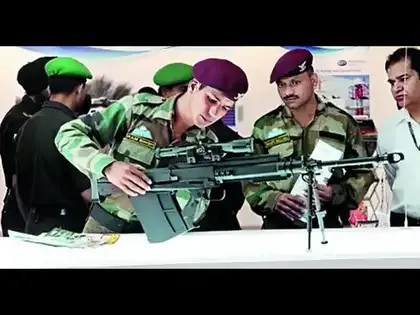
With the ongoing war in West Asia, a precarious ceasefire notwithstanding, military modernisation has got another painful push. While the US military's technological capabilities have been on display, it is hardly been an 'excursion' as Trump described it early into the conflict. The mighty US military-industrial complex (MIC) is groaning under the weight of a 2-front logistical challenge - supplying Ukraine, and sustaining a high-tempo operation in the Persian Gulf region.
As the largest rearmament programme since WW2 continues globally, all countries are scrambling to build insurance. India's own calculus is changing as well. Op Sindoor brought the hypothesis of a 2-front war closer to reality. Defence allocations in the budget reflected some urgency, going up 15%, a trend-break from the past few years when it has grown at roughly the same pace as nominal GDP. India's last sustained period of frenetic military modernisation (outside of war years) was in the mid-1980s, when defence expenditure reached 4% of GDP.
That didn't end well. By 1990, India nearly went bankrupt at the first hint of an external crisis (First Gulf War). Memories of that experience has kept policymakers prudent about def-ex ever since.
A bigger worry is India's continuing muddle in managing the economics of war-preparedness and of waging war. At a doctrinal level, India's defence policy seems to be frozen in time. Theatrisation still being litigated within various branches of the military. While the process is attempting to merge different units across service arms, war- planning still seems siloed. Consequently, 'sum of the parts' of individual plans of each service arm adds up to a sprawling conventional concept of 20th-c. conflicts. Requirements expand and limited budgets struggle to meet 'bare minimum'.
Aggregating plans of all 3 services, we end up with a desired TOE (table of organisation and equipment) of over 1.2 mn active personnel, nearly 5,000 main battle tanks, 42 squadrons of fighter aircraft, 3 aircraft carriers, 30 conventional submarines, 6 nuclear-powered attack submarines.... At a tactical level, this sum-of-parts planning shows up in apparent wastefulness. The army recently raised a squadron of 6 Apache helicopters for $1 bn, duplicating IAF's fleet of 22.
Large-platform acquisitions attract attention. In the last few months, big- ticket clearances are illustrative - 114 Rafales (estimated $30 bn), 26 Rafale-Ms for the navy ($8 bn), 6 German T212 subs ($10 bn) and plethora of tactical munitions from Israel ($7-8 bn). One distinctive feature of most of these acquisitions is that they are imported. This has downstream impact on both economics of war-preparedness and of war-fighting.
In terms of the former, it's a linear economic impact. For most countries with large military expenditure - the US, China, Russia, Israel - bulk of defence capex is spent in domestic MIC, which benefits the economy.
But bulk of Indian defence capex has been traditionally on imported gear. While licence manufacturing has been a recurring theme, value-added from screwdriver assemblies is low. In effect, defence capex, in its current avatar, is like a tax on the economy rather than being a multiplier.
Economic impact of war fighting is starker. Every imported platform ties the country to munitions, maintenance and upgrades with the original vendor. The primary munitions of Rafale, for instance, are French origin. Rafale's predecessor, Mirage 2000, had to go back to Dassault for a limited upgrade, a project that cost India $50 mn a piece.
In short, imported platforms are often closed-architecture affairs, creating long-term dependencies on foreign supply chains. They also impair magazine depth maths. In the last 20-odd yrs, every time there has been a flare-up at its borders, India has had to scout overseas markets to replenish stocks of ammunition. Op Sindoor necessitated $1 bn replenishment of S400 missile stocks alone.
With so much capex committed to maintaining and buying legacy platforms, there is little left over for innovations and domestic R&D. Kaveri, India's sole aero-engine project, has spent only $300 mn over three decades. Not much to spare for frontier technologies like AI, quantum computing and cyber-operations, areas in which China is making leading-edge advances.
India's geopolitical challenges are immense, resources limited, and competition for the same tax rupee severe. While it needs to spend more on defence, it's a lot more important to prioritise areas to focus on, look at asymmetric options and double down on domestic products.
Legendary Chinese rocket engineer Qian Xuesen argued in the 1950s that his country needed to focus its defence on a strong missile force and nuclear weapons to deter a superior-armed West, instead of spreading resources thin. India needs to adopt similar asymmetric approaches to improve its economics of war-prep and war-fighting.
As the largest rearmament programme since WW2 continues globally, all countries are scrambling to build insurance. India's own calculus is changing as well. Op Sindoor brought the hypothesis of a 2-front war closer to reality. Defence allocations in the budget reflected some urgency, going up 15%, a trend-break from the past few years when it has grown at roughly the same pace as nominal GDP. India's last sustained period of frenetic military modernisation (outside of war years) was in the mid-1980s, when defence expenditure reached 4% of GDP.
That didn't end well. By 1990, India nearly went bankrupt at the first hint of an external crisis (First Gulf War). Memories of that experience has kept policymakers prudent about def-ex ever since.
A bigger worry is India's continuing muddle in managing the economics of war-preparedness and of waging war. At a doctrinal level, India's defence policy seems to be frozen in time. Theatrisation still being litigated within various branches of the military. While the process is attempting to merge different units across service arms, war- planning still seems siloed. Consequently, 'sum of the parts' of individual plans of each service arm adds up to a sprawling conventional concept of 20th-c. conflicts. Requirements expand and limited budgets struggle to meet 'bare minimum'.
Aggregating plans of all 3 services, we end up with a desired TOE (table of organisation and equipment) of over 1.2 mn active personnel, nearly 5,000 main battle tanks, 42 squadrons of fighter aircraft, 3 aircraft carriers, 30 conventional submarines, 6 nuclear-powered attack submarines.... At a tactical level, this sum-of-parts planning shows up in apparent wastefulness. The army recently raised a squadron of 6 Apache helicopters for $1 bn, duplicating IAF's fleet of 22.
Large-platform acquisitions attract attention. In the last few months, big- ticket clearances are illustrative - 114 Rafales (estimated $30 bn), 26 Rafale-Ms for the navy ($8 bn), 6 German T212 subs ($10 bn) and plethora of tactical munitions from Israel ($7-8 bn). One distinctive feature of most of these acquisitions is that they are imported. This has downstream impact on both economics of war-preparedness and of war-fighting.
In terms of the former, it's a linear economic impact. For most countries with large military expenditure - the US, China, Russia, Israel - bulk of defence capex is spent in domestic MIC, which benefits the economy.
But bulk of Indian defence capex has been traditionally on imported gear. While licence manufacturing has been a recurring theme, value-added from screwdriver assemblies is low. In effect, defence capex, in its current avatar, is like a tax on the economy rather than being a multiplier.
Economic impact of war fighting is starker. Every imported platform ties the country to munitions, maintenance and upgrades with the original vendor. The primary munitions of Rafale, for instance, are French origin. Rafale's predecessor, Mirage 2000, had to go back to Dassault for a limited upgrade, a project that cost India $50 mn a piece.
In short, imported platforms are often closed-architecture affairs, creating long-term dependencies on foreign supply chains. They also impair magazine depth maths. In the last 20-odd yrs, every time there has been a flare-up at its borders, India has had to scout overseas markets to replenish stocks of ammunition. Op Sindoor necessitated $1 bn replenishment of S400 missile stocks alone.
With so much capex committed to maintaining and buying legacy platforms, there is little left over for innovations and domestic R&D. Kaveri, India's sole aero-engine project, has spent only $300 mn over three decades. Not much to spare for frontier technologies like AI, quantum computing and cyber-operations, areas in which China is making leading-edge advances.
India's geopolitical challenges are immense, resources limited, and competition for the same tax rupee severe. While it needs to spend more on defence, it's a lot more important to prioritise areas to focus on, look at asymmetric options and double down on domestic products.
Legendary Chinese rocket engineer Qian Xuesen argued in the 1950s that his country needed to focus its defence on a strong missile force and nuclear weapons to deter a superior-armed West, instead of spreading resources thin. India needs to adopt similar asymmetric approaches to improve its economics of war-prep and war-fighting.
(Disclaimer: The opinions expressed in this column are that of the writer. The facts and opinions expressed here do not reflect the views of www.economictimes.com.)




Somnath Mukherjee