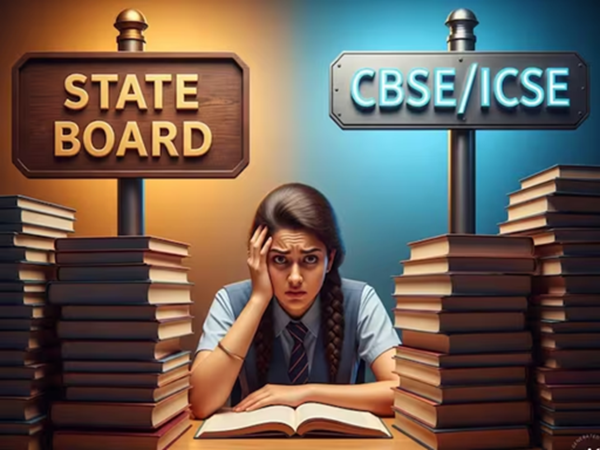
From State Board to CBSE/ICSE: There are over 70 education boards in India. Among these, the boards of all individual states—along with CBSE and ICSE—are the most popular. Many parents of students studying in classes 9 through 11 at State Board-affiliated schools decide to switch their child's board during these specific grades. At this age, students are already grappling with the changes associated with adolescence as well as anxieties regarding their future careers. In such a context, the decision to change boards can serve as an opportunity for growth for some, while for others, it may become a monumental source of stress. Most parents view the CBSE board as an ideal launchpad for competitive examinations.
The rationale frequently cited behind the decision to switch boards is that the curriculum of central boards is best suited for national-level examinations such as the JEE and NEET. However, there is another side to the coin: every board possesses its own distinct pedagogical approach and methodology. While State Boards may emphasize rote learning and proficiency in regional languages, CBSE and ICSE boards demand analytical thinking skills. Classes 9 and 11 serve as the foundational pillars for board examinations. Consequently, making a transition at this critical juncture can significantly impact a child's mental health and academic performance. It is essential to carefully assess whether this change truly poses a risk to your child's grades.
Changing Boards: A Risk to Grades or a Career Opportunity?
If you are contemplating the decision to change your child's school—and, more specifically, their education board—during Class 9 or 11, it is crucial to understand how this move might impact their future career trajectory. However, it is also pertinent to note that every child possesses a unique learning capacity; what proves beneficial for one student may not necessarily be suitable for another.
Why Are Classes 9 and 11 Considered the Most Critical Junctures?
Classes 9 and 11 act as transitional bridges. Class 9 lays the groundwork for the Class 10 board examinations, while Class 11 serves as the foundation for both the Class 12 board examinations and various competitive entrance exams. When a student transitions from a State Board to either CBSE or ICSE, they are suddenly confronted with a vast and extensive syllabus. If a student is unable to adapt to this change quickly, a decline in grades during initial unit tests and examinations is to be expected.
**The Significant Disparity in Syllabus and Evaluation**
State Boards often focus on a fixed pattern and a specific set of important questions. In contrast, the syllabi of the CBSE—and particularly the ICSE—are far more in-depth and comprehensive. Here, the emphasis is not merely on *what* is being taught, but also on *how* and *why*. A child who has previously studied within a limited scope may require anywhere from six months to a year to fully adjust to this new "application-based" learning approach.
**Potential Language Barriers**
If a child was previously studying under a State Board curriculum in a regional language (such as Hindi or Marathi) and is suddenly required to tackle the high-level English Literature curriculum of the ICSE, this can prove to be a risky decision. Due to this language barrier, the child may intellectually grasp the subject matter but struggle when it comes to articulating their understanding in written answers. This inevitably impacts their self-confidence and, ultimately, their academic grades.
**Is Taking the Risk of Changing Boards Justified?**
Taking the risk of switching education boards is advisable only if the child is academically exceptionally bright. If their career goal lies in the fields of Engineering or Medicine, transitioning to the CBSE tends to be more beneficial in the long run. However, if a student is switching boards after completing the 10th grade—specifically upon entering the 11th grade—they will need to put in extra effort to strike a balance between their schoolwork and their coaching classes. Parents should not panic if they observe an initial dip in grades; this is a natural part of the learning curve.
**A Checklist for Parents**
Before deciding to change your child's education board, consider the following factors:
**The Child's Willingness:** Is the child mentally prepared to take on this challenge?
**Academic Foundation:** Are the fundamental concepts from previous grades clear and solid?
**Support System:** Are you in a position to provide them with additional support, whether through private tutoring or by dedicating extra time to assist them at home?
Given its profound impact on a child's education and prospects, the decision to switch education boards is a significant and challenging one. You may also wish to consult with a career counselor before making this final choice.
Disclaimer: This content has been sourced and edited from TV9. While we have made modifications for clarity and presentation, the original content belongs to its respective authors and website. We do not claim ownership of the content.
-
Financial Horoscope Today, April 19, 2026: Aries to See New Income Streams, Check Financial Forecast for Other Zodiac Signs

-
Weekly Tarot Reading for All Zodiac Signs: April 20–26 Forecast

-
'It Was Purely A Gimmick': Varun Dhawan's Hai Jawani Toh Ishq Hona Hai Team Denies AI Use In Film Amid Row Over 'AI Babies' In Teaser

-
Drishyam 3 Director Abhishek Pathak Welcomes Baby Girl With Shivaleeka Oberoi 3 Years After Marriage: 'Our Goddess Laxmi Has Arrived'

-
Supreme Leader Ayatollah Mojtaba Khamenei's First Army Day Message Hails Iran's 'Courageous Defence' In 40-Day US-Israel War