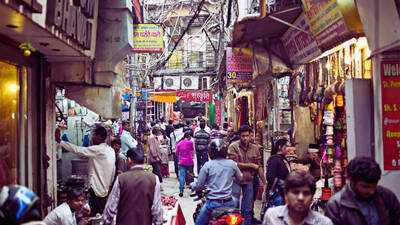
On World Heritage Day, it feels almost limiting to call Delhi a “heritage city.” Delhi is something far more restless and far more alive. It is not one city but many. The Indian Capital is at least seven cities laid one over the other, century after century. None of them has fully disappeared. They rise, interrupt, and insist on being seen, like memories that refuse to fade. You don’t just visit Delhi. You probably move through time in it. The only way to truly feel that and to let the city reveal itself is on foot. It should be done in the same unhurried pace at which its history was lived.
Here are six heritage walks in the capital that are worth every step you will take.
Mehrauli Village Walk
It’s everything in one kilometre range. A temple, a dargah, a church and a gurdwara. All these structures sitting side by side in Mehrauli, Delhi’s oldest inhabited settlement . Among its living traditions is the ‘Phool Walon Ki Sair’. At this annual event, floral fans symbolising goodwill are offered in the same procession at both Hindu temple and Sufi shrine. Surviving since Mughal times, it is largely carried forward by the local community. The area is a quiet reminder that culture does not always need institutions to endure. It is also one of the city’s most accessible heritage walks, making it a natural starting point for newcomers.
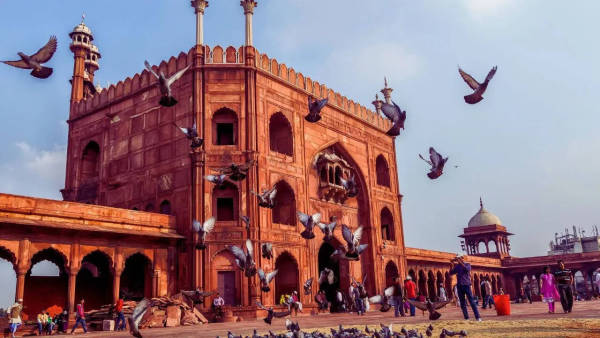
‘Raat ke Afsane’ Night Walk at Qutub Minar
Most visitors arrive during the day, navigate the crowds, and then leave. They end up missing something inexplicable. The site entirely changes character at night. In the absence of sunlight, the stone sheds its postcard quality. Engravings missed in daylight begin to surface.The stories of Delhi sultanate generals — men who rose from slavery to rule — land differently under a dark sky. Then there is the iron pillar of sixteen centuries old and most remarkably rust-free, something which is still puzzling metallurgists. Reading about it informs but standing beside it on a still night does something else entirely.
Gandhi Smriti Walk
Birla House is not reverent in a distant way. This walk traces Mahatma Gandhi’s final months spanning his fasts, his disagreements with Jawaharlal Nehru over Kashmir, Sardar Patel’s visible strain, and the deep fractures left by Partition. It is history without polish. The most affecting stretch is the short path from his room to the prayer ground, which is preserved for one century, step by step in concrete. Visitors often walk it themselves being fully aware of how it ends.
Agrasen ki Baoli
Tucked behind the office blocks of iconic Kasturba Gandhi Marg lies a 14th-century stepwell. The structure seems almost withheld from the city around it. Its geometry alone is reason enough to visit. 108 steps descending in perfect symmetry! At the base, the noise above disappears. There are no ticket counters. It is just open access to all. Students sketch in one corner and families sit quietly in another. It feels like what public heritage is meant to be. The experience is unforced, shared, and intact.
Feroz Shah Kotla
Call it superstition or folklore. But it has endured centuries. Every Thursday, people arrive at these Tughlaq-era ruins with handwritten letters. They place them into the cracks of old walls. They make petitions to djinns for jobs, marriages and court cases. Incense hangs in the air. This is not preserved folklore but aliving ritual. The complex also holds one of Delhi’s two Ashokan pillars and a 3rd-century BC column brought here from Punjab by Firoz Shah Tughlaq. Mauryan stone, Tughlaq ambition and present-day faith are layered into one space. Few places in Delhi compress time this densely.
Sunder Nursery Heritage Park
For years, Sunder Nursery remained in the shadow of Humayun’s Tomb. Today, it stands on its own. It is a 90-acre heritage park with restored Mughal-era structures and carefully revived biodiversity. What works here is not just the restoration, but the way people use it. On weekends, families spread out on the lawns and cafés fill up. Heritage settles best when it becomes part of routine life and not just an item on an itinerary. Sunder Nursery manages that with ease.
Delhi gives you in proportion to the attention you pay it. Glass towers may suggest a clean break from the past, but the city rarely lets it go. Its history stays close. The past is not behind glass. It is alongside us in everyday life.
The above article has been written by Anshuman Magazine. He is the Chairman & CEO, India, South East Asia, Middle East & Africa, CBRE and a regular heritage walker
-
Kannur Dental College denies caste angle in BDS student death, family unhappy with probe

-
Heinrich Klaasen Defends His Batting Approach Amid Strike Rate Criticism

-
Hockey Punjab and Odisha Shine at National Championship 2026

-
A Woman's Life Transformed After Betrayal: A Remarkable Lottery Win

-
Controversial Family Dispute in Shahjahanpur Sparks Community Debate