Indian Bandhani skirt at ₹44,800? Ralph Lauren under fire for 'audacity' of copying traditional craft
ETimes | April 21, 2026 4:40 PM CST
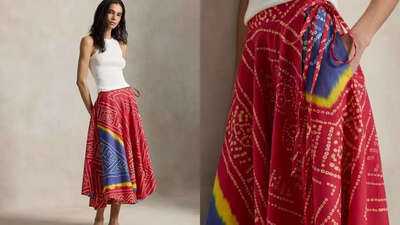
Similar to the insane tension between the characters of a movie that has you on the edge of your seat, the fine line between inspiration and appropriation toes in fashion. Especially when it comes to luxury fashion houses that have all eyes on them when they are releasing their annual collections on the ramp or on their websites.
Over the past few years, India has emerged as a global economy that is influencing not only geopolitics but also soft power. Its multidimensional cultures and diversity provide an immense inspiration and market for fashion enthusiasts across the globe. While this should have put the country on the fashion map it has rather raised a question on the borders. To what extent can fashion remain within the limits of inspiration and when does it cross the boundary towards appropriation?
In another one of a series of contentious moves, luxury brand was called out by Indians globally for launching what it described as a 'Print Cotton Wrap Skirt' under the Polo line. Priced at Rs44,800 the skirt comes in a 'Tie-Dye Multi' colour-way, is 'beautifully draped' and features a 'vibrant design inspired by traditional Bandhini tie-dye techniques and motifs.'
The skirt has wrapped the brand and its aim in a controversy with people calling it out online for copying Indian culture and appropriating it without giving due credit. Radha Patel, an Indian-origin digital creator took to Instagram to point out that the design on the skirt was printed and it was overpriced.
"Why Ralph Lauren , why," asked Patel while adding that a metre of the cloth cost somewhere between Rs200-500 per metre and by that logic the cost of the skirt should not have exceeded Rs2,000-3,000. Moreover, she added that the brand should have given some credit, such as 'India-inspired Bandhani'.
"The audacity to copy another country's culture and e* it up so bad oml," added another.
"It’s high time the art and design of India should be given due credit" one called out.
"ITS PRINTED NOT REAL BANDHANI they’re making it into fast fashion without even paying the actual artisans" one pointed out.
Bandhani: A game of the thread
Bandhani is an art of creating designs by tying and dyeing fabric, which dates back to the Indus Valley Civilisation. Believed to have existed as early as 4000BCE, it is now widely found in creations in Gujarat and Rajasthan. Varieties of the art are manufactured in Anjar, Mandvi, Pethapur, Udaipur, Porbandar, Rajkot, Jaipur, Bikaner, Jetpur and other places on fabrics including georgette, silk, cotton, chiffon and more.
Is India truly inspiring global brands?
This is not the first time a Western brand or even Ralph Lauren itself has made a poor attempt at appropriating Indian culture without crediting the artisans and the art. Previously Ralph Lauren was under hot water for models sporting dome-shaped bell earrings, resembling Indian jhumkas at its Fall 2026 runway show at the Paris Fashion Week.
Other luxury fashion houses including Prada and Dior have also come under the radar for piggybacking on Indian cultural objects. Prada launched T-strap sandals resembling Kolhapuri chappals and it was only after a massive backlash that the brand admitted that the designs had been 'inspired by Kolhapuri footwear'.
In July 2025, Dior was called out for its $200K ivory and gold houndstooth coat featuring traditional Indian mukaish embroidery from Lucknow without crediting the 12 Indian artists who spent 34 days creating the piece.
While India might be inspiring global fashion houses, as it must with its decades of cultural and fashion richness, the credit for its ingenuity is lacking in the global subtext, which seems to be the demand now.
Over the past few years, India has emerged as a global economy that is influencing not only geopolitics but also soft power. Its multidimensional cultures and diversity provide an immense inspiration and market for fashion enthusiasts across the globe. While this should have put the country on the fashion map it has rather raised a question on the borders. To what extent can fashion remain within the limits of inspiration and when does it cross the boundary towards appropriation?
In another one of a series of contentious moves, luxury brand was called out by Indians globally for launching what it described as a 'Print Cotton Wrap Skirt' under the Polo line. Priced at Rs44,800 the skirt comes in a 'Tie-Dye Multi' colour-way, is 'beautifully draped' and features a 'vibrant design inspired by traditional Bandhini tie-dye techniques and motifs.'
The skirt has wrapped the brand and its aim in a controversy with people calling it out online for copying Indian culture and appropriating it without giving due credit. Radha Patel, an Indian-origin digital creator took to Instagram to point out that the design on the skirt was printed and it was overpriced.
"Why Ralph Lauren , why," asked Patel while adding that a metre of the cloth cost somewhere between Rs200-500 per metre and by that logic the cost of the skirt should not have exceeded Rs2,000-3,000. Moreover, she added that the brand should have given some credit, such as 'India-inspired Bandhani'.
Other netizens supported the influencer's sentiment online. "That looks like if bandhani print was made with a bad AI slop prompt" quipped one.
"The audacity to copy another country's culture and e* it up so bad oml," added another.
"It’s high time the art and design of India should be given due credit" one called out.
"ITS PRINTED NOT REAL BANDHANI they’re making it into fast fashion without even paying the actual artisans" one pointed out.
Bandhani: A game of the thread
Bandhani is an art of creating designs by tying and dyeing fabric, which dates back to the Indus Valley Civilisation. Believed to have existed as early as 4000BCE, it is now widely found in creations in Gujarat and Rajasthan. Varieties of the art are manufactured in Anjar, Mandvi, Pethapur, Udaipur, Porbandar, Rajkot, Jaipur, Bikaner, Jetpur and other places on fabrics including georgette, silk, cotton, chiffon and more.
Is India truly inspiring global brands?
This is not the first time a Western brand or even Ralph Lauren itself has made a poor attempt at appropriating Indian culture without crediting the artisans and the art. Previously Ralph Lauren was under hot water for models sporting dome-shaped bell earrings, resembling Indian jhumkas at its Fall 2026 runway show at the Paris Fashion Week.
Other luxury fashion houses including Prada and Dior have also come under the radar for piggybacking on Indian cultural objects. Prada launched T-strap sandals resembling Kolhapuri chappals and it was only after a massive backlash that the brand admitted that the designs had been 'inspired by Kolhapuri footwear'.
In July 2025, Dior was called out for its $200K ivory and gold houndstooth coat featuring traditional Indian mukaish embroidery from Lucknow without crediting the 12 Indian artists who spent 34 days creating the piece.
While India might be inspiring global fashion houses, as it must with its decades of cultural and fashion richness, the credit for its ingenuity is lacking in the global subtext, which seems to be the demand now.
READ NEXT
-
The Chi Season 8: Release window, returning cast, plot twists – Everything we know so far
-
The Chi Season 8: Release window, returning cast, plot twists – Everything we know so far
-
No Iranian Team Headed to Pakistan for Talks with America

-
No Iranian Team Headed to Pakistan for Talks with America
-
Government has banned Ashwagandha leaves, saying it is dangerous for health, know what is safe in the capsules.