Over recent weeks, President Donald Trump has been making prolific use of social media, regularly posting on Truth Social across a broad range of subjects.
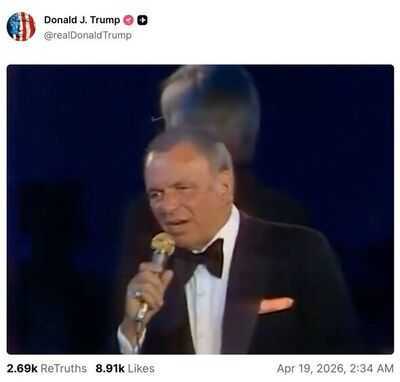
Following a frenetic week during which the Head of State threatened to wipe out Iran's population, labelled Pope Leo XVI "weak," shared an AI-generated image of himself as a divine figure, issued further warnings to Iranian forces, and ominously posted a clip of Frank Sinatra's 'My Way,' clinical psychologist Dr Tracy King has voiced serious concerns over what she describes as a troubling cognitive pattern emerging from his late-night social media activity.
She has suggested the style, timing, and structure of his posts may shed light on how the US President is processing decisions in real time - and the implications are deeply alarming.
In carrying out her analysis, the expert focused not solely on the content of the messages themselves, but also on the speed, intensity, and apparent level of reflection behind their construction - identifying a communication pattern that points to a narrowing of cognitive filtering under pressure.
"The volume, the overnight timing, and the intensity all suggest a high level of nervous system activation," she told the Mirror US.
"Posting repeatedly in this way can function as a form of regulation, a way of discharging internal pressure by pushing it outward."
She draws attention to the repetitive frequency of the posts, saying: "Rather than slowing down, thinking something through, and then communicating it, the thinking and the expression seem to be happening together."
The timing of the posts, predominantly appearing late at night or in the early hours, could be another revealing factor, she noted.
Dr King explained: "These posts are appearing late at night and into the early morning, which raises the possibility of reduced or disrupted sleep."
While emphasising that posting times alone cannot confirm one's sleep patterns, Dr King underscores the well-established effect of sleep on cognitive functioning.
She said: "We do know that lack of sleep affects cognitive functioning. It is associated with greater impulsivity, faster but less considered decisions, reduced emotional regulation, and a stronger reliance on instinctive responses."
Dr King suggested that such behaviour can diminish the brain's capacity to assess nuance, weigh up alternatives, or moderate tone prior to posting - and that is precisely where risk begins to emerge in high-pressure environments.
She said "In decision-making terms, this combination of intensity, certainty, and speed can shorten the gap between impulse and action," she explained. "It can narrow perspective, making it harder to adapt, reconsider, or tolerate ambiguity.
"The volume, the certainty, the capitalisation, and the dominance framing are all effective tools for controlling the narrative and projecting strength. The line between deliberate performance for the sake of strategy and genuine high arousal can start to blur," she said.
"When someone in a position of power communicates like this, the behaviour does not merely express a viewpoint. It shapes reality."
-
Gold Price Today: Gold Slips for Second Day After Akshaya Tritiya; Check Latest Rates Across Major Cities

-
Gold Price Today: Strong Dollar and Rate Pressure Weigh on Gold; Prices Slip for Second Straight Session

-
Silver Price Today: Silver Holds Steady on April 21; Check Latest Rates in Delhi, UP, Bihar and Major Cities

-
Platinum Price Today: Platinum Becomes Cheaper Again on April 21; Check Latest Rates Across India

-
Gold & Silver Price Today: Profit Booking Hits Bullion; Experts See Trading Opportunities in Commodities