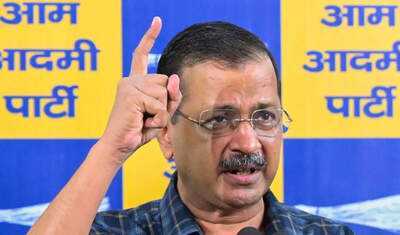
Arvind Kejriwal, the leader of the Aam Aadmi Party, requested Justice Swarna Kanta Sharma of the Delhi High Court to recuse herself from the hearing of the Delhi liquor policy case. However, Justice Sharma firmly dismissed Kejriwal's petition. This ruling not only reinforced the dignity of the judiciary but also directly challenged the politics of allegations. Kejriwal, who has a history of questioning leaders, investigative agencies, and institutions, attempted to put the court in the dock, but this time he received a strong rebuttal. Justice Sharma made it clear that the court operates independently of any pressure, perception, or accusation. Her clear and direct responses effectively undermined Kejriwal's arguments, leaving him without a counter. This decision sends a powerful message that questioning the judiciary is not taken lightly and that only the law will prevail.
Kejriwal's Allegations Questioned
The pressing question now is why Kejriwal was raising doubts about the Indian judiciary. Was this merely a legal tactic, or was there a larger conspiracy at play? A person under serious allegations and investigations questioning the court's impartiality could be seen as an attempt to influence the judicial process and create confusion among the public. This suggests that when the facts and legal grounds weaken, there is an inclination to undermine the credibility of institutions. However, the court's stern stance has made it clear that such attempts have no place, and no one is above the law.
Justice Sharma's Detailed Ruling
Justice Sharma read her detailed order for nearly an hour, systematically addressing all the allegations and concerns raised by Kejriwal. She stated unequivocally that repeating a falsehood a thousand times does not make it true. She dismissed the questions raised about judicial impartiality outright.
Judicial Impartiality Assured
In her ruling, Justice Sharma emphasized that a judge's impartiality is presumed and can only be challenged based on solid evidence. She noted that Kejriwal's expressed concerns were merely personal apprehensions that did not meet any legal standards. Furthermore, she clarified that the petition presented before her was based on insinuations, accusations, and doubts rather than evidence, suggesting an attempt to influence the judicial process.
Concerns Over Alleged Bias
Kejriwal had also alleged that Justice Sharma participated in events associated with the RSS-affiliated lawyer's council, raising concerns of bias. Justice Sharma responded by stating that judges attending events of various ideological organizations is a normal part of their duties. She explained that the relationship between the bar and the bench extends beyond the courtroom and is an essential aspect of the judicial system. Being a chief guest or speaker at an event does not constitute evidence of ideological bias.
Family Connections Dismissed
Another allegation from Kejriwal suggested that some family members of Justice Sharma were part of a government panel, potentially leading to a conflict of interest. Justice Sharma clarified that no direct connection or influence was demonstrated that could affect her decisions. She also stated that judges' children cannot be barred from pursuing legal careers, as that would infringe upon their fundamental rights. She made it clear that none of her relatives had any connection to this case.
Past Reliefs and Current Allegations
The court noted that Kejriwal and other leaders from his party had previously received relief from this very court without any allegations being raised. Justice Sharma pointed out that when orders favor the petitioners, no questions are asked about the court's integrity, but when orders are unfavorable, doubts arise. This trend poses a danger to the judicial system.
Supreme Court's Stance
Kejriwal also argued that the Supreme Court had overturned some of Justice Sharma's orders in his cases. In response, Justice Sharma clarified that the Supreme Court did not make any adverse comments regarding her orders. She explained that relief in certain cases was granted for other reasons and did not call into question the quality or impartiality of her decisions.
Political Reactions
Kejriwal raised questions about judicial impartiality based on statements made by the Home Minister. Justice Sharma stated that the court is not influenced by any political statements, and recusing herself on such grounds would be purely speculative. In her ruling, she mentioned that if she were to recuse herself, it would set a dangerous precedent, suggesting that the judiciary could be pressured. She emphasized that such actions would undermine the credibility of the judiciary and create the perception that judges are aligned with political ideologies.
Judicial Process Integrity
The court described a scenario where Kejriwal would benefit regardless of the outcome. If he did not receive relief, he would claim to have anticipated the result, and if he did, he would cite pressure. The court deemed this situation as a manipulation of the judicial process. Justice Sharma firmly stated that recusing herself would mean shirking her duty. She highlighted her constitutional obligation to deliver justice and asserted that she would not yield to any pressure. This case is not just a legal dispute but also a test of the independence and credibility of the judiciary.
Political Tensions Rise
Following this ruling, the political atmosphere has intensified. BJP MP Baansuri Swaraj accused Kejriwal of attempting to pressure the judiciary. She stated that the country's judicial system does not operate according to an individual's convenience but is governed by the Constitution and the law. She also alleged that Kejriwal sought to transfer the case simply because he disagreed with the court's previous order.
Background of the Case
This entire matter pertains to a petition challenging a lower court's order that acquitted Kejriwal, Manish Sisodia, and 22 other accused individuals. The court has already issued a notice on this petition and has also stayed the relevant order.
Significance of the Ruling
Ultimately, this case transcends a mere legal dispute; it symbolizes the independence, impartiality, and institutional strength of the judiciary. Justice Swarna Kanta Sharma's ruling clarifies that the court will not retreat from its duties based on any form of pressure, accusation, or perception. This incident has made it evident that attempts to influence the judicial process will be taken seriously, and allegations made without solid evidence will not be accepted. This ruling is seen as a reinforcement of trust in the Indian judicial system, conveying that justice will not only be served but will also be visibly impartial.
-
Snooker wonderkid Stan Moody 'couldn't feel my legs' in Kyren Wilson collapse

-
UK brewery collapses and wound up - founded by friends in 2014

-
No procurement centre to close until district target is met: LS Speaker
-
I'm A Celeb star forced to exit show with immediate effect after incident

-
Baby girl killed in Redcar dog 'attack' named as her tragic final moments emerge