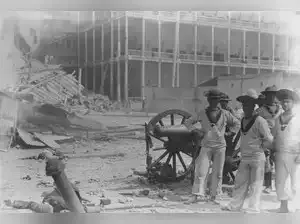
What if a war started and ended before you could even check the time? It sounds impossible, but history says otherwise. The Anglo-Zanzibar War of 1896 stands as one of the most unusual conflicts in history due to its extraordinary brevity. Lasting just 38 minutes, it remains the shortest war ever recorded. Despite its short duration, the event reflected deeper political tensions and imperial ambitions in East Africa.
Fought between the British Empire and the Sultanate of Zanzibar, the conflict ended in a swift and decisive British victory. The war emphasized the imbalance of power between colonial forces and local rulers, while also marking a significant moment in the broader context of European expansion and control during the late nineteenth century.
Shortest war in history
The Anglo-Zanzibar War of 1896 may not rank among the most major global conflicts. It was not even the largest war that involved Britain during that period, particularly when compared to events such as the Second Boer War. However, it received a remarkable place in history for one reason, it was really short.Fought on 27 August 1896 between the British Empire and the Sultanate of Zanzibar, the conflict lasted around 38 minutes.
Why Zanzibar mattered
Zanzibar, an island group off the coast of modern-day Tanzania, served as a crucial commercial center in the Indian Ocean. It was positioned along key maritime routes and was rich in valuable resources.By 1890, Zanzibar had become a British protectorate. Although a sultan ruled in name, real authority rested with Britain. This arrangement enabled the empire to secure trade routes and maintain influence in the area, mainly amid competition with European powers like the German Empire.
Zanzibar was also a focal point in efforts to end the East African slave trade, adding both political and humanitarian significance to British involvement.
The spark that triggered the war
The conflict started following the sudden death of Sultan Hamad bin Thuwaini in August 1896. His cousin, Khalid bin Barghash, instantly declared himself the new ruler without British approval.This move alarmed British officials, who supported a different candidate, Hamoud bin Mohammed. Khalid’s actions were seen not only as a political challenge but also as a possible threat to British dominance in the area.
He strengthened the palace defenses and assembled thousands of supporters, preparing for confrontation.
The 38-minute war
Tensions escalated quickly, and the British delivered an ultimatum: step down by 9:00 AM on 27 August or face military action. Khalid refused.At precisely 9:02 AM, British naval forces launched the attack under the command of Harry Rawson. The bombardment was swift and overwhelming.
Within minutes:
- The palace was heavily damaged
- Zanzibar’s defenses collapsed
- The royal yacht was sunk
Casualties and immediate aftermath
Despite its short length, the war caused significant loss. Around 500 Zanzibari men and women were killed or wounded, while British forces experienced minimal casualties.Khalid fled to the German consulate and later went into exile. During World War I, he was eventually captured by British forces and exiled.
Britain immediately installed Hamoud as the new ruler, ensuring continued control over Zanzibar.
A symbol of imperial power
After the conflict, the British Empire reinforced its authority in Zanzibar, with the sultan acting largely as a symbolic figure. The event became a clear demonstration of European dominance in East Africa.It also reflected the broader context of the Scramble for Africa, during which European nations divided and controlled much of the continent.
Zanzibar remained under British rule until 10 December 1963, when it achieved independence and became part of the Commonwealth.
FAQs:
Q1. What is the shortest war in history?The Anglo-Zanzibar War is considered the shortest war ever recorded. It lasted around 38 minutes.
Q2. When did the Anglo-Zanzibar War take place?
The war occurred on 27 August 1896. It began and ended within the same hour.