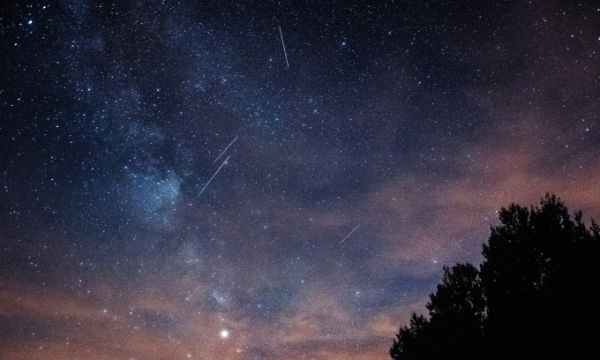
Stargazers across the region can expect to see between 10 and 18 meteors per hour streaking from the constellation Lyra, weather permitting, in what astronomers consider the best meteor shower of April.
The American Meteor Society predicts maximum activity around 8 p.m. UTC on April 22, which translates to roughly 3 a.m. on April 23 in Vietnam, Thailand and Indonesia, and 4 a.m. in Singapore, Malaysia and the Philippines.
That timing is unusually favorable for Asian observers: most years the Lyrid peak falls during daylight hours in the region, leaving viewers to catch only the tail end.
The Royal Observatory Greenwich says the shower will be active between April 16 and 25, with the best viewing in the early morning hours after the radiant point in the constellation Lyra has risen in the east. NASA expects up to 15 meteors per hour near the peak under typical conditions, though under the dark, moonless skies forecast during the Southeast Asian peak window, rates could push higher.
A waxing crescent moon, only about 27% illuminated, will set well before the peak hours, leaving the sky dark for what astronomers say should be one of the better Lyrid displays in recent years. The meteors will be visible to the naked eye, and no telescope or binoculars are needed.
How to watch from Vietnam and the region
The radiant point near the bright star Vega rises in the northeast before midnight and climbs higher through the early morning, so the closer to dawn you watch, the more meteors you are likely to catch.
Observers should look for spots well away from city lights: coastal areas, national parks, rural highlands and reservoirs all work better than urban viewpoints.
In Vietnam, locations such as Ba Vi, the Central Highlands around Da Lat, and stretches of coastline north of Hoi An offer some of the darkest accessible skies near major cities.
The biggest obstacles for regional viewers are not astronomical but atmospheric. Late April brings unsettled pre-monsoon weather across much of Southeast Asia, with frequent cloud cover and haze in parts of mainland Southeast Asia from agricultural burning.
The Lyrids occur every April when Earth passes through a trail of debris left behind by Comet C/1861 G1 (Thatcher), a long-period comet that orbits the sun once every 415 years.
According to EarthSkythe comet was last seen in 1861, when it was discovered by amateur astronomer A.E. Thatcher in New York City. The comet itself will not return until the year 2278, but the icy fragments scattered along its orbital path enter Earth’s atmosphere at around 49 kilometers per second, vaporizing into the bright streaks observers see as shooting stars.
The shower is one of the oldest known meteor showers, first recorded by Chinese astronomers in 687 BC, more than 2,700 years ago, making it the earliest documented meteor shower in human history, NASA meteor expert Bill Cooke told Space.com.
The Lyrids are best known among astronomers for their occasional dramatic outbursts, when meteor rates can briefly surge to around 100 per hour. NASA says these surges occur roughly every 60 years, driven by gravitational forces from Jupiter and Saturn that periodically reshape the comet’s debris stream into denser clumps.
Notable Lyrid outbursts were recorded in 1803, 1922 and 1982. Peter Jenniskens, an astronomer at the SETI Institute and NASA Ames Research Center, has proposed a 60-year periodic cycle for these outbursts, which would place the next one around 2042, according to Space & Telescope.
-
UK Set to Implement Groundbreaking Anti-Smoking Legislation

-
Morrisons to close UK branch as supermarket giant confirms 'difficult decision'

-
US nuclear chief 'escorted out Pentagon' as probe launched into 'sensitive leak'

-
Heartbreaking truth behind Jimmy Bullard's sudden I'm a Celeb exit revealed

-
Michael Jackson movie biopic Part 2 release date teased by studio