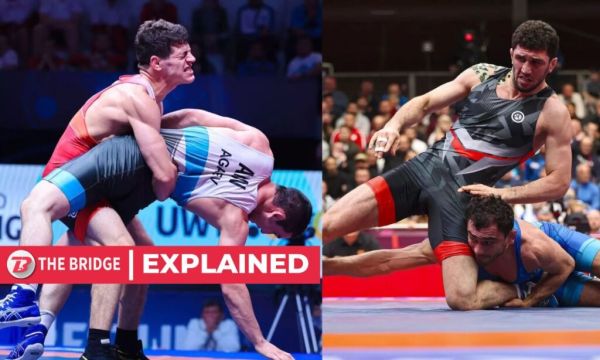
Wrestling, one of the oldest martial arts, has evolved as the most popular and widely practised combat sport globally, giving rise to numerous variations in other individual sports.
Modern wrestling, also known as international wrestling, has been a permanent feature of the Olympic Games since the modern era, particularly in its two main disciplines: Greco-Roman and Freestyle.
While the ultimate goal in the two disciplines is to finish with more points than your opponents at the final whistle, the two disciplines are still very different from each other.
Here are a few differences between the two Olympic Styles of Wrestling:
Style of Play
The Greco-Roman wrestling style is more traditional, originating from the European folkstyle wrestling, restricting the grappler from any below-the-belt attack.
A wrestler can’t attack the legs of their opponents or even use their own legs to apply an attack in Greco-Roman; instead, they have to use their upper-body strength to induce a take-down.
On the other hand, freestyle wrestling allows you more of a free flow, and you can make any legal move, whether it’s the upper body or the lower limbs.
While the Greco-Roman is more upright wrestling, the body posture in freestyle feels more curved as wrestlers try to bend their knees to keep their legs away from opponents’ reach.
Passivity Warning
Passivity Warning is a big part of modern wrestling, which forces wrestlers to continue the same attacking spirit throughout the given 6-minute bout.
But the role of passivity becomes much more important in Greco-Roman than in freestyle wrestling, as it enables the more aggressive wrestler to score multiple points.
In freestyle wrestling, when the referee decides that a particular wrestler is not going for an attack, he puts up a 30-second activity clock against them.
If the wrestler still didn’t score any points in these 30s, a point is awarded to the opponent. However, it has little impact on the bout if the wrestler already holds a significant lead.
But in Greco-Roman, once a wrestler is declared passive, the opponent can request a ‘par terre’ position, forcing the passive wrestler to lie down on the mat.
After that, the aggressive wrestler is given a chance to lift his opponent without much counterplay and score big points, which most of the time proves decisive in bouts.
More Popular Moves
As the Greco-Roman wrestling doesn’t allow below-the-belt attacks, it restricts the number of scoring moves with the big arm throws, and gut wrenches being more common.
In contrast, freestyle wrestling permits a broader range of moves such as leg attacks, laces, and underhooks, along with everything that is allowed in Greco-Roman.
Also, because of the restricted moves in Greco-Roman wrestling, the highest lead required for a technical superiority win is lower in Greco-Roman (8 Points) with respect to Freestyle (10 points).
While the Greco-Roman style showcases more sheer power, the freestyle is known for speedy and more flexible manoeuvres. These unique differences are what keep the audience’s interest in both styles.
-
UK Set to Implement Groundbreaking Anti-Smoking Legislation

-
Morrisons to close UK branch as supermarket giant confirms 'difficult decision'

-
US nuclear chief 'escorted out Pentagon' as probe launched into 'sensitive leak'

-
Heartbreaking truth behind Jimmy Bullard's sudden I'm a Celeb exit revealed

-
Michael Jackson movie biopic Part 2 release date teased by studio