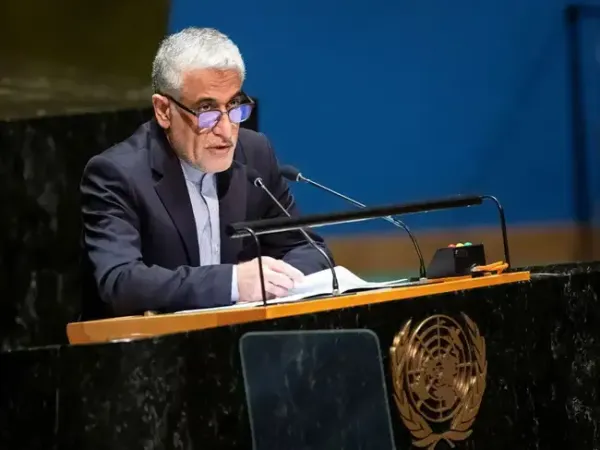
New York: In a significant diplomatic development, Iran has established a clear precondition for the resumption of negotiations, with its UN Ambassador, Amir Saeid Iravani, stating that Tehran is prepared to engage in talks only after the United States ends its naval blockade.
Citing an interview given by Iravto Rudlaw News Network at the UN HQ, Tasnim News Agency reported that the Iranian envoy emphasised that for any dialogue to proceed, Washington must first halt its "ceasefire violations."
Click here for live updates on the US Israel Iran War
"The naval blockade of the United States, it is a violation of the ceasefire. And we told them that they should break this blockade. We have received some sign that they are ready to break it. And as soon as they break this blockade, I think that the next round of the negotiation will take place in Istanbul. Listen to them, we have not initiated the military aggression. They initiated the war against us and we are ready. If they want to sit on table and discuss and find a political solution, they will find us ready. If they want to go to the war, in this case also Iran is ready for that," Iravani said.
The ambassador's remarks suggest that while a channel for communication may exist, the removal of the blockade remains the primary obstacle to a formal diplomatic process.
The insistence on this precondition underscores the deep-seated mistrust between the two nations as they navigate a fragile ceasefire extension. This tension was further highlighted as the US President announced late on Wednesday that he would prolong the current ceasefire to provide a window for further diplomacy.
Earlier, US President Donald Trump claimed that Tehran is privately lobbying for the reopening of the Strait of Hormuz to curb mounting economic losses, despite its public posturing of a continued standoff.
Trump further claimed that Iran's outward hostility regarding the waterway is a performance intended for a political audience rather than a reflection of its financial reality.
"Iran doesn't want the Strait of Hormuz closed; they want it open so they can make USD 500 million a day (which is, therefore, what they are losing if it is closed!)" he posted, suggesting the blockade is crippling the Iranian economy.
Also Read: Trump indefinitely extends ceasefire with Iran on Pakistan's request
Tensions in the Strait continue to mount. On Wedenesday the United Kingdom Maritime Trade Operations (UKMTO) reported that a container ship sustained heavy damage to its bridge after being fired upon by an Islamic Revolutionary Guard Corps (IRGC) gunboat 15 nautical miles northeast of Oman. The Master of the vessel reported that the ship was approached by one IRGC gunboat, which did not issue a VHF challenge before opening fire. UKMTO said that that while the attack caused heavy damage to the bridge, no fires or environmental impacts have been reported.
For now, the Strait of Hormuz stays at the heart of the friction. As the primary artery for global oil and liquefied natural gas, its continued closure poses a persistent threat to "international energy markets and maritime security."
Citing an interview given by Iravto Rudlaw News Network at the UN HQ, Tasnim News Agency reported that the Iranian envoy emphasised that for any dialogue to proceed, Washington must first halt its "ceasefire violations."
Click here for live updates on the US Israel Iran War
"The naval blockade of the United States, it is a violation of the ceasefire. And we told them that they should break this blockade. We have received some sign that they are ready to break it. And as soon as they break this blockade, I think that the next round of the negotiation will take place in Istanbul. Listen to them, we have not initiated the military aggression. They initiated the war against us and we are ready. If they want to sit on table and discuss and find a political solution, they will find us ready. If they want to go to the war, in this case also Iran is ready for that," Iravani said.
The ambassador's remarks suggest that while a channel for communication may exist, the removal of the blockade remains the primary obstacle to a formal diplomatic process.
The insistence on this precondition underscores the deep-seated mistrust between the two nations as they navigate a fragile ceasefire extension. This tension was further highlighted as the US President announced late on Wednesday that he would prolong the current ceasefire to provide a window for further diplomacy.
Earlier, US President Donald Trump claimed that Tehran is privately lobbying for the reopening of the Strait of Hormuz to curb mounting economic losses, despite its public posturing of a continued standoff.
Trump further claimed that Iran's outward hostility regarding the waterway is a performance intended for a political audience rather than a reflection of its financial reality.
"Iran doesn't want the Strait of Hormuz closed; they want it open so they can make USD 500 million a day (which is, therefore, what they are losing if it is closed!)" he posted, suggesting the blockade is crippling the Iranian economy.
Also Read: Trump indefinitely extends ceasefire with Iran on Pakistan's request
Tensions in the Strait continue to mount. On Wedenesday the United Kingdom Maritime Trade Operations (UKMTO) reported that a container ship sustained heavy damage to its bridge after being fired upon by an Islamic Revolutionary Guard Corps (IRGC) gunboat 15 nautical miles northeast of Oman. The Master of the vessel reported that the ship was approached by one IRGC gunboat, which did not issue a VHF challenge before opening fire. UKMTO said that that while the attack caused heavy damage to the bridge, no fires or environmental impacts have been reported.
For now, the Strait of Hormuz stays at the heart of the friction. As the primary artery for global oil and liquefied natural gas, its continued closure poses a persistent threat to "international energy markets and maritime security."