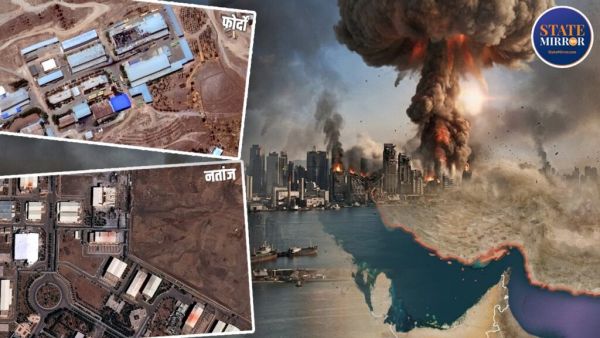
Tension between Iran and America is not a new thing in the politics of the Middle East, but whenever the situation worsens, the biggest question that arises is – is this conflict only about nuclear weapons or is there a deeper strategic fight hidden behind it? To understand the inside story, know the history behind this war, what is the meaning of geo-politics and recent developments?
Is Iran making nuclear weapons?
iran It has consistently maintained that its nuclear program is for peaceful purposes, such as power generation and medical research. But America and Western countries suspect that Iran is increasing uranium enrichment to a level that would make it possible to make a nuclear bomb. According to the reports of the International Atomic Energy Agency (IAEA), Iran has enriched uranium up to 60%, whereas about 90% is required to make weapons. This doubt is the biggest trigger of this entire controversy.
Why was the 2015 nuclear deal broken?
In 2015, an important agreement was reached between Iran and six world powers, which is called JCPOA (Joint Comprehensive Plan of Action). Under this, Iran had accepted strict limits on its nuclear program and in return the economic sanctions imposed on it were removed. But in 2018, the then US President Donald Trump decided to withdraw from this agreement. After this, America again imposed strict sanctions on Iran, due to which the tension increased rapidly.
Why did Trump decide to exit the JCPOA agreement?
Donald Trump pulled the US out of the JCPOA in 2018 because he considered it a “weak and incomplete” agreement. He said that this deal does not permanently stop Iran’s nuclear program and the sanctions end after a few years. Also, there was no strictness on Iran’s ballistic missile program and its activities in the Middle East. Trump imposed tough economic sanctions under the “Maximum Pressure” policy to force Iran into a new and tougher agreement.
Is the nuclear issue the only real reason?
The truth is that the nuclear issue is only one part of this conflict. The real story is much bigger than this. Iran wants to increase its influence in the Middle East. Be it Iraq, Syria, Lebanon or Yemen. At the same time, America and its allies, especially Israel and Saudi Arabia, consider it against their interests. Iran-backed organizations such as Hezbollah and Houthi rebels also complicate the conflict.
What is the role of oil and geopolitics?
The Middle East is the world’s largest oil reserves area. About 20% of the world’s oil passes through the Persian Gulf and the Strait of Hormuz. Iran maintains its hold on this strategic route. If tensions increase, he closes this route, which could lead to a rise in global oil prices. For America, it is not only a matter of security, but also of economic and global balance of power.
What is Israel’s role in this?
Israel considers Iran’s nuclear program a direct threat to its existence. Israel has openly said many times that it will not allow Iran to acquire nuclear weapons. Even if military action is required for this. It has also come to light in many reports that there have been cyber attacks and secret operations on Iran’s nuclear bases, behind which Israel is believed to be behind.
Is the threat of war real?
The situation is extremely sensitive, but an all-out war is still costly for both sides. Iran has the power of missiles and proxy networks. Whereas America has state-of-the-art military power. Small skirmishes, drone strikes and maritime confrontations have happened before, but both countries have tried to avoid direct major war.
What could happen next?
The future of the Iran-US war will depend on how successful diplomacy is. If there is a fresh nuclear agreement then the tension may reduce. But if talks fail and Iran advances its nuclear program further, the possibility of military confrontation may increase.
Limiting the conflict between Iran and America to just “nuclear weapons” is an incomplete picture. This conflict is a multi-layered battle of power, influence, security and resources, in which the nuclear issue is an important but not the only factor.
-
HMWSSB seizes 17 illegal motors in Secunderabad, 3rd raid this month

-
Man held for possessing 4.1 gram ganja in Hyderabad
-
Jammu mule operator threatened, asked to leave Kedarnath over ban on non-Hindus
-
Bengaluru residents confront ex-army officer after wife calls man ‘terrorist’

-
Vijayawada: Five advocates trapped between floors in court lift after power cut